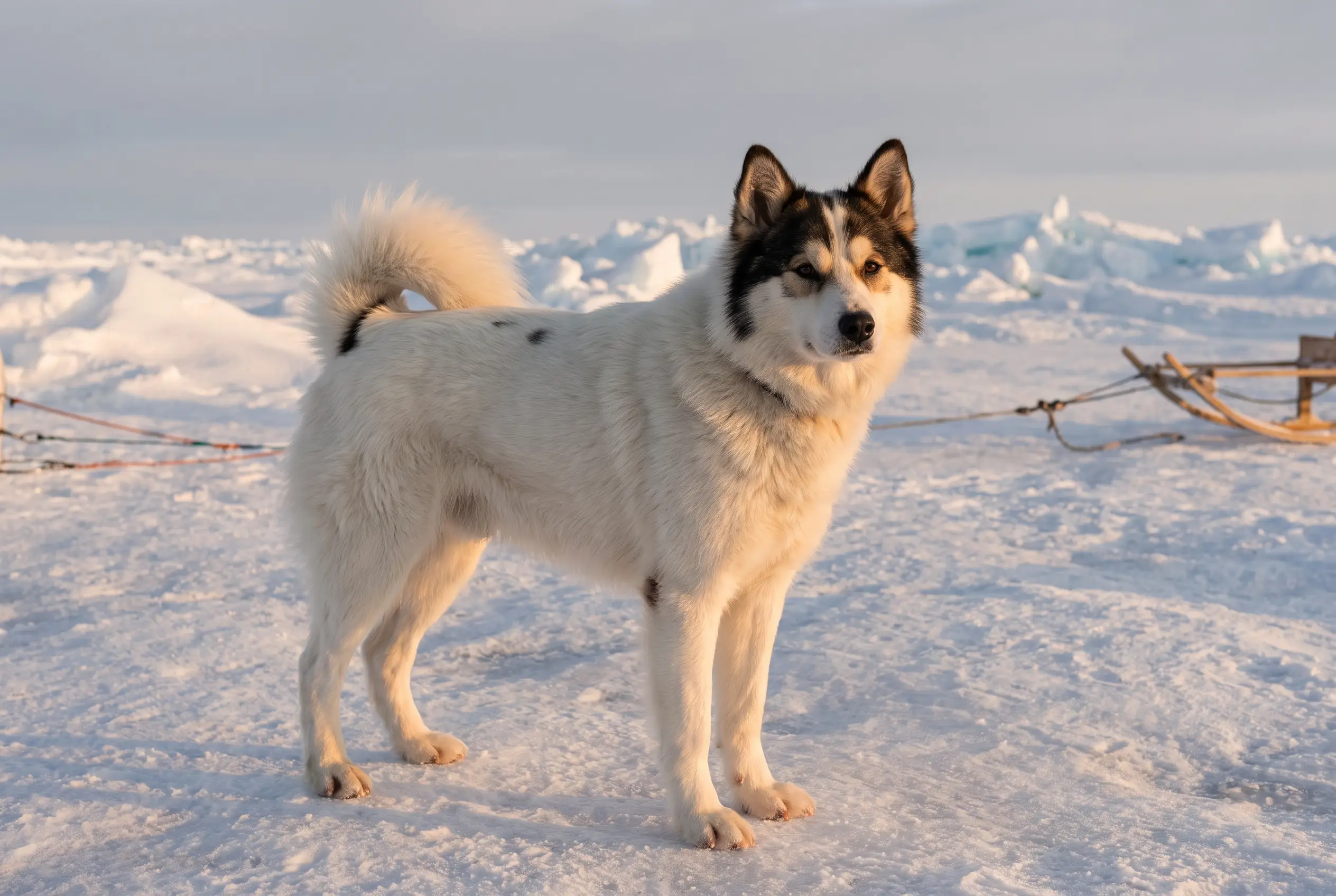
Canadian Eskimo Dog
The Inuit sledge dog of Arctic Canada — and, by the genetics, the same dog as the Greenland Dog.
Vital stats
| Size | Large · 58–70 cm (males), 50–60 cm (females) |
| Weight | 30–40 kg (males), 18–30 kg (females) |
| Life expectancy | 10–15 years — breed literature, not survey data |
| Energy | Very high — built to haul 45–80 kg per dog, all day |
| Shedding | One heavy annual moult, usually August or September |
| Coat | Dense underfur under hard guard hairs 7–15 cm long · eight colour patterns, none dominant |
| Group | Working · Nordic Sledge Dogs (FCI №211, Group 5) |
| Origin | Arctic Canada |
Breed traits
Friendliness
Care
Mind
Temperament
The standard opens the temperament section by warning you off: this dog is not to be viewed as a domestic pet, but as a primitive dog domesticated by Inuit for specific tasks in a harsh arctic environment. What follows is warmer than that sounds. A mature Canadian Eskimo Dog is described as gentle and affectionate with the average person and glad of attention, and with total strangers the dogs are rarely standoffish — quiet friendliness and harmless curiosity, or complete indifference. The reservation is about intensity, not temper. Compared with modern domestic breeds the standard records an almost over response to any stimulus, whether food, work, defence or play, and draws the conclusion itself: a companion for adults, not a child's pet. It is also a pack animal in the literal sense. Raised in a group it will sort out dominant and subordinate roles under a boss dog, and torn ears and battle scars are common enough in group-reared kennels that the standard exempts battle-torn ears from the disqualification for floppy ears. Aggression towards people, and excessive shyness, both disqualify.
Habits & quirks
No colour is the breed colour
The standard begins its colour section by saying that no one colour or pattern should dominate, then lists eight: all-white with pigment around eyes, nose and lips; white with a trace of colour at the ears or eyes; white with a coloured head and the odd patch at hip or flank; even halves of red, buff, cinnamon or black with white; coloured body with white beneath; sable, black or dark grey with white; silver grey or greyish white; and a buff-to-brown undercoat under black guard hairs.
Blue eyes end the show
Dark eyes are usual, hazel and yellow both appear, and blue disqualifies — one of the clearest lines between this breed and the Siberian Husky. The eyes are small, wide-spaced and set obliquely, which the standard concedes gives a wilder impression than the dog deserves.
One moult, over in days
The coat sheds once a year, usually in August or September, and the dense underfur comes away in clumps over a few days rather than drifting out for weeks. Bitches carry less coat overall because they moult again after a litter. Males grow a mane over neck and shoulder that makes them look taller at the withers than they are.
Built for the load, not the sprint
The working gait is a powerful, brisk trot with a wide stance and some swing outwards in the stride, which can look awkward until you see what it is for: heavy pulling, day after day. The standard notes that bitches move faster and more freely than the heavier males and can gallop far longer.
Care
| Exercise | It has to pull, and the standard sets the scale: 45 to 80 kg per dog, 15 to 70 miles in a day, with a 15 kg pack in summer. A rig, a sled, a bike or a loaded harness, for hours, most days. Heat is the ceiling rather than distance, so summer work happens at first light or not at all, and a warm climate is a bad fit for the breed. |
| Grooming | Undemanding for eleven months and then intense for a week, when the underfur lifts out in clumps and needs raking daily. Never take scissors or clippers to it — altering the coat that way is a disqualifying fault, and the coat insulates against heat as well as cold. Check between the toes: the pads are well furred, and in hard winter conditions that fur grows long enough to cover their undersides. |
| Training | Reward-based, early, and realistic about the ceiling. This is a pack-oriented primitive breed with, in the standard's phrase, an almost over response to any stimulus, and the hunting history is not decorative — these dogs found seal breathing holes and held musk ox and polar bear at bay. Recall around livestock and small animals is not a realistic goal, so fence deep as well as high, and treat off-lead freedom as off the table. |
| Health | No breed-wide health survey exists, and the registered population is tiny, so pedigree depth is the first question for any breeder. Ask for hip scoring and an eye check. Day to day the risks are overheating, weight gain in an under-worked dog, and the damage a bored one does; breed literature also reports gastric torsion, entropion and cataracts, and puts life expectancy at 10–15 years. |
Common questions
Is the Canadian Eskimo Dog the same as the Greenland Dog?
Genetically, yes; on paper, no. Brown and colleagues (Heredity, 2015) tested autosomal, paternal and maternal markers across the Arctic breeds and concluded that the Inuit dogs of Canada and the Greenland Dog should not be distinguished as two breeds — both descend from Thule dogs, both kept their indigenous ancestry through colonisation, and both are clearly apart from the Siberian Husky, the Alaskan Malamute and the Alaskan husky. The registries have not followed. The FCI carries them as two standards, No. 211 with Canada as country of origin and No. 274 under Danish patronage, and they are judged separately. The standards do differ in what they ask for: 211 fixes heights at 58–70 cm for males and 50–60 for females, lists eight colour patterns and disqualifies blue eyes, while 274 sets only a minimum height and permits any colour but albino. In practice the Canadian population is far smaller, and its recent history is Canadian rather than Greenlandic.
Can one live as a family dog?
The standard answers this itself, and the answer is narrow. It calls the breed a companion for adults and states that it is not to be considered a child's pet, on the grounds of that near-total response to any stimulus around food, work, defence or play. Nothing in that describes a nasty dog — aggression and marked shyness are both disqualifying faults, and the breed is friendly to strangers to a degree that makes it a poor guard. But it needs to pull for hours in cool weather, it lives best with other dogs, its hunting drive rules out off-lead walking near livestock, and it was never bred to be biddable indoors. Homes with sled work, secure ground and a cold winter make it work. Most homes are not those homes.
Why is the breed so rare?
Around 20,000 dogs worked the Canadian Arctic a century ago. Snowmobiles replaced sled teams from the late 1950s, and over the same period hundreds and probably thousands of dogs were shot by RCMP officers and other settlement authorities in the eastern Arctic; the Qikiqtani Truth Commission, reporting in 2010, found no coordinated federal plan to end Inuit sled-dog use, but found that the animal-control laws being enforced were frequently never explained to the Inuit owners whose dogs were killed. By the early 1970s a few hundred were left. The Eskimo Dog Research Foundation, funded by the governments of Canada and the Northwest Territories, spent six years buying survivors from Inuit families on the Boothia and Melville peninsulas and parts of Baffin Island, and every dog in the standard's living breed traces to that stock. Fewer than 300 are registered with the Canadian Kennel Club today. Nunavut made the qimmiq its official animal on 1 May 2000.