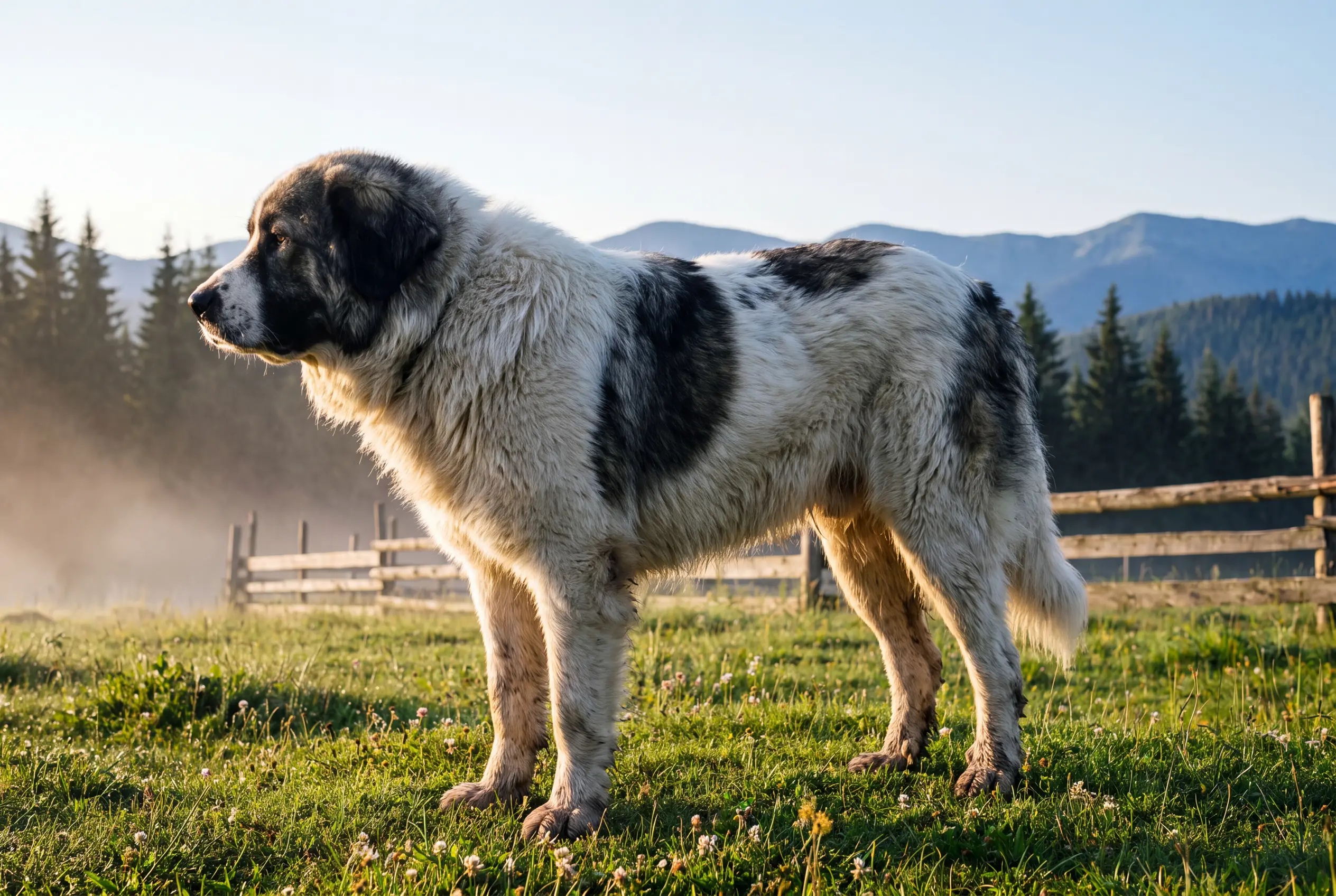
Ciobănesc Românesc de Bucovina
Romania's biggest guardian, with the night patrol written into its standard.
Vital stats
| Size | Very large · 68–78 cm males (ideal 71–75), 64–72 cm females (ideal 66–68), ±4 cm |
| Weight | Not set by the standard · commonly cited 50–90 kg males, 50–80 kg females |
| Life expectancy | 10–12 years · breed-source figure, not registry data |
| Energy | Moderate — a patroller's pace, mostly at a trot |
| Shedding | Heavy — 6–9 cm topcoat over a very dense undercoat |
| Coat | Long (6–9 cm), flat and rough · white or white-beige with distinct grey or black patches; solid colours accepted but not encouraged |
| Group | Working · Mountain Dog (FCI №357, Group 2) |
| Origin | The Bucovina province and the Carpathians of north-eastern Romania |
Breed traits
Friendliness
Care
Mind
Temperament
The standard opens warmly for a livestock guardian: balanced, calm and loyal, he likes children. It then names the job without softening it, calling the dog courageous and a real fighter against the possible animals of prey, and listing them as bear, wolf and lynx. The two halves are not in conflict. This is a dog that spends most of the day settled and undemonstrative, keeps its own people close, and reserves everything else for whatever comes up the track. The standard also describes what it does at night, which most standards leave out: it patrols around the household or the flock. Strangers get a bark the standard calls very strong and low in tone, and that bark is not a fault to be trained away, it is the equipment. What none of this tells you is the weight of the decision. A dog of this size was bred to hold ground alone, in the dark, without anyone to check with, and it keeps that habit of deciding for itself in a garden as surely as on a mountain. It will listen to someone it trusts. It will not hand over the question of who is allowed in.
Habits & quirks
The night shift is in the standard
Breed standards describe what a dog looks like and rarely what it does after dark. This one states that during the night it patrols around the household or the flock, and pairs that with a bark it specifies as very strong and low in tone when strangers or animals approach. Both lines are worth reading as a description of the product rather than a bonus feature.
Solid colours are tolerated, not wanted
The colour clause is written in two tiers. The classical Bucovina is clear white or white-beige with distinct patches of grey, black, or black with red-fawn reflections, and a brindled look to those patches is rejected outright. Then comes the second tier: solid dogs, white, white-beige, ashen-grey or black, are accepted but not encouraged. That wording is unusual. The Tornjak's standard disqualifies a solid-coloured dog, and the Corb's requires a black one, so the Bucovina sits between two neighbours that both take a firm line where it takes a reluctant one.
Too big is also a fault
Most large-breed standards set a floor and let the ceiling look after itself. This one disqualifies at both ends. A male under 64 cm or over 82 cm is out, and a female under 60 cm or over 78 cm is out, which puts a hard stop on the arms race towards ever bigger guardians. The fault list backs it up from the other side, naming both lack of substance and too heavy, and overweight and weak subject.
Nothing gets cut
Cropping is prohibited, docking is prohibited, and a naturally absent or atrophic tail is a disqualifying fault rather than a minor one. The ears are meant to be relatively high set, V-shaped with a slightly rounded tip, pendent and carried close to the cheeks. The tail hangs at rest to the hock or below, and rises to the level of the back or a little above when the dog is alert, with a slight upward curve and never a curl over the back.
Care
| Exercise | An hour to ninety minutes of steady walking a day, ideally on hill ground rather than pavement, and the dog will spend the rest of the day lying somewhere it can see the approaches. The preferred gait in the standard is a trot, and that is what it wants: ground covered at a working pace, not sprints and not fetch. Growth is the part people underestimate on a dog heading for 70 kg or more. Keep a youngster off stairs, jumps and forced distance until well past its first birthday, because the joints are carrying a frame that takes two years to finish. |
| Grooming | Six to nine centimetres of rough, flat topcoat over an undercoat the standard calls very dense and supple. Brush it weekly and get down to the skin instead of skimming the surface; the mane, behind the ears and the culottes are where mats start, and the bushy tail needs its own pass. When the undercoat goes, twice a year, this becomes a daily job. Do not clip it. Hair under 6 cm is listed as a fault, which tells you the length is doing work rather than decorating. |
| Handling and visitors | Every piece of training has to be finished while you can still physically move the dog, and on this breed that window closes early. Lead manners, a settle, a place command and a rehearsed routine for the gate should be reliable at 30 kg, not attempted at 75. Reward-based work suits it and heavy handling does not. Socialise widely through the first two years, then keep managing introductions for the rest of the dog's life. Night barking is normal here and comes with the breed rather than despite it, so settle the question of neighbours before you settle on a puppy. |
| Health | There is no breed-specific screening scheme and no published health survey, so the individual breeder is all you have. Ask for hip and elbow scores on both parents, an eye check and a look at the heart. On a deep-chested dog this size gastric torsion is a real risk: split meals, keep exercise away from them, learn the signs. Weight itself is worth watching, since the standard sets none and heavy dogs are common in the breed. Treat any confident claim about lifespan or soundness as an opinion until someone produces the paperwork. |
Common questions
How is it different from Romania's other shepherd dogs?
Colour answers it fastest, with one honest exception. Romania has four shepherd breeds. The Mioritic (FCI №349) and the Carpatin (FCI №350) both sit in FCI Group 1 with the sheepdogs: the Mioritic is the long shaggy white-based dog, the Carpatin a shorter-coated fawn one overlaid with black so it reads wolf-grey, built lighter and faster than either Group 2 breed. The Bucovina and the Corb (FCI №373) are the two mountain molossoids, and they are genuinely close in build. Both standards give skull width as 16–18 cm in males and 15–17 cm in females, both describe a long rough coat with a mane, fringes and culottes, and their height ranges overlap almost completely. What separates them on paper is colour, pointing opposite ways. Standard 373 requires black: the Corb is black outright or black over more than 80 percent of the body, white is confined to the chest and forelegs, more than 30 percent white disqualifies, and between two otherwise equal dogs the blacker one wins. Standard 357 asks for the reverse, a clear white or white-beige dog carrying distinct grey or black patches. The overlap is exactly one line of text. Solid Bucovinas, black included, are accepted but not encouraged, so a solid black dog is the ideal in one standard and a tolerated exception in the other. In practice you will rarely meet one, because breeders follow the discouragement and nearly every Bucovina you see is the patched white dog. If you did meet a black one, your eye would not settle it and the pedigree would. Range helps as well: the Bucovina belongs to the north-east, the Corb to the southern Carpathians and the counties below them.
Does a Bucovina suit a home without livestock?
For most households, no. Remove the sheep and nothing switches off; the dog simply reassigns the job to your family, your gate and your boundary, which makes a shared entrance, a garden onto a public path or a regular flow of unfamiliar visitors close to the worst setting available. The bark decides it in many places on its own, because the standard asks for a voice that is very strong and low in tone and the breed was selected for exactly that, night after night. Size compounds everything else: an adult that may pass 70 kg cannot be managed by being stronger than it, only by having been taught early. On the other side of the ledger, the standard describes a dog that is balanced, calm and fond of children, and owners report the same thing indoors, where a mature Bucovina is quiet and asks for very little. It can work with secure fencing, ground of its own, neighbours out of earshot, an owner prepared to manage arrivals for a decade and time set aside every week for the coat. Anyone who wanted a large, easy-going family dog that greets guests should look elsewhere first.
Is it a fully recognised FCI breed?
Yes, and that sets it apart from several of its neighbours. The FCI accepted the Ciobănesc Românesc de Bucovina provisionally on 26 March 2009 and recognised it definitively on 29 April 2019, which means the breed can compete for the CACIB, the international beauty championship certificate that stays closed to provisionally accepted breeds. The Corb, by contrast, has been provisional only since September 2024. The current standard text, number 357, was published on 20 August 2023, filing the breed in Group 2, Section 2.2, mountain type molossoids, without a working trial. Romania's own kennel association got there long before the FCI did, writing a first standard in 1982 and revising it in 2001 and 2002. Outside the FCI system the picture is thinner. It is not an American Kennel Club breed and it has not been admitted to the AKC's Foundation Stock Service either, which does list the Mioritic and the Carpatin. Population figures, weights and lifespans quoted for the breed come from breed sources rather than published registry returns, so treat them as estimates.