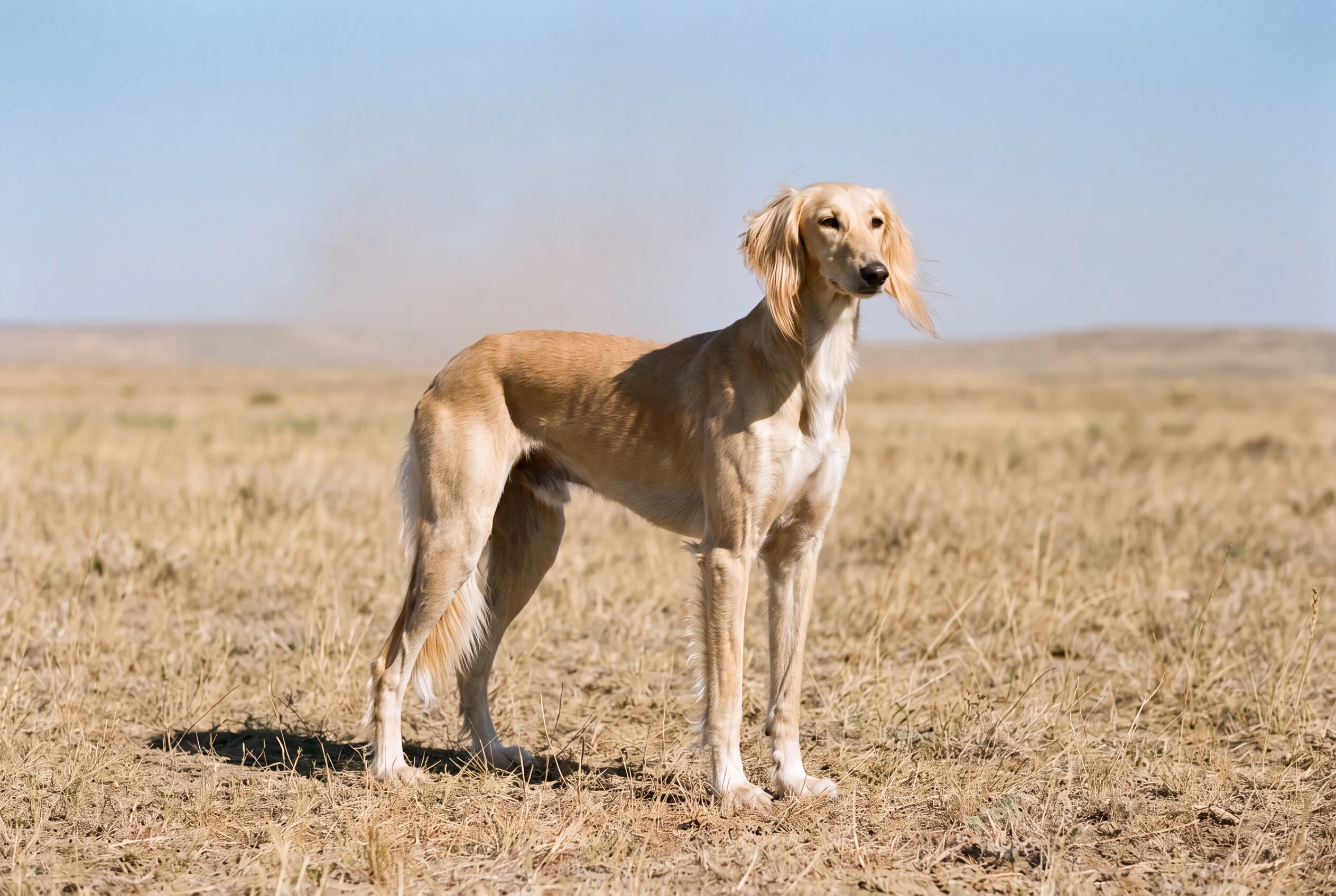
Kazakh Tazy
The steppe hound of the Kazakhs, on the FCI's books since 2024 and only provisionally.
Vital stats
| Size | Large · 58–70 cm |
| Weight | 20–30 kg |
| Life expectancy | 12–15 years |
| Energy | High — built to hold speed over long distances |
| Shedding | Low to moderate — short coat, heavy spring drop of the winter undercoat |
| Coat | Short and smooth · fringed ears, feathered legs and tail · fawn to red, grey, white or black |
| Group | Hound · Sighthound (FCI №372, Group 10) |
| Origin | Kazakhstan |
Breed traits
Friendliness
Care
Mind
Temperament
The standard's own summary is balanced and agile, quick to read a situation and decide, calm and unobtrusive at home, a little reserved with strangers, and intolerant of maltreatment. That last phrase is an unusual thing to find in a breed standard, and owners repeat it: a tazy shuts down under a heavy hand and remembers who used one. Around the house it is quiet and undemanding, sleeps through most of the day and attaches to its own people without making a show of it. Hunting is the other setting. The standard credits it with high speed held over long distances, sharp sight and a working nose, and notes that some individuals retrieve. Once a hare is up, the dog is gone, and nothing you shout reaches it.
Habits & quirks
Sight and scent, both
Group 10 dogs are meant to hunt by eye. The tazy standard lists sharp-sightedness and scent search side by side, and adds that some dogs retrieve. After a catch it will either stay with the game where it lies or carry it in.
Half of an eagle hunter's outfit
A berkutchi rides with a golden eagle on the fist and a tazy on the ground. The dog works ahead and puts fox or hare out of cover, the bird is cast at it from horseback, and during its two or three years of training the eagle is taught to accept that particular horse and that particular dog. The FCI standard says hunting in company with birds is especially appreciated.
Fringes rather than a long coat
Short over the body, then soft wavy hair hanging 5–6 cm past the ear leather, feathering behind the legs, and a thin fringe along the outer half of the tail. Dogs under about eighteen months often carry extra fluff on the forelegs, ribs and brisket that they lose later.
Two speeds and little in between
Searching, it covers ground at an easy free trot; when it finds, a short gallop; in the chase, flat out and for a long way. Off the hunt it lies down and stays down.
Care
| Exercise | Kazakh owners run them 10–15 km, two or three times a week, on top of ordinary walks. A tazy wants distance more than games, and it wants somewhere it can gallop safely, which open country with hares in it is not. |
| Grooming | A weekly brush handles the short body coat. The ear fringes and tail feathering are the parts that need looking at, since they collect burrs and mat behind the ear. There is almost no undercoat in summer and a dense one in winter, so expect one heavy drop in spring. Thin skin and bony pressure points call for soft bedding. |
| Training | Reward-based and patient. The standard's line about intolerance of maltreatment is not decoration: rough handling ends the session and costs you the dog's cooperation for a good while afterwards. Teach recall, then keep the lead on anywhere game runs. |
| Health | Nobody can answer this properly yet. Gathering health data across the population is precisely what the FCI's provisional period exists for, and there are no breed-wide screening results to quote. Tell any vet it is a sighthound before anaesthesia, and ask a breeder what they have actually tested rather than what they believe about the line. |
Common questions
Can you get a Kazakh Tazy outside Central Asia?
Realistically, not yet. Nearly the entire registered population sits in Kazakhstan, the Kazakhstan Cynological Union only became a full FCI member in 2023, and export pedigrees have been possible for a short time. The breed showed at a World Dog Show for the first time in Helsinki in 2025 and drew 61 entries at the Astana show in May 2026, which gives a fair sense of the numbers involved. Outside Kazakhstan and its neighbours there is no breeder network to join a waiting list with. Anyone advertising tazy puppies in western Europe or North America deserves hard questions about the paperwork.
Is it just a Saluki under another name?
No, although the build and the region of origin overlap. The tazy carries its own standard with details a Saluki's does not: a short body coat of about 3 cm at the loin, ear fringes called the burka, a low-set tail finishing in a half-curl or a small ring, and brindle listed among the disqualifying colours. A 2023 review in PLOS One treats it as a distinct national breed with a conservation problem rather than a local Saluki type.
Does it really hunt with a golden eagle?
Yes, though not in the way the phrase suggests. The dog and the bird are not a self-organised team. A berkutchi trains a golden eagle over two to three years, part of which is getting the bird used to his horse and his dog, and on a hunt the tazy works the ground while the eagle is cast from the fist at fox or hare. The FCI standard lists hunting alone, in groups and with hunting birds, and says the last of those is especially appreciated. The practice survives in Kazakhstan among a small number of working berkutchi and around the winter hunting festivals.