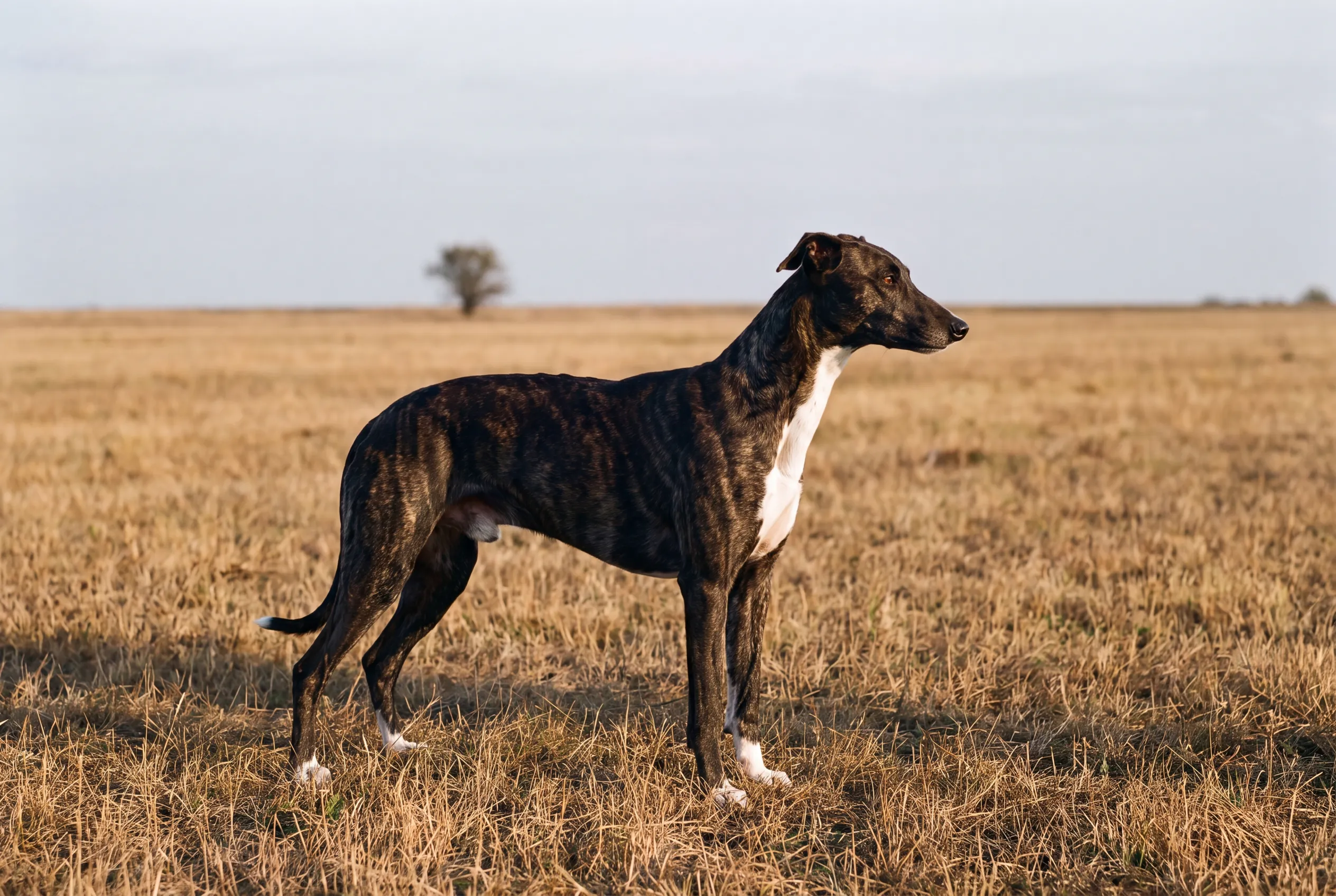
Magyar Agár
Thirty kilometres behind a horse, then the warmest spot in the house.
Vital stats
| Size | Large · 62–70 cm |
| Weight | 22–31 kg |
| Life expectancy | 12–14 years |
| Energy | High — bred to cover 30–50 km in a day |
| Shedding | Moderate — heavier in spring when the winter undercoat lifts |
| Coat | Short, dense and coarse · most sighthound colours; blue, brown, wolf-grey, black-and-tan and tricolour are disqualified |
| Group | Hound · Sighthound (FCI №240, Group 10) |
| Origin | Hungary |
Breed traits
Friendliness
Care
Mind
Temperament
The standard's temperament line reads like a job advert: untiring, full of stamina, fast, tough, robust. What owners notice at home is the sentence after it. Reserved by nature but not shy, and watchful — the FCI text credits the breed with an instinct to protect its people and their property while ruling out aggression, which few Group 10 standards bother to claim. Day to day that is a dog which registers the doorbell, mentions it once, and lets it go. It is steady with its own household, courteous rather than delighted with visitors, and undramatic about most things. The hunting is untouched. A hare crossing a field pulls harder than any recall you have built, and this is a breed with the engine to be several hundred metres away before it decides whether to listen.
Habits & quirks
Distance over dash
The old day's work was thirty to fifty kilometres alongside riders. A Magyar Agár still prefers a long steady trot to a short burst, and it is one of the few sighthounds happier going far than going fast.
Built for weather
Thick skin, a coarse short coat and a genuine undercoat by December. It will choose to lie out in a cold yard, and it needs a winter rug far less often than a Greyhound or a Galgo does.
Keeps the door in view
It clocks arrivals and stays interested until it knows who they are. Nothing about it is pushy, but it is not the oblivious sighthound people expect either.
Uses its nose
The FCI standard goes out of its way to call the breed's nose noteworthy, which is rare in a dog that hunts by sight. Owners see it when a dog loses sight of what it was after and starts working the ground instead.
Care
| Exercise | An hour or more a day, and make it distance rather than laps: long lead walks, a bike, a securely fenced field for sprints, or lure coursing where a club runs it. Once the mileage is done it settles indoors and stays out of the way. |
| Grooming | Ten minutes a week. The short coarse coat sheds moderately and drops properly in spring when the winter undercoat comes out. Check the skin after rough ground; it is thicker than most sighthounds' but it still tears on wire. |
| Training | Reward-based and unhurried. It reads people well and picks things up quickly, but it is a hunting dog with opinions and repetitive drilling gets you nothing. Teach recall early, keep paying for it, and plan around the day it fails. |
| Health | A sound breed with no long list of inherited problems, which the working background helps explain. Tell any vet it is a sighthound before anaesthesia. Ask breeders about hips, eyes and hearts, and about pedigree depth: the population went through a hard bottleneck in the 1960s. |
Common questions
How is a Magyar Agár different from a Greyhound?
Same job, different animal. Side by side the Magyar Agár is heavier in bone and muscle, broader in the skull, blunter in the muzzle, and its rose ears are thick — the standard says heavy ears are preferred. The skin is thicker and the coat grows a winter undercoat. Over a short track a Greyhound wins. Over the distances Hungary bred for, a full day's hunting behind horses, the Magyar Agár is still going, and its own standard claims it beats the Greyhound at some distances. The name Hungarian Greyhound is a translation of convenience: the breed does not descend from the English dog, though nineteenth-century breeders crossed Greyhound in to add speed.
Is one hard to find outside Hungary?
Yes. The breed was close to extinct by the end of the Second World War and was rebuilt from 1963 with a small number of survivors found in villages. Most of the population is still Hungarian, with pockets in Germany, Austria, the Netherlands and North America. There is no AKC recognition and so no AKC breeder directory to search; the UKC has recognised it since 2006. In practice you go through the Hungarian breed club or a European coursing club, and you wait.
Can it live with a family and other pets?
With people, usually well. It is steady, low-maintenance in the house and attached to its household, though guests get politeness rather than enthusiasm and small children need to learn that a sleeping sighthound is left alone. Other dogs are generally fine. Cats and rabbits are the honest problem: a dog bred to catch and dispatch hares does not file the family cat under family by default. Some manage it with careful introductions from puppyhood, plenty never do, and it is worth deciding which risk you are taking before the puppy arrives.