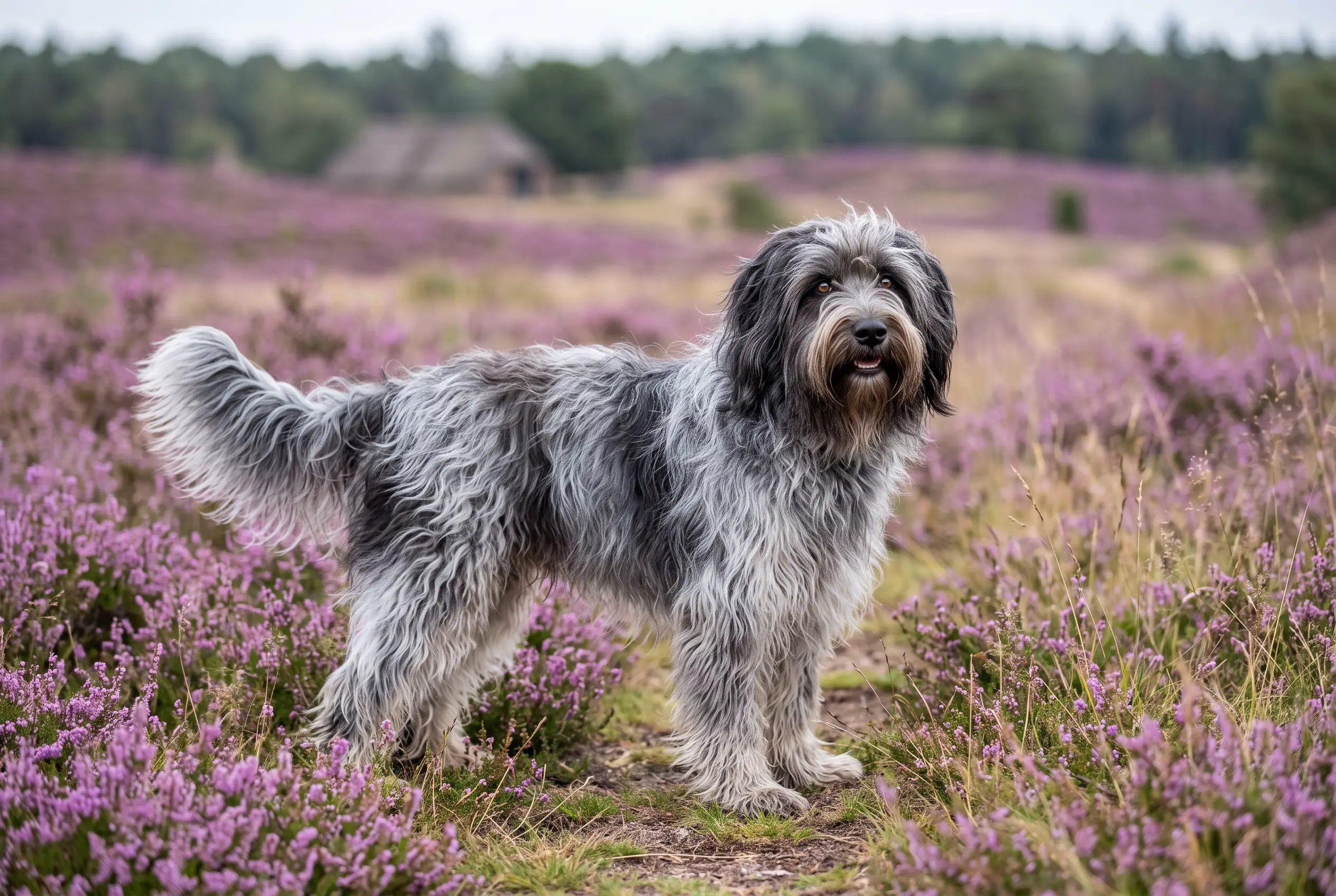
Schapendoes
The shaggy Dutch herder that would rather jump the ditch than walk around it.
Vital stats
| Size | Medium · 40–50 cm |
| Weight | 12–20 kg |
| Life expectancy | 12–15 years |
| Energy | High — daily running plus something to think about |
| Shedding | Moderate — long hair that mats before it drops |
| Coat | Long, thick and slightly wavy over undercoat, with topknot, moustache and beard · all colours, blue-grey to black preferred |
| Group | Herding · Sheepdogs, without working trial (FCI №313, Group 1) |
| Origin | Drenthe and the Veluwe, Netherlands |
Breed traits
Friendliness
Care
Mind
Temperament
The standard asks for a dog that is intelligent, watchful, jolly, lively, friendly and high-spirited, and the breed largely delivers. A Schapendoes fastens onto its household, wants to be in whichever room the people are in, and is genuinely easy with the children it lives with. That comes packaged with a working brain and a herder's independence: it learns fast, has opinions, and will make its own decision if nobody else is making one. It is also a soft dog. Harsh corrections shut it down instead of sharpening it, so a light hand and food get much further than pressure. What it will not forgive is being under-exercised or left alone all day — an hour or more of real movement, and company, are the price of the easy character.
Habits & quirks
Gallops, doesn't trot
The standard is explicit about it: in work this dog gallops, light-footed and springy, without burning energy it will need later. A steady walk on a lead is not the gait the breed was assembled around.
Treats fences as suggestions
Bred to clear ditches and hedges out on the heath, it jumps far better than its size predicts. Check the height of the garden fence before the puppy arrives rather than after.
Lives in the middle of things
It follows its people from room to room and inserts itself into whatever is happening. Long days home alone are the one thing this breed handles badly.
Brings the outdoors home
Burrs, seeds, mud and leaves travel back in the feathering, and the fine undercoat behind the ears and under the elbows knits into mats within days.
Care
| Exercise | An hour or more a day with real running in it, plus work for the head. Agility, flyball, obedience and scent work all suit a dog bred for speed and quick turns. It is no good on its own in a garden; the point is doing something with someone. |
| Grooming | Comb all the way down to the skin every week and expect it to take the best part of an hour. Around nine to eighteen months the puppy coat changes over and mats can form daily, which is when most owners get caught out. Tidy the hair around eyes, feet and hindquarters, bathe rarely, and do not clip: the coat is meant to be natural, and hair that has been shaved off tends to grow back softer and woollier than what you removed. |
| Training | It learns quickly and bores just as quickly, so keep sessions short, varied and well paid. Build recall early, because a galloping dog covers ground fast. Shouting and force backfire — a Schapendoes under pressure stops offering anything at all. |
| Health | Progressive retinal atrophy is the breed's known inherited problem. A single-base insertion in the CCDC66 gene, identified in Schapendoes in a 2010 study, causes sight to fail somewhere between two and five years of age. A DNA test exists, Dutch breeding rules require it, and no litter should ever be bred from a pairing that can produce an affected puppy — ask to see both parents' results. Also ask about ECVO eye examinations and about persistent ductus arteriosus, distichiasis and cataract, all reported in the breed. |
Common questions
Is a Schapendoes a good family dog?
Yes, more so than most of the herding group. It is affectionate, cheerful, patient with the children it lives with, usually sociable with other dogs, and friendly to visitors rather than suspicious of them. The conditions are real though: an hour or more of proper exercise a day, company for most of the day, and about an hour a week with a comb for the next fourteen years. Cover those three and it is an easy dog to live with.
How is it different from a Bearded Collie?
Same shaggy herding family, different dog. The Bearded Collie is Scottish and bigger at 51–56 cm, with a flat, harsh outer coat and a long show-ring history. The Schapendoes is Dutch, 40–50 cm, lighter in build, with a finer, drier coat that is left natural, and its standard permits every colour while preferring blue-grey to black. It is also nothing like the Dutch Shepherd, FCI standard 223 — a brindle working dog of the Dutch police and KNPV clubs, harder and sharper, and a completely different proposition despite the shared country.
Can the coat be clipped short?
Better not. It is long, thick and slightly wavy over a fine undercoat, and the standard describes it as natural, untrimmed hair. Dutch breed clubs advise against shaving it: clipped hair tends to return softer and woollier, which then mats faster than the coat you were trying to simplify. The workable version is a weekly comb that actually reaches the skin, plus tidying around the eyes, the feet and the rear.