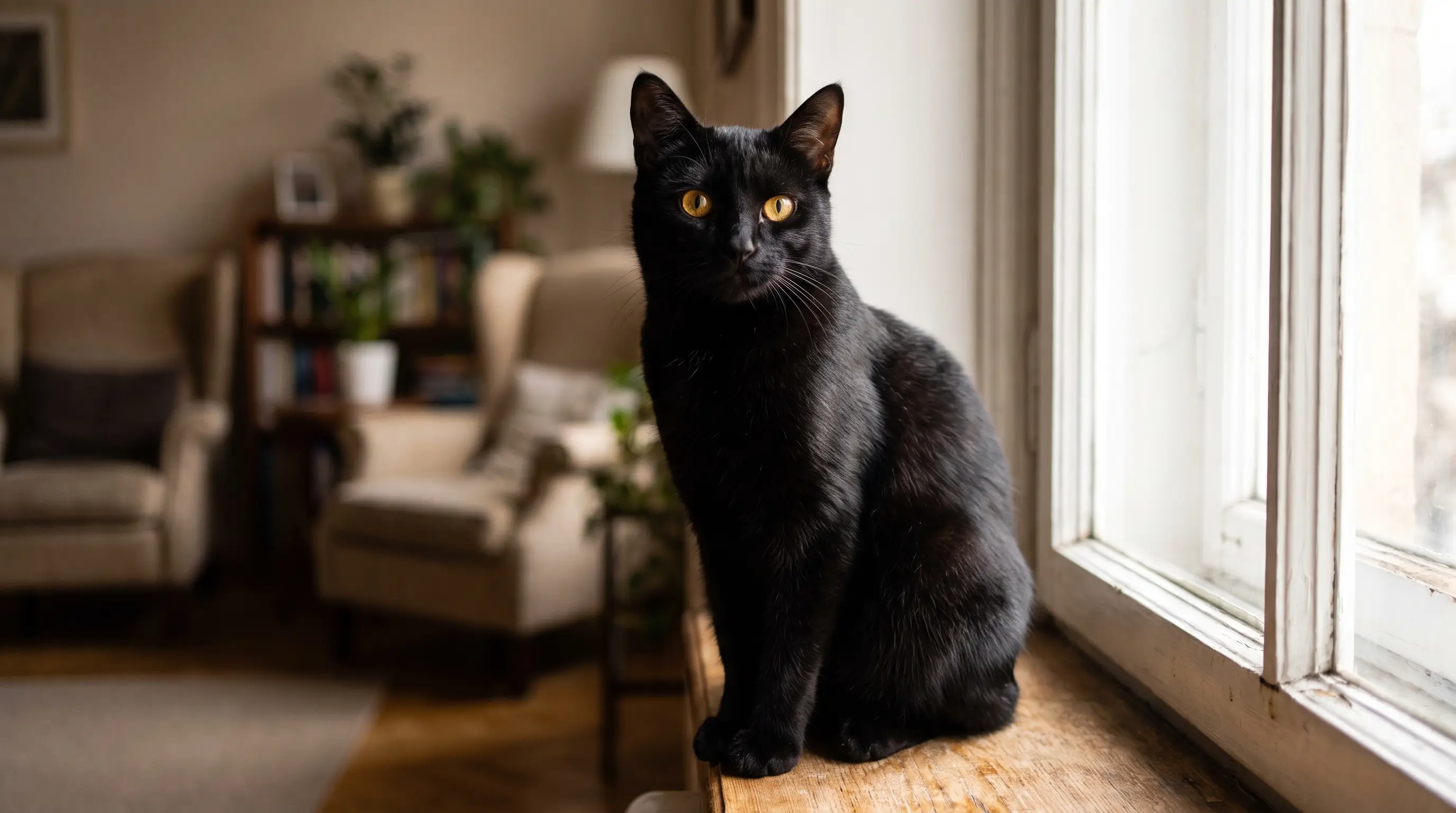
Black cats: the luckiest and unluckiest cat alive
A black cat walking toward you is a windfall in Scotland and a warning in the United States, and it is the exact same animal. No cat carries a heavier folklore load, and almost none of it agrees with itself. The bad-luck story and the good-luck story grew up side by side across a few hundred miles of coastline, which tells you the omen was never really about the cat.
One cat, two omens
The contradiction is the whole point: black cats are read as bad luck and good luck by cultures that sit right next to each other. In the US a black cat crossing your path is the classic sign of trouble ahead. Cross the Atlantic and the same crossing flips meaning, so British folklore treats a black cat walking toward you as fortune arriving and one walking away as fortune leaving. German tradition splits it by direction, right-to-left for misfortune, left-to-right for luck.
When a single animal can mean opposite things depending on which harbor you are standing in, the symbolism is doing the talking, not the cat. That is worth holding onto before any of the spookier history lands, because the spooky history is where most people stop.
Bad luck: witches and the crossed path
The bad-luck reputation is medieval European, and it was deadly. As the witch panic spread, black cats got cast as witches' familiars or as witches themselves in disguise, and the papal letter Vox in Rama, issued under Pope Gregory IX around 1233, tied cats to devil worship in the Church's official imagination. That framing gave people license to kill them, and for centuries they did.
The American "black cat crossing your path" superstition is a thinner, later echo of the same fear, carried over by European settlers and stripped down to a single unlucky moment. There is no mechanism behind it and never was. A cat crossing a road at night is a cat crossing a road at night, occasionally spooking a horse with its reflective eyes, which is likely where the whole omen started.
Good luck: Scotland, sailors, and Japan

In much of Britain, and especially Scotland, a black cat arriving at your door is a sign of coming prosperity rather than a threat. Fishing communities took this seriously in practical terms: sailors kept black cats aboard ship for a safe voyage, and their wives kept a black cat at home believing it helped bring the boat back. A working cat that killed rats and protected the food stores earning a reputation as a good omen makes a certain sense.
Japan runs the same way. Black cats are read as lucky and as guardians that ward off bad spirits, and the black version of the maneki-neko, the beckoning cat, is sold specifically as a charm against illness and misfortune. Same coat, same species, opposite verdict from the medieval one, which is the tell that the luck was always projected onto the animal.
Melanism and the immune-gene link
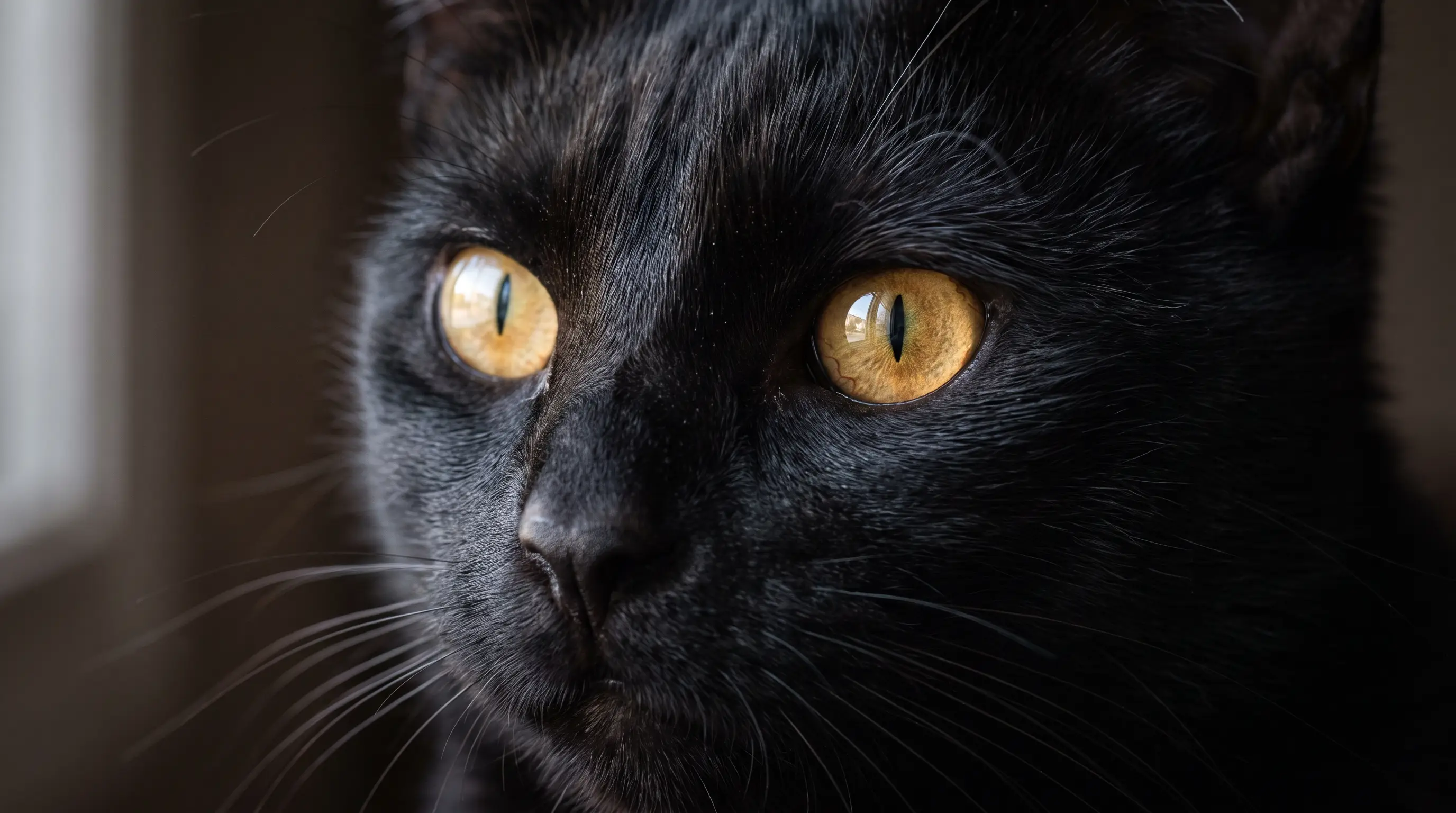
The black coat comes from melanism, an overproduction of the dark pigment eumelanin, and in domestic cats it usually traces to a recessive change in the ASIP gene that switches pigment production fully to black. The genetics get more interesting than the coat, though. In a 2003 study of melanism across the cat family, Eduardo Eizirik and Stephen O'Brien found that the mutations behind dark coats sit in the same gene family as genes involved in human disease resistance, including relatives of the MC1R gene and the CCR5 gene tied to HIV resistance.
That raised a real hypothesis: melanism might travel with some resistance to viral infection, which would help explain why black coats keep evolving independently in wild cats like the melanistic jaguars and leopards we call black panthers (more on those in wild cats). It is a hypothesis, not a proven health perk in your house cat. The honest version is that the same stretch of DNA does double duty, and researchers are still working out what that means for the animal.
The shelter penalty
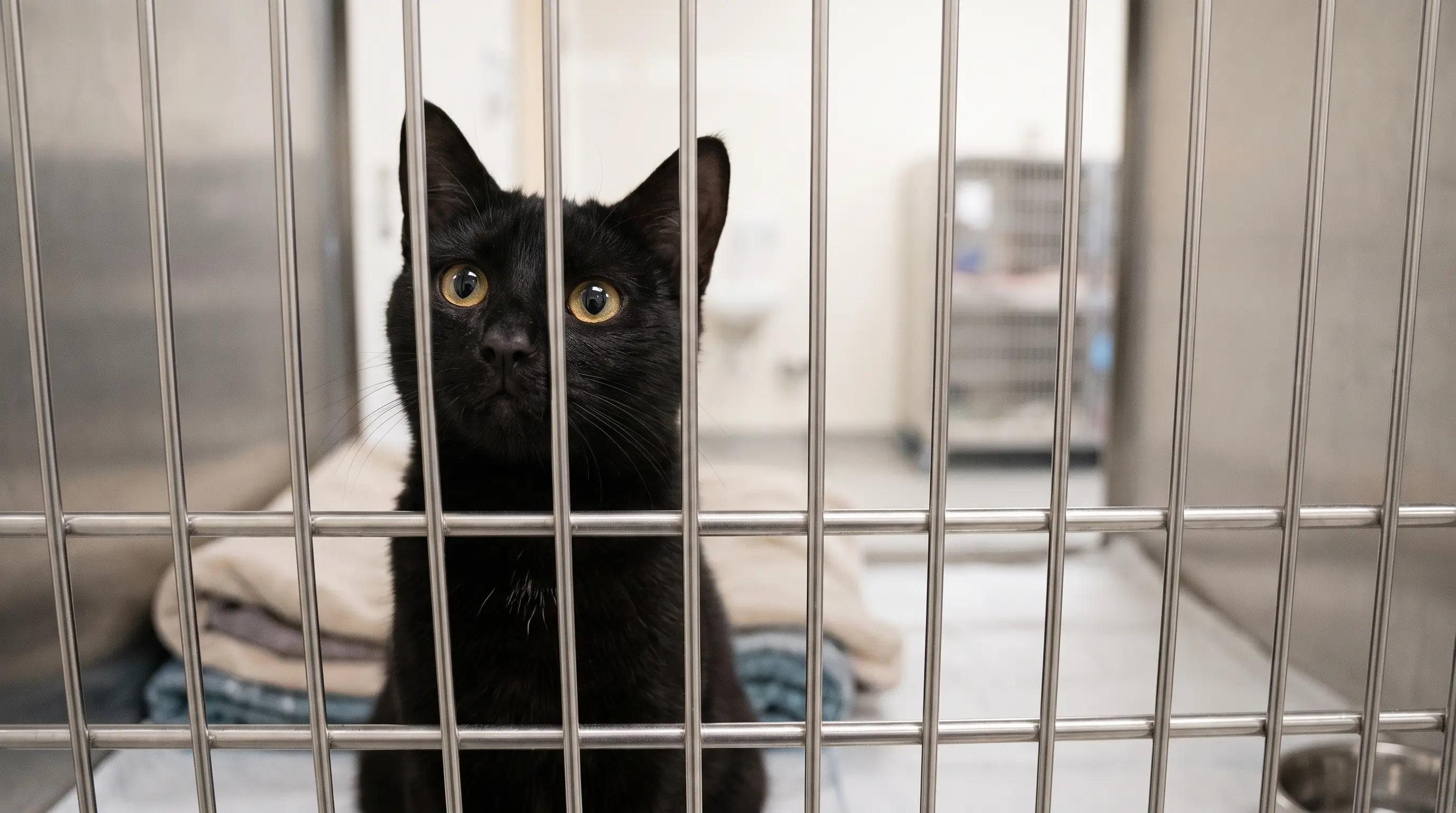
Black cats get adopted less and wait longer, and it costs them. Multiple shelter studies find solid-black cats spend more time in care and have lower adoption rates than other colors. Superstition is one reason, but not the only one: black fur photographs poorly, flattening a cat's face and expression in the online listing photos that now drive most adoptions, and dim shelter lighting hides them further. One perception study found people rated black cats as less friendly purely from photos, before meeting a single one.
There is no evidence any of that is fair. Coat color does not predict temperament, and behavior research finds no link between black fur and aggression or friendliness. Black Cat Appreciation Day on August 17 exists to push back on the bias and move these cats out of shelters faster. If you are weighing one, judge the cat in front of you, and if you have already taken one in off the street, our guide on what to do when you've found a stray cat covers the first steps.
Common questions
What does it mean when a black cat comes to your house?
It depends entirely on where you are. In Scottish and Japanese tradition a black cat arriving at your home signals coming prosperity and protection, while older American and Southern European superstition reads it as bad luck. There is no evidence a cat's arrival predicts anything about your fortune either way.
Why are black cats considered bad luck?
The bad-luck belief traces to medieval Europe, where black cats were cast as witches' familiars and tied to the devil in Church documents like Vox in Rama around 1233. That association survived as folklore and crossed to America as the "black cat crossing your path" superstition. It has no basis in fact.
Do black cats have a different personality?
No differently than any other cat, because coat color does not shape personality. Behavior studies find no reliable link between black fur and aggression or friendliness, so temperament comes down to the individual cat, its genetics, and how it was raised, not its color.
How rare are black cats?
Solid-black coats are fairly common in mixed-breed cats, but a purebred all-black cat is rarer. The Bombay is the only breed developed to always be black, and the Cat Fanciers' Association recognizes roughly 22 breeds that can be born fully black, so a consistently jet-black pedigree is the uncommon part.
What do black cats symbolize?
Prosperity in some cultures and misfortune in others, which is the point. Britain, Scotland, Japan and ancient Egypt treated the black cat as a lucky or sacred figure, while medieval European folklore made it a symbol of witchcraft and bad luck. The meaning was always assigned by the culture, not the animal.
What is an all-black cat called?
There is no single name for an all-black cat, but the one breed bred to be solid black is the Bombay, created to resemble a miniature black panther. Many other breeds and countless mixed cats can also carry a fully black coat, so "black cat" usually refers to coloring rather than a specific breed.
More in Cats
Can you take your cat to the beach? An honest guide
Most cats should skip the beach, and a few can go safely. The honest, vet-checkable guide to heat, sun, saltwater, harnesses and who stays home.
What Catnip Really Does to a Cat
The honest, myth-busting guide to catnip: what nepetalactone does, why 1 in 3 cats ignore it, and what to try instead.
You Found a Stray Cat: What to Actually Do
A friendly cat on your doorstep may already have a home. Here is the honest, welfare-first order of steps before you take it in.