Organic, natural, holistic: which pet food claims are real
Of all the reassuring words on a bag of pet food — organic, natural, holistic, premium, gourmet — only one is defined and enforced by law: organic. The rest run from a real but loose standard (natural) to marketing that guarantees nothing at all (holistic, premium, gourmet). Here is what each word legally promises, where the US and Europe part ways, and why not one of them is the claim that tells you a food can actually feed your pet.
Organic: the one word backed by law
Organic is a certification, not a mood. In the US it is governed by the USDA National Organic Program, with tiers that mirror human food: 100% organic (every ingredient), organic (at least 95% organic ingredients, may carry the USDA Organic seal), and made with organic (at least 70%, no seal). In Europe the EU organic logo — the green Euro-leaf — needs at least 95% of the agricultural ingredients to be organic under Regulation (EU) 2018/848, with pet-food rules that applied from May 2024. Either way, the word is checked by an accredited certifier and means something specific: it governs how the ingredients were farmed — no synthetic pesticides or fertilisers — not how nutritious the finished food is. One honest wrinkle: the US only issued its first pet-food-specific organic rule in late 2024, then proposed rolling it back in 2025, so the dedicated standard is genuinely unsettled; historically, organic pet food has ridden on the human-food organic rules.
Natural: a real definition, but a loose one
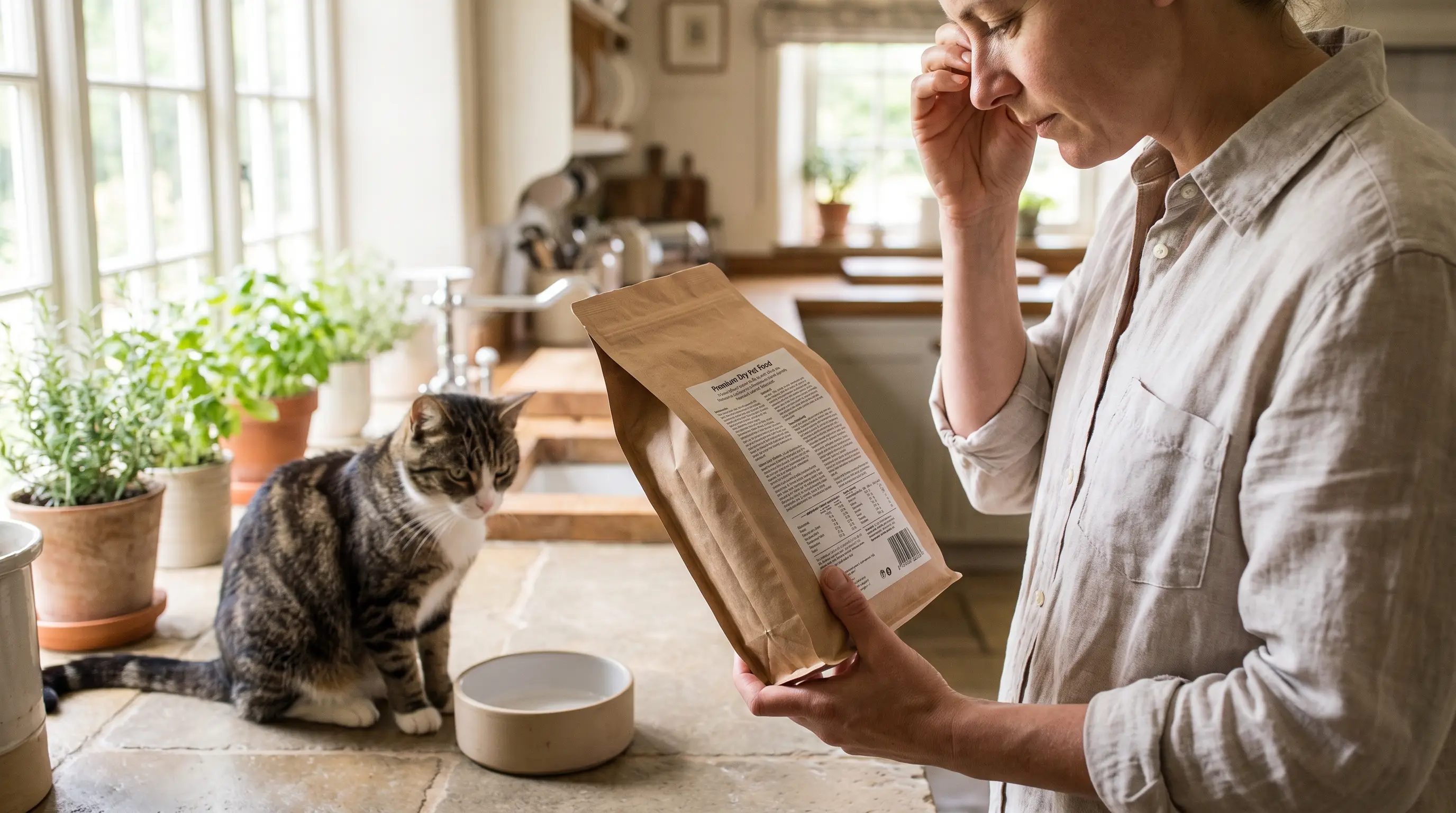
'Natural' does have a definition, but a permissive one. Under the AAFCO feed standard used in the US, a natural food is made from plant, animal or mined sources with nothing chemically synthetic — except the added vitamins, minerals and trace nutrients that a complete diet needs, which are almost always synthetic. That is why so many bags read 'natural with added vitamins and minerals': the disclaimer is the tell that the pure claim couldn't stand alone. It is an AAFCO labelling rule, not an FDA one, and in Europe 'natural' rests on FEDIAF's voluntary code rather than hard law. Most importantly, natural is not organic, not grain-free, not by-product-free, and says nothing about quality or nutrition — it only limits synthetic additives.
Holistic, premium, gourmet: words that mean nothing
Some of the most expensive-sounding words on the shelf are the emptiest. Holistic has no legal definition in pet food anywhere — not in the US, not in the EU — so any product can print it with no criteria to meet. Premium, super-premium and gourmet are marketing tiers, not standards: a 'premium' food isn't required to contain better ingredients or hit any higher nutritional bar than a plain one. On a bag that says 'natural and holistic', only 'natural' carries any weight. Treat these three as decoration and spend your attention elsewhere.
US vs Europe: who actually enforces what
The split is worth knowing. In the US there is no single pet-food law: the FDA sets a safety-and-truthful-labelling baseline, AAFCO writes the model definitions that states adopt (that's where 'natural' lives), and the USDA owns 'organic'. Holistic, premium and gourmet answer to nobody. In Europe, organic (or 'bio') is hard EU law, certified nationally; everything else — natural, holistic, premium — sits under FEDIAF self-regulation, which is voluntary. And a myth worth killing on both sides of the Atlantic: there is no such thing as 'AAFCO approved'. AAFCO is not a government agency and does not test, approve or certify any food; it only publishes the standards.
The claim that actually matters

None of these five words tells you the one thing you actually need to know: whether the food can be your pet's whole diet. That job belongs to the complete-and-balanced statement for the right life stage — the only claim on the pack that certifies real nutritional adequacy, and the first thing to read every time. We cover it in the complete-and-balanced guide. Buy organic if the farming standard matters to you and the certification is genuine; read 'natural' as a narrow, honest limit on synthetic additives; and ignore holistic, premium and gourmet entirely. Once you've chosen a food, our food calculator sorts out how much to feed.
Common questions
What is the difference between natural and organic dog food?
Organic is a certification about how ingredients were farmed — at least 95% organic ingredients for the seal, verified by an accredited certifier. Natural is a looser AAFCO labelling term meaning nothing chemically synthetic except added vitamins and minerals. Organic is legally enforced; natural is a narrower claim about additives, and neither guarantees better nutrition.
Is organic dog food worth it?
It depends on what you value. Organic controls how ingredients are produced, not whether the food is nutritionally adequate, so it isn't automatically healthier for your pet. If certified-organic farming matters to you and the seal is genuine, it's a reasonable choice — but a non-organic food that is complete and balanced meets the same nutrient needs.
What does organic mean for dogs?
It means the ingredients were produced to organic farming rules — no synthetic pesticides or fertilisers — and certified by an accredited body (USDA in the US, the EU organic logo in Europe). It's a claim about sourcing and production, not about nutrition or safety, both of which are governed separately.
What is holistic dog food?
Nothing, in legal terms. 'Holistic' has no regulatory definition in pet food in the US or the EU, so any product can use it without meeting any standard. It's a marketing word; judge the food by its complete-and-balanced statement and ingredient list instead.
What does 'natural' actually mean on a dog food label?
Under AAFCO it means the food is made from plant, animal or mined sources with nothing chemically synthetic — apart from added vitamins, minerals and trace nutrients, which is why labels add 'with added vitamins and minerals'. It limits synthetic additives; it does not mean organic, grain-free, higher quality or more nutritious.
Does organic pet food have to be certified?
Yes. To make an organic claim, a food's ingredients must come from a certified organic operation and meet USDA (US) or EU organic rules, verified by an accredited certifier. Without certification, a product can't legitimately call itself organic — unlike 'holistic' or 'premium', which anyone can print.
More in Dogs
Reading the pet food ingredient list: meat, meal and by-product
'Chicken' first isn't the win it looks like, and 'by-product' isn't the villain. How to read an ingredient panel the way the people who write it do.
Human-grade vs feed-grade pet food, decoded
'Human-grade' is one of the few pet-food terms with a legal meaning — and one of the most stretched. Here's what it really requires, and whether it's worth paying for.

Pet food quality words, decoded: what the label really promises
Human-grade, holistic, natural, premium, single protein. Most of it is marketing, some of it is law. Here's what each word actually guarantees — and the one claim that really matters.