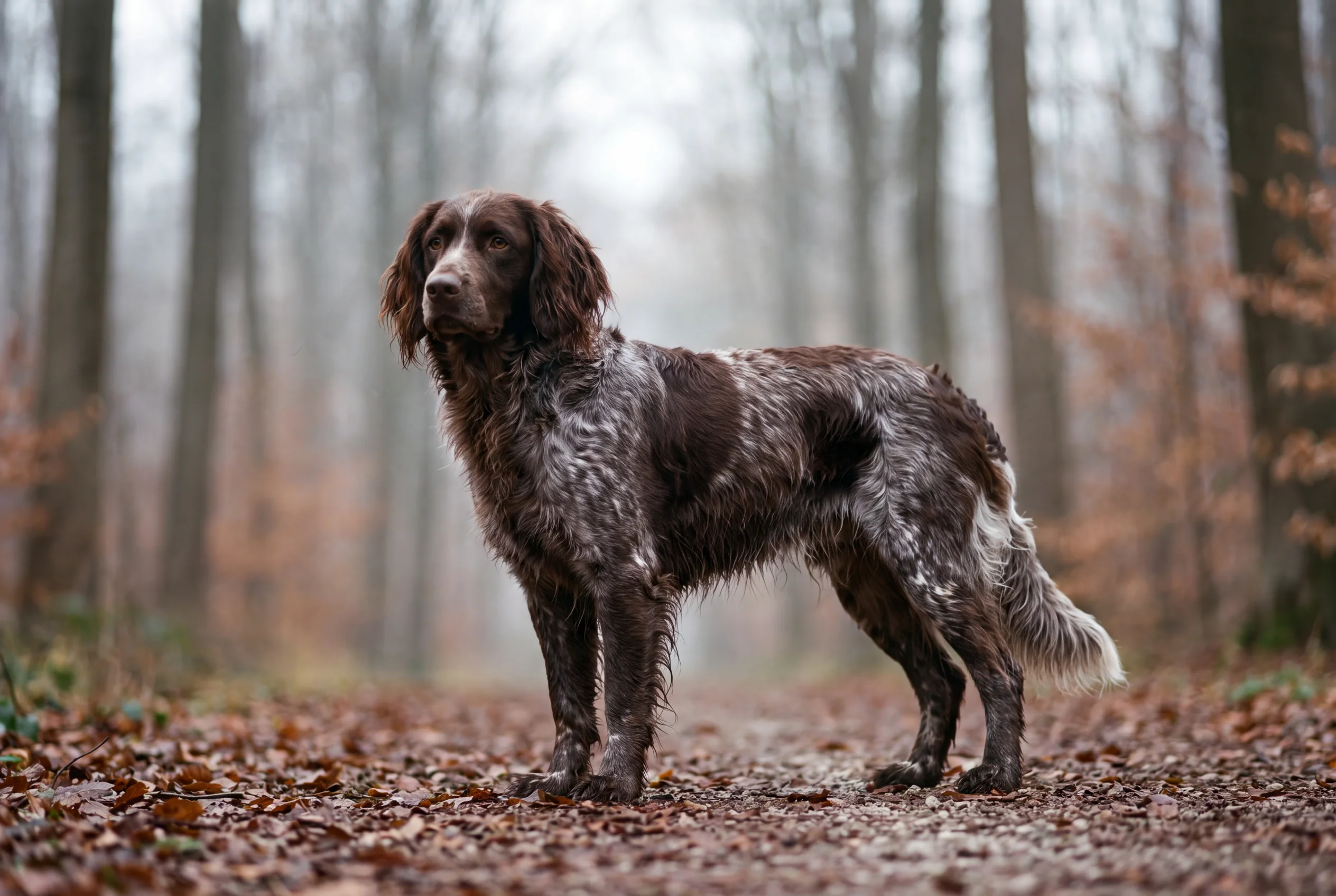
Deutscher Wachtelhund
You need a German hunting licence before the club will let you breed one.
Vital stats
| Size | Medium · 45–54 cm |
| Weight | 18–25 kg |
| Life expectancy | 12–14 years |
| Energy | Very high — bred for a full day in cover and water |
| Shedding | Moderate year-round — a real coat with feathering |
| Coat | Long, wavy, dense undercoat · solid brown or brown roan (Braunschimmel), red in both |
| Group | Sporting · Flushing Dog (FCI №104, Group 8) |
| Origin | Germany |
Breed traits
Friendliness
Care
Mind
Temperament
The FCI standard lists what the breed is for before it lists what it is like: a strong desire to find, a fine nose, firm on a track, reliable at giving tongue, keen on retrieving and water, sharp with game and vermin. Then it asks for friendly, assured, very docile, neither nervous nor aggressive. Both halves are real, and German owners describe the same split, a dog that goes flat out through brambles for three hours and then sleeps under the kitchen table. Pointing was never selected for, so a Wachtelhund pushes game out instead of freezing on it. The sharpness is not a figure of speech either. These dogs are used to track wounded boar and to work fox, and the same drive shows up in a suburban garden that happens to contain a rabbit. Noise is part of the design: a handler who cannot see the dog in thick cover has to be able to hear it, so the voice is bred for rather than tolerated.
Habits & quirks
Says what it is doing
Spurlaut, giving tongue on a track, is a scored breeding requirement, and a dog that runs a line silently fails it. That same voice comes out at the doorbell, at the postman and at anything moving in the hedge.
Gets in the water first
Water work is tested before a dog can be bred, so the willingness is selected for generation after generation. Ditches, ponds, canals in February. It does not check with you first.
Works out ahead, then checks in
Flushing thick cover means the dog goes out of sight and keeps hunting. A well-bred Wachtelhund pushes forward on its own and comes back through on its own, which is a very different feel from a heel-position dog.
Brings the forest home
Feathering behind the legs and tail collects burrs, seeds and mud, and the long hanging ear leathers hold water. Most owners keep a comb by the back door and check ears the way you would check a horse's feet.
Care
| Exercise | Two hours of real work most days, and searching counts for more than distance. Cover to quarter, water to swim, scent trails, retrieves. A Wachtelhund kept on lead loops around a park is a dog looking for its own job, and it will find one. |
| Grooming | Brush the wavy coat two or three times a week, more where it feathers, and go through it after every outing in cover. Dry the ears and check inside them; hanging leathers over a dense coat are the breed's most common nuisance. |
| Training | It learns fast, wants to work with a person and takes reward-based work well. The hard part is not obedience, it is managing prey drive: recall away from live game needs building from puppyhood and may never be fully reliable near deer or boar. |
| Health | Generally sound and long-lived for its size. The VDW screens hips and elbows by X-ray, breeds only from HD grades A, B or C, runs a breeding-value estimate twice a year and holds breeders to a minimum X-ray quota, so ask for the parents' HD and ED results and the club paperwork behind them. |
Common questions
Can a Deutscher Wachtelhund live in a non-hunting home?
Honestly, most of the time no, and you will probably not be sold one. A German breeder holds a hunting licence, breeds under club rules for hunters, and will normally place puppies with people who will put them through the tests; the VDW grants breeding rights only to members eligible for a German hunting licence, which tells you where the whole system is pointed. The dog itself needs hours of searching work daily, water, and something to find, and it will bark on a scent whether or not the scent is legal quarry. Sport homes doing serious mantrailing, blood-tracking or gundog work can make it work. A family that wants a friendly medium-sized spaniel for weekend walks is describing a different dog, and the breed clubs will say so.
What is the difference between the brown and the Braunschimmel?
Colour, and a piece of breeding policy. Solid browns and brown roans are kept as separate strains and crossing them needs approval from the club's breeding director, a rule set up by Rudolf Friess to protect genetic diversity in a breed founded on very few dogs. Breeders once said the browns hunted closer and the roans ran longer lines, but the standard notes that enough crossing has happened since that the temperament split no longer holds. Red versions of both exist, and roan pups can appear from two brown parents, in which case they are registered with the roans.
How do you get one outside Germany?
Slowly, and usually through hunting. The breed exists in North America in the low hundreds, with clubs in the US and Canada importing from German lines, and waiting lists run through people who test and hunt their dogs. In Europe outside Germany it moves through the same hunting networks. The AKC lists the breed only in its Foundation Stock Service, not as a fully recognised breed, so you will not meet one at a conformation show.