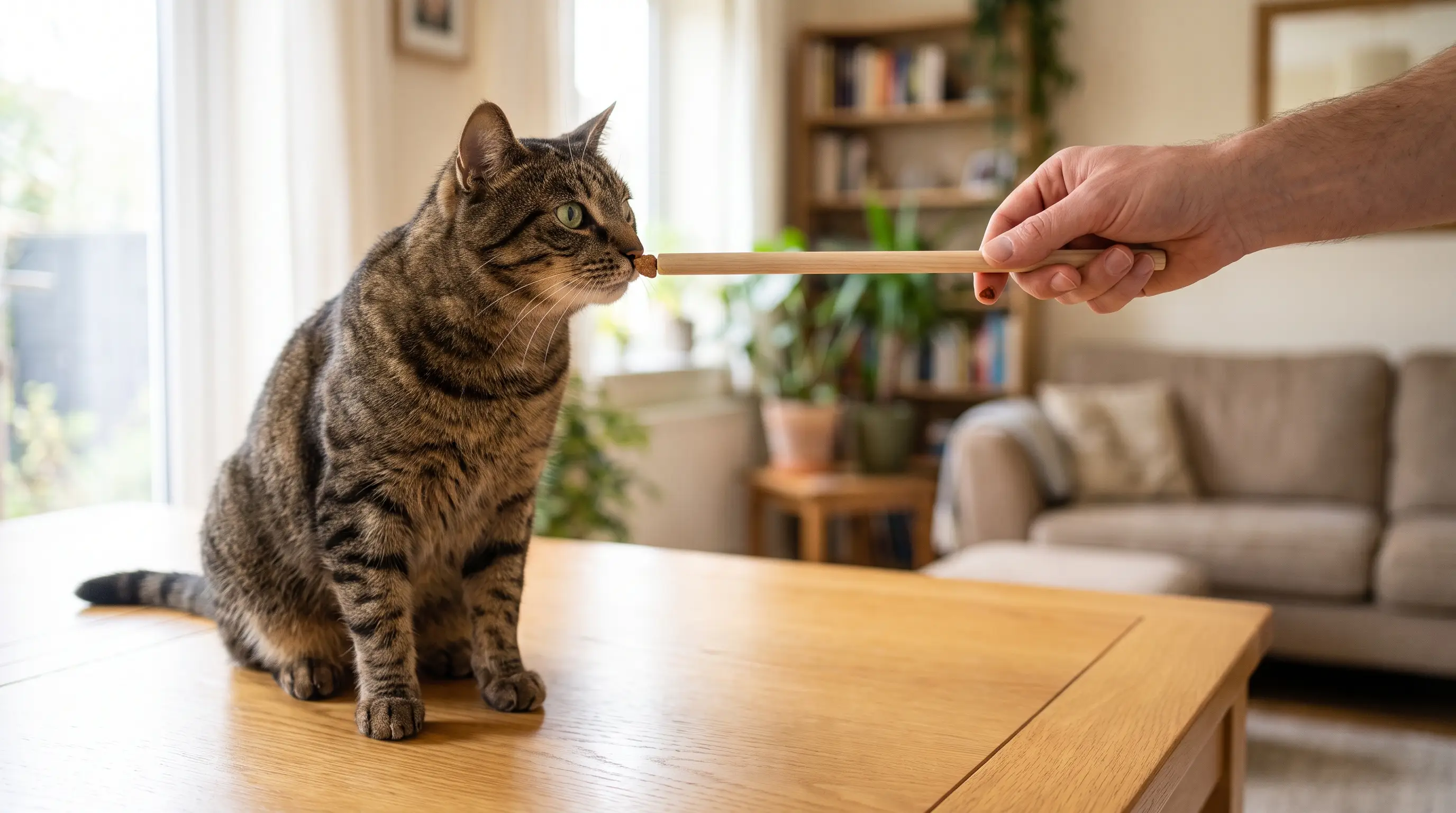
Clicker training a cat: the honest beginner's guide
Yes, you can train a cat, and the belief that you can't is mostly a failure of method, not of the animal. Cats learn the same way dogs and dolphins do: through food they want and a clear signal that tells them exactly what earned it. The tool is a clicker, a small plastic noisemaker that marks the precise instant your cat does the right thing. Get the timing right and a bored, aloof-looking cat turns into an eager student.
Why cats are trainable
Cats are trainable because they respond to reinforcement exactly like every other animal, they just work for different currency. A dog will often perform to please you; a cat performs because there is something in it for the cat, usually food. Once you accept that, the reputation for stubbornness falls apart. Cats in laboratories, shelters, and vet clinics learn to touch targets, step onto scales, and hold still for injections, all through the same reward-based methods.
The science is ordinary operant conditioning: behaviour that gets rewarded happens more often. What makes cats seem untrainable is that people try to bribe or scold them at the wrong moment, so the cat never connects the action to the outcome. Fix the timing and the myth evaporates. Highly food-driven and active breeds like the Bengal pick it up fast, but so does an ordinary tabby dozing on the sofa.
Charging the clicker
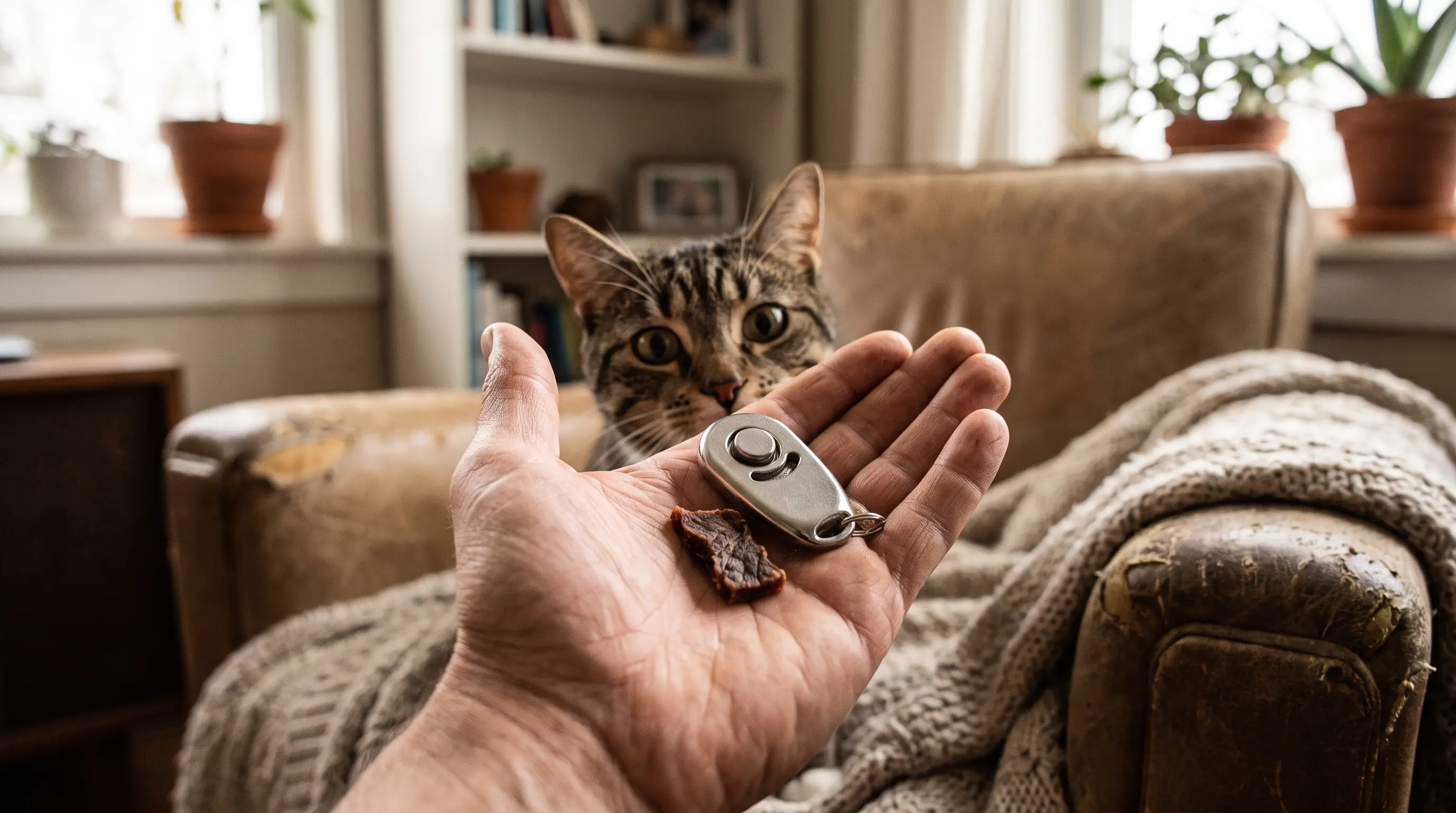
Before you teach anything, you "charge" the clicker so the sound means food is coming. Click once, then immediately give a tiny, high-value treat, a shred of chicken, a lick of tuna, a crumb of freeze-dried meat. Repeat this a handful of times over a minute or two. You are not asking the cat to do anything yet; you are building a reflex so that the click alone predicts a reward.
You know it has worked when your cat hears the click and instantly looks for the treat. That association is the whole point. Later, the click marks the exact instant a behaviour happens, even if the treat takes a second to arrive, so the cat knows precisely what earned it. A spoken marker word like "yes" works too, as long as you use the same word every time and say it the same way. The clicker is just faster and more consistent than a human voice.
Target training
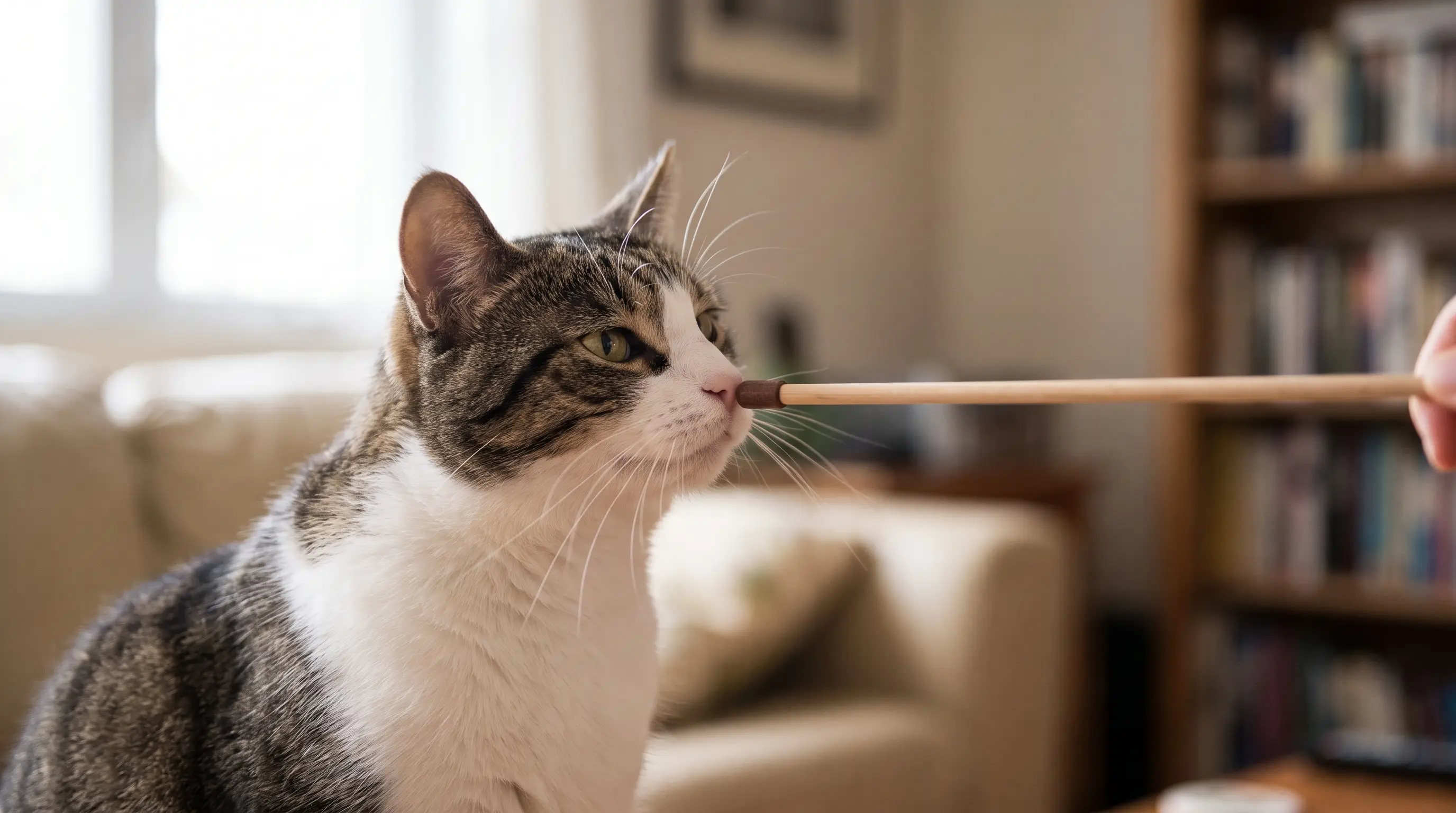
Target training, teaching the cat to touch a stick or your fingertip with its nose, is the easiest first behaviour and it unlocks everything else. Hold the end of a chopstick or a proper target stick a couple of centimetres from your cat's nose. Cats are curious, so most will lean in to sniff it. The instant the nose makes contact, click, then treat. Move the target a little each time so the cat has to step or turn to reach it.
Within a few short sessions most cats will follow the target reliably. That single skill lets you lead a cat off a counter, onto a scale, into a carrier, or through a jump, all without lifting or forcing it. Keep sessions to just a few minutes, ideally before a meal when your cat is a little hungry and motivated, and always stop while the cat still wants more. Ending on a win keeps the next session eager.
Sit, high five, and come when called
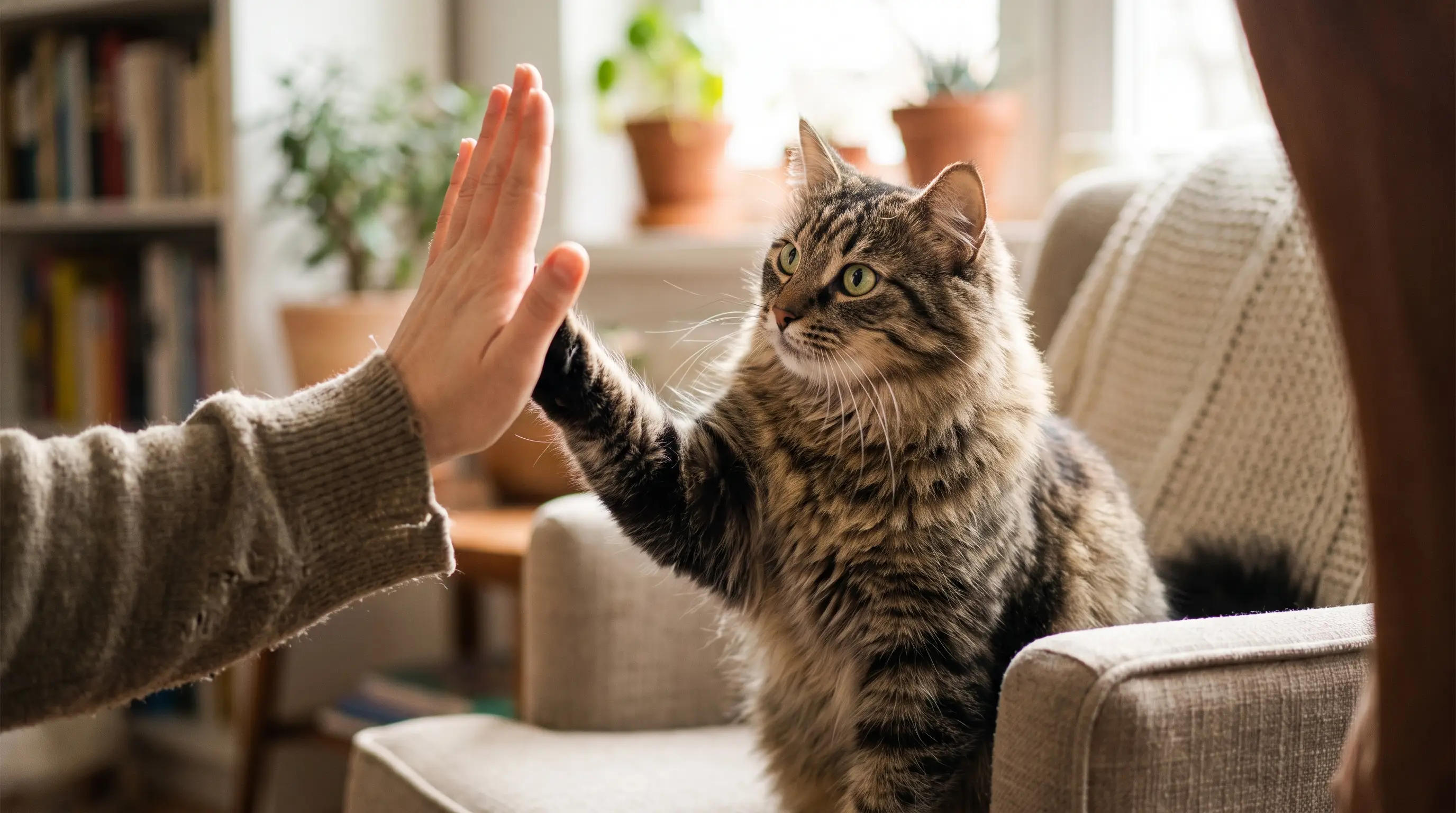
Once your cat targets, tricks like sit, high five, and come when called follow quickly through luring or capturing. For sit, move a treat slowly up and back over the cat's head; as the nose tilts up the rear naturally drops, and the moment it touches down you click and treat. For high five, hold a treat in a closed fist near the cat; when a paw comes up to investigate, mark and reward, then shape it toward your open palm.
Come when called is capturing at its simplest: pair a word or a specific sound with the click and treat whenever the cat approaches, and it will start running to you on cue. These are charming party pieces, but the same technique handles real problems, redirecting a counter-surfer to a mat, or asking a cat to move without a chase. Consistency matters more than talent; use the same cue and reward the behaviour every time while it is still new.
Carrier training for stress-free vet trips
The most useful thing you can teach is calm carrier entry, and it turns vet day from a wrestling match into a non-event. Leave the carrier out as ordinary furniture, door open, a soft blanket and the odd treat inside, so it stops being the box that only appears before something scary. Then use your target stick to lead the cat in, clicking and rewarding for stepping closer, then in, then settling.
Build up slowly: reward going in, then closing the door for a second, then a short lift, over days rather than one sitting. A cat that walks into its carrier on cue arrives at the clinic far less frightened, which makes the vet's job safer and the visit shorter. This is the payoff that convinces most sceptical owners that training a cat is worth the effort. It is also the behaviour vets and clinics most wish owners would teach.
Why punishment doesn't work on cats
Punishment does not train cats; it teaches them to fear you. Shouting, spray bottles, or scruffing do not tell a cat what to do instead, and cats rarely link the telling-off to their own behaviour. What they learn is that hands, voices, or your presence predict something unpleasant, so they hide, avoid you, and grow more anxious, which often makes the original problem worse. A stressed cat scratches and sprays more, not less.
The reward-based alternative works because it gives the cat a job it can succeed at. Instead of punishing a cat for jumping on the counter, teach and reward a mat to sit on, and make the counter boring. Timing and consistency are everything: mark the right behaviour the instant it happens, reward it, and repeat. Any cat, any age, from a kitten to a senior, can learn this way, so it is genuinely never too late to start.
Common questions
Can you train a cat like a dog?
Yes, cats learn through the same reward-based methods as dogs, but they work for food rather than to please you. Use a clicker or marker word to reward the exact moment of the right behaviour, and most cats will learn sits, targets, and recall.
What is the easiest thing to train a cat to do?
Target training, teaching your cat to touch a stick or your fingertip with its nose, is the easiest first skill. Cats are naturally curious enough to investigate the target, and once they do it reliably it becomes the foundation for nearly every other behaviour.
Is it ever too late to train a cat?
No, cats of any age can learn, including seniors and set-in-their-ways adults. Older cats may work a little more slowly, but the method is identical: short sessions, tiny high-value treats, and a clear marker for the right behaviour.
How long does it take to clicker train a cat?
Many cats grasp the first behaviour, like touching a target, within a few short sessions over a few days. Progress depends on keeping sessions to a couple of minutes, working before meals when the cat is hungry, and staying consistent rather than doing one long marathon.
Do you need a clicker to train a cat?
No, you can use a consistent marker word like "yes" instead of a clicker. The clicker just gives a sharper, more identical sound every time, which makes your timing clearer to the cat, but any signal works as long as it always predicts a treat.
How do you discipline a cat that misbehaves?
Skip punishment, which makes cats fear you rather than change their behaviour, and reward the behaviour you want instead. To stop counter-jumping, for example, teach the cat to sit on a mat for treats and make the counter boring and unrewarding.
More in Cats
Can you take your cat to the beach? An honest guide
Most cats should skip the beach, and a few can go safely. The honest, vet-checkable guide to heat, sun, saltwater, harnesses and who stays home.
What Catnip Really Does to a Cat
The honest, myth-busting guide to catnip: what nepetalactone does, why 1 in 3 cats ignore it, and what to try instead.
You Found a Stray Cat: What to Actually Do
A friendly cat on your doorstep may already have a home. Here is the honest, welfare-first order of steps before you take it in.