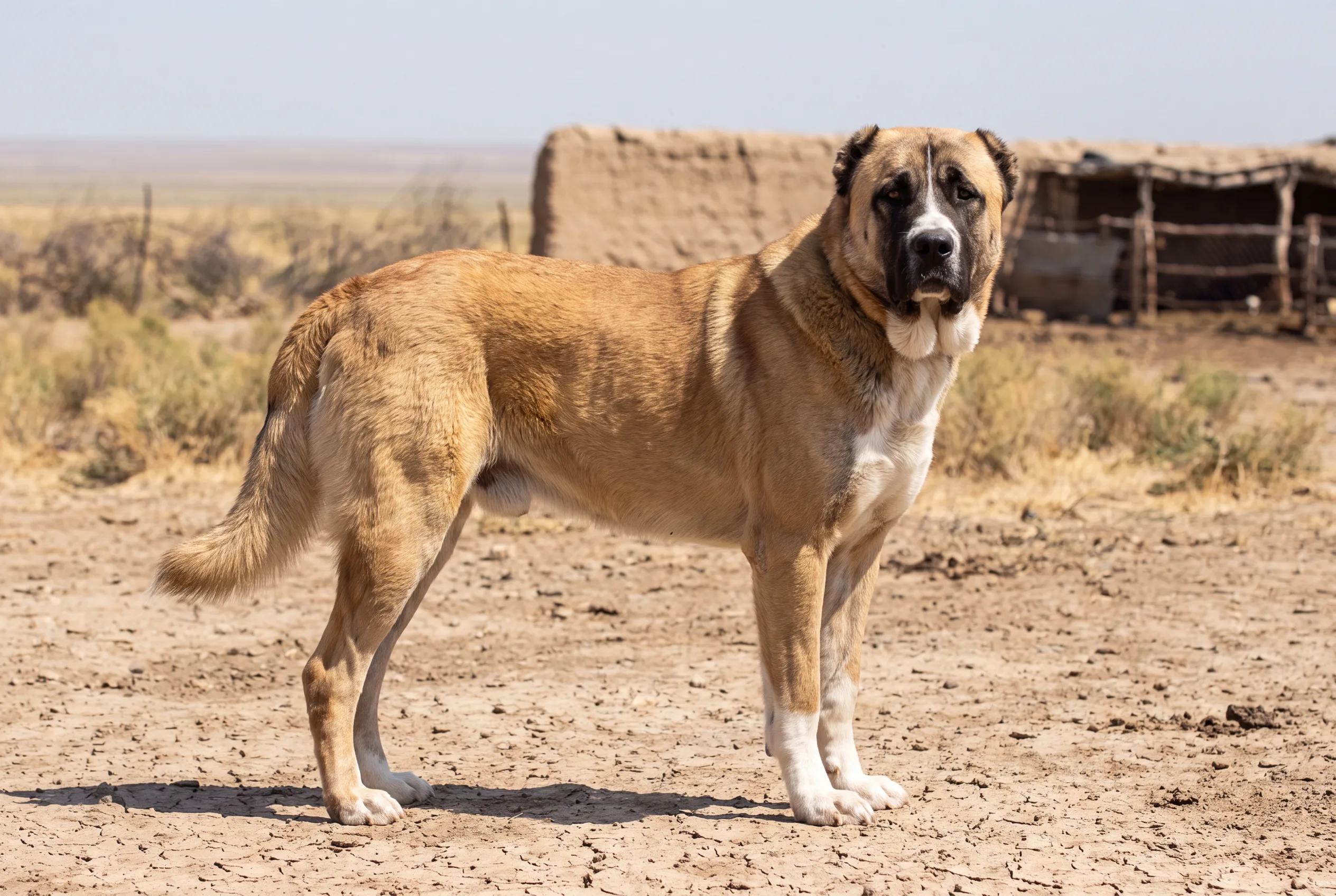
Sredneasiatskaya Ovtcharka
Half a continent of open country, and three years to grow up.
Vital stats
| Size | Giant · males minimum 70 cm, females minimum 65 cm · no upper limit |
| Weight | A floor, not a range · minimum 50 kg males, 40 kg females |
| Life expectancy | 12–15 years |
| Energy | Moderate — endurance and patrol rather than speed, and long stretches of nothing |
| Shedding | Heavy — both coat lengths carry a full undercoat |
| Coat | Coarse, straight double coat · short (3–5 cm) or long (7–10 cm) · any colour except genetic blue, genetic brown or tan with a black mantle |
| Group | Working · Mountain Dog (FCI №335, Group 2) |
| Origin | The regions of Central Asia, from the Caspian Sea to the Chinese border |
Breed traits
Friendliness
Care
Mind
Temperament
The standard's list is short: self-assured, balanced, quiet, proud and independent, with high working capacity, endurance and a natural instinct of territory. Then it singles out one trait as characteristic of the breed, fearlessness towards large predators, which tells you plainly what the job was. Independence here carries its working meaning. The dog was expected to read a sound at the edge of a camp, decide what it was and deal with it while the herder slept, and waiting for instructions was never part of the arrangement. What the standard rules out is just as informative. Highly strung is a severe fault, and aggressive, overly shy, timid and overexcited dogs are all disqualified. A correct Alabai is quiet, hard to provoke, slow to escalate and economical with effort, which is why people who have only seen one asleep in a yard tend to underestimate it. At home that reads as a dog lying where it can see the approach, indifferent to household traffic it has already cleared, and forming its own view of anyone new. Its warmth is for its people and does not stretch much past them. Same-sex dogs are a frequent flashpoint, and it will have opinions about the neighbours' comings and goings as readily as about a stranger's.
Habits & quirks
Two coats, and both are correct
Most standards describe one coat. This one admits two, and says so in centimetres: either shorter hair of 3–5 cm covering the whole body, or longer hair of 7–10 cm that forms a mane on the neck, feathers behind the ears and furnishings down the backs of the limbs and the tail. Both carry a well developed undercoat, so the short-coated dog is not the low-maintenance option, only the tidier-looking one. Very short coat is listed as a fault, which rules out the sleek thing people sometimes expect.
Loose skin, on purpose
The skin clause asks for thick, sufficiently elastic, loose-lying skin to prevent injuries if in combat with predators, and the neck section names the dewlap as a specific breed feature. That is a working specification rather than a cosmetic one: skin that slides is skin that does not tear. It also means this is a wetter dog around the muzzle and jowl than its close relatives, and worth a wipe rather than a shrug.
The standard pulls in two directions on size
Larger stature is called desirable, and a dog 2 cm under the stated minimum height is a severe fault. So is a leggy appearance, light bone or soft muscle. Between those two the standard fixes a proportion instead of a number: the foreleg to the elbow is 50–52 % of the height at the withers, so the dog stands about half legs. That is what gives a Central Asian its longer-legged look next to the heavier mountain guardians, and why a dog this size can still cover ground at a free, elastic trot.
One breed, several names
Across its range it answers to different things. Alabai in Turkmenistan, Tobet in Kazakhstan, and Central Asian Shepherd Dog on FCI paperwork, with regional types that look distinct to breeders and much the same to everyone else. It is genuinely still working: livestock and property guarding across Central Asia, well outside the show world. In Turkmenistan it is also a national symbol, with a gilded monument unveiled in Ashgabat in 2020 and an annual holiday since 2021, both widely reported by international agencies.
Care
| Fencing and the front door | This is the decision that determines whether the dog works out, and it comes before the puppy does. Solid fencing at least 1.8 m high, dug in at the base, self-closing gates that latch, and a way to reach your door that does not cross ground the dog considers its own. Nobody is let in while the dog is loose, ever, so build the routine early: dog behind a door, guest inside, introduction on lead if there is one at all. Rehearse it until it bores everybody. Delivery drivers, meter readers and children who climb are the three that catch people out, and none of them read signs. |
| Three years of growing | The standard says full maturity comes at three, which is a long adolescence to plan around. Physically, a puppy adding this much weight this fast needs stairs, jumps and forced distance kept off the menu well past its first birthday, and a giant-breed growth diet with nobody trying to bulk it early. An adult wants an hour or so of steady walking on real ground, spread out, and nothing fast. Behaviourally, every rule has to be taught and made habit while the dog is under 30 kg, because there is no physical override available later. Reward-based work is the only route that leads anywhere; force builds a larger problem inside the same dog. |
| Coat and weather | Weekly work with a rake and a slicker holds either coat length; through the seasonal drops it becomes daily and the undercoat comes out in handfuls. On long-coated dogs check the mane, the ear feathering and the trousers by hand rather than by eye, since that is where mats start. Never clip the coat down to cool the dog, because it insulates in both directions. The breed handles cold and dry heat far better than damp heat, so manage summer with shade, water and early and late walks. |
| Health and the paperwork | Hip and elbow scores on both parents are not optional at this weight, and a cardiac check is worth asking for. Eyes deserve a proper look: loose eyelids are a listed fault, and the standard prefers no visible third eyelid, which tells you where the breed has form. A chest this deep carries real gastric torsion risk, so split meals, keep exercise well away from them and learn the signs before you need them. Screening culture varies enormously across the breed's range, so ask for the actual certificates rather than an assurance, and budget honestly, because anaesthesia, medication and food all scale with the dog. |
Common questions
Should a first-time owner consider a Central Asian Shepherd Dog?
No, and not as a second dog either unless the first one was also a guardian breed. The problem is not that the breed cannot be trained. It is that four of the qualities it was selected for all point away from a novice household: it decides things for itself, it claims ground, it is unmoved by pressure, and it finishes at 50 kg or more. The ordinary mistakes a first dog is for, a gate left on the latch, a visitor who lets themselves in, a puppy allowed to practise barking at the path, are survivable with most breeds and are not survivable here. The slow maturity compounds it. You get roughly three years of a dog that is not yet the dog, and anything you failed to settle in that window has to be enforced later against an animal you cannot physically move. Then the practical layer: Denmark bans the breed outright, other countries restrict it, and insurers, landlords, boarding kennels and airlines all treat it differently from a labrador. People who do well with one usually have land rather than a garden, previous guardian experience, distant neighbours and a specific reason for wanting this dog. If what you actually want is a large, calm family dog, say that out loud, because several breeds answer it and this is not one of them.
How is it different from the Caucasian Shepherd Dog?
They sit in the same FCI section, they were both organised into modern breeds by Soviet programmes, and both standards still record the USSR, so the confusion is fair. The standards separate them cleanly. Coat is the fastest tell: the Caucasian sets a floor, guard hair and undercoat both at least 5 cm, while the Central Asian admits a short coat of 3–5 cm alongside a long one of 7–10 cm, and most working dogs you meet are the short kind. Skin runs the opposite way. The Caucasian standard demands thick skin without any folds or wrinkles; the Central Asian asks for loose-lying skin and names the dewlap as a breed feature, so this is the jowlier of the two. On size the Central Asian's minimum height for males is taller, 70 cm against 68 cm, while the Caucasian's floor for females is heavier, 45 kg against 40 kg, and only the Caucasian standard names a desirable height range. Colour rules differ too: the Caucasian disqualifies black in any form, the Central Asian disqualifies genetic blue, genetic brown and tan with a black mantle. In the flesh the Central Asian generally reads longer in the leg and lighter through the coat and moves more freely, and the Caucasian looks the heavier, hairier animal. Neither is a beginner's dog. Both are on Denmark's prohibited list.
Why do so many photos show cropped ears and a docked tail?
Because both are traditional across the breed's home range, and the FCI standard records the practice rather than the surgery. On ears it says traditional ear-cropping, in the fashion illustrated on the cover, is still practiced in country of origin and in countries where it is not prohibited by law. On tails it says the same about docking, then adds a sentence it does not add for ears: natural tail is of equal value to a docked tail. Cropping and docking for appearance are banned across most of Europe, including the UK, Ireland, Germany and the Netherlands, so a European-bred puppy will have the ears and tail it grew. Some of the practice is tied to use. Organised dog fighting involving the breed is documented in parts of its range: AFP, reporting from Turkmenistan, describes dogs prepared for traditional bouts with ears clipped and tails cut short, and quotes a former head of the country's main Alabai association saying a contest is stopped when one dog shows fear. That is a real use in specific places, and it is not the breed's registered one. The FCI standard lists the utilisation as guard and watch dog, and the great majority of these dogs across Central Asia are livestock and property guardians. If you are buying, ask where the parents were bred and what they were bred for, and expect a European litter to look different from photographs taken at home.