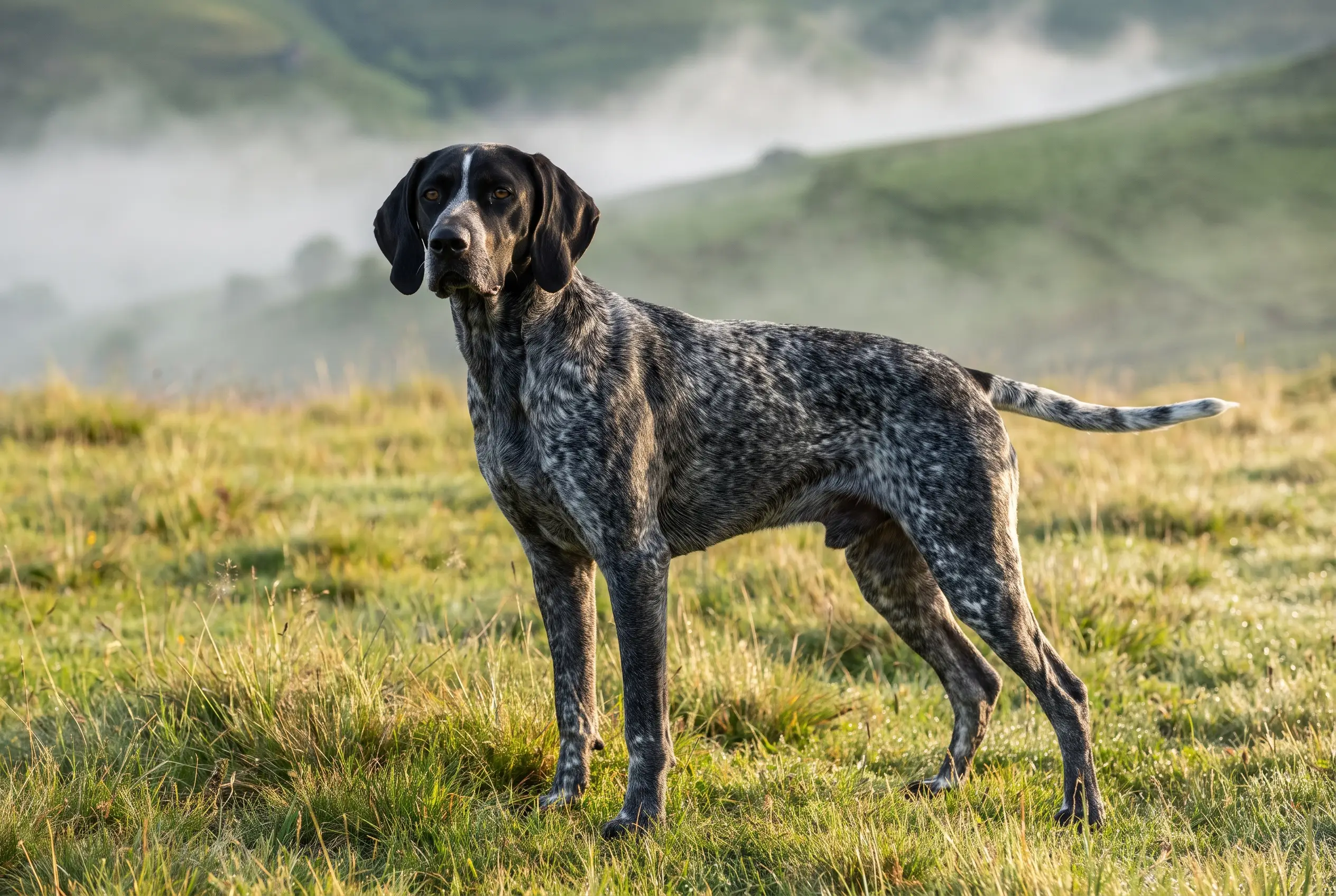
Braque d'Auvergne
The black-and-white pointer of the Cantal, galloping since before anyone wrote standards.
Vital stats
| Size | Medium-large · 57–63 cm (dogs), 53–59 cm (bitches) |
| Weight | 22–28 kg — breed literature; the standard sets none |
| Life expectancy | 12–15 years — breed literature, not survey data |
| Energy | High — 2+ hrs/day, with free running |
| Shedding | Moderate — short coat, a weekly brush |
| Coat | Short, shiny, never hard · black with white markings, flecked or greying |
| Group | Sporting · Continental Pointing Dogs, braque type (FCI №180, Group 7) |
| Origin | Auvergne (Cantal), France |
Breed traits
Friendliness
Care
Mind
Temperament
Gentle, very affectionate, intelligent and obedient: the standard's behaviour section is four adjectives long, and it closes with the line that matters for households — it adapts well to family life. It is a hunter's dog all the same. The same page asks for a powerful nose and says training consists mainly of developing its natural qualities, which in practice means the pointing, the ranging and the scent obsession arrive pre-installed, and your job is to give them somewhere to go. Breed literature adds two honest notes the standard does not: the Auvergne matures slowly, and it likes to talk — expect commentary when it is excited or under-occupied. It is also a sensitive gundog that works for warmth and rewards; heavy handling shuts it down.
Habits & quirks
Black and white, full stop
The colour section allows exactly one scheme: black with white markings, in two recognised types, flecked or greying — and a judge may not use the difference to split two dogs of equal quality. Entirely black, entirely white, absence of flecking, tawny marks and 'burnt bread' glints all disqualify, along with an unpigmented nose and yellow 'hawk' or wall eyes.
No dewclaws, either way
The standard disqualifies the presence of dewclaws — and also traces of their removal. A dog is expected to be born clean-legged, which is rare wording even among the braques.
Ears low and satiny
Set towards the rear and hanging below the line from nose to eye at rest, slightly turned inward, rounded at the tip, and long enough, drawn forward, to reach the root of the nose. The standard calls the leather supple and slightly satiny; set too high, too short or corkscrewed counts as a severe fault.
A rocking gallop
Its habitual hunting gait is an average gallop, regular and slightly rocking — the standard's own words — at a sustained rhythm the same text credits for the breed's notorious endurance. This is a dog conformed to cover long distances on the most difficult terrain, all day.
Care
| Exercise | Two hours a day or more, with genuine free running. This is a pointing breed judged with a working trial and shaped to gallop across hard country from morning to evening; hunting, field trials, canicross or long off-lead hill walks all fit. A nose this good needs employment — scent games count as work. |
| Grooming | A weekly session with a stiff bristle brush keeps the short, shiny coat in order, and shedding stays moderate. The real maintenance is the ears: long, low-hung and folded against airflow, they need a regular look and a clean, especially after a day in cover. |
| Training | The standard says training consists mainly of developing its natural qualities, and that is the honest method: channel the pointing and the nose rather than fight them. Keep sessions short, rewards real and hands soft — this is a sensitive breed — and start recall early, because breed literature has it maturing slowly. |
| Health | Breed literature reports no widely recognised breed-specific problems, and there is no breed-wide survey behind the 12–15 years usually quoted. Outside France the population is small, so ask breeders about hip scoring and pedigree depth — sensible practice for any pointing breed rather than a documented scheme requirement. |
Common questions
Why is it nicknamed Bleu d'Auvergne?
Because of the greying coat type — grisonnée in the French standard — where black ticking runs so dense through the white that the whole dog looks blue-grey. The nickname is the same as the region's blue cheese, which confuses search engines and nobody else. The standard itself claims no blue at all: black with white markings, flecked or greying, and the two patterns rank equally in the ring.
How is it different from the other French braques?
France keeps several pointing braques — the Braque français in two sizes, the Bourbonnais, the Saint-Germain, the Ariège — and most of them wear liver, chestnut or orange. The Auvergne alone is strictly black and white, with low-set satiny ears and its own regional history: the standard has it in the Cantal for more than two centuries, from a common pointer stock refined by selection in which, in the standard's careful wording, the Knights of Malta might have participated.
Are they good family dogs?
The standard says it directly: a gentle dog, very affectionate, that adapts well to family life. The caveats are the ones that come with any working pointer — a two-hour daily exercise bill, a nose that will follow a scent out of the county without early recall work, and, per breed literature, a voice it enjoys using.