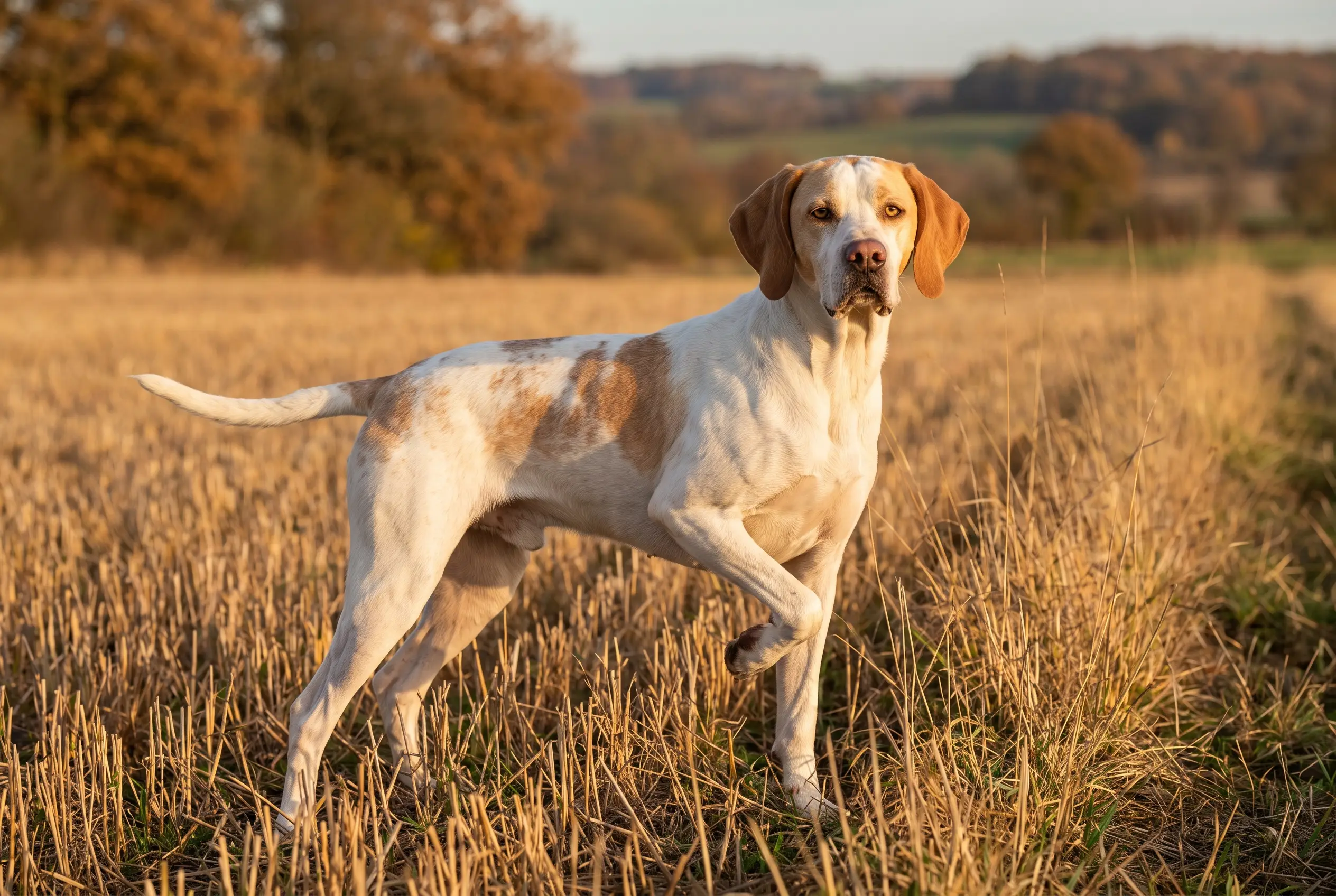
Braque Saint-Germain
The royal kennels' fawn-and-white pointer, golden-eyed by rule, with black banned down to the toenails.
Vital stats
| Size | Medium-large · 56–62 cm (dogs), 54–59 cm (bitches) |
| Weight | 18–25 kg — breed literature; the standard sets none |
| Life expectancy | 12–15 years — breed literature, not survey data |
| Energy | High — a galloping gundog that needs real field time |
| Shedding | Light to moderate — short coat, year-round |
| Coat | Short, not too fine · dull white with orange (fawn) markings, fawn ears |
| Group | Sporting · Continental Pointing Dogs (FCI №115, Group 7) |
| Origin | France |
Breed traits
Friendliness
Care
Mind
Temperament
The standard opens its temperament clause with 'hunter above all', then spends the rest of it on gentleness: very sociable, equable and affectionate, easy to train, and a dog that 'won't suffer brusque treatment' — a warning against rough handling written into the breed's own text. In the field it hunts pheasant, partridge and woodcock with passion on any terrain, quests at an average range rather than the horizon-chasing sweep of its English Pointer ancestor, and retrieves with a soft mouth. At home the standard calls it very close to man, happiest living with the family, and owners should take that literally: this is a house companion that hunts, not a kennel dog. The engine is still a gundog's, so a bored, under-run Saint-Germain will invent work of its own.
Habits & quirks
Not one black hair
The general appearance clause says it plainly: fawn and white 'without any black being present'. Black on the nose, lips, palate or even in the toenails is a disqualifying fault — the whole dog runs on pink and fawn pigment.
Golden eyes, in writing
The standard wants well-open, golden-yellow eyes with a 'candid and mild' look. Lemon eyes are a fault; brown or black eyes disqualify outright, which makes this one of the few breeds where a brown-eyed dog cannot be shown.
Feather first
The utilisation line reads 'principally on feather', and the temperament clause names the birds: pheasant, partridge and woodcock, on any terrain, brought back with a soft mouth. Fur is allowed work, but birds are the job.
Handle it gently
'Won't suffer brusque treatment during its training' is the standard's own phrasing. This is a soft-tempered gundog that shuts down under harsh corrections and, everything considered, trains easily without them.
Care
| Exercise | Plan on an hour or two of free running a day — the standard's normal gait is the gallop, supple and made to be maintained. Field work, dummy retrieves or nose games meet the pointing instinct; lead walks alone leave it half spent. The standard says nothing on hours; this is standard practice for a working pointer. |
| Grooming | The short, not-too-fine coat is as easy as dog coats get: a weekly rubber-mitt once-over, more during moults, and a check of the long, creased ears after cover work. Baths only when it has found something to roll in. |
| Training | Easy by the standard's own account, provided the handler stays soft: reward-based methods, short sessions, no harsh corrections. Start steadiness to birds and recall early — the passion for pheasant and partridge does not wait for permission. |
| Health | A hardy gundog with no breed-wide health survey; the population is small, so ask breeders about pedigree depth and hip results. That advice is general good practice for pointing breeds, not a documented club scheme — flag, not fact. |
Common questions
Is the Braque Saint-Germain related to the English Pointer?
Directly. The standard's history section describes the breed as descended from an English pointer crossed with a continental pointer, around 1830 in the royal kennels at Compiègne and then Saint-Germain-en-Laye, the town that named it. The English side shows in the outline and the gallop; the continental side in the closer quest, the fawn-and-white coat and the softer temper.
How rare is it?
Genuinely rare, and almost entirely French. Breed sources report around forty LOF registrations a year — 44 in 2024 — and estimate fewer than 500 living studbook dogs, with breeding outside France anecdotal. It was the opposite once: the most shown pointing breed at France's first dog shows in the 1860s.
Is it a good family dog?
The standard says so in as many words: very sociable, equable, affectionate, very close to man, and a dog that appreciates living with the family. The honest caveats are a gundog's exercise bill, a hunting passion that needs managing around birds, and the practical difficulty of finding one at all outside France.