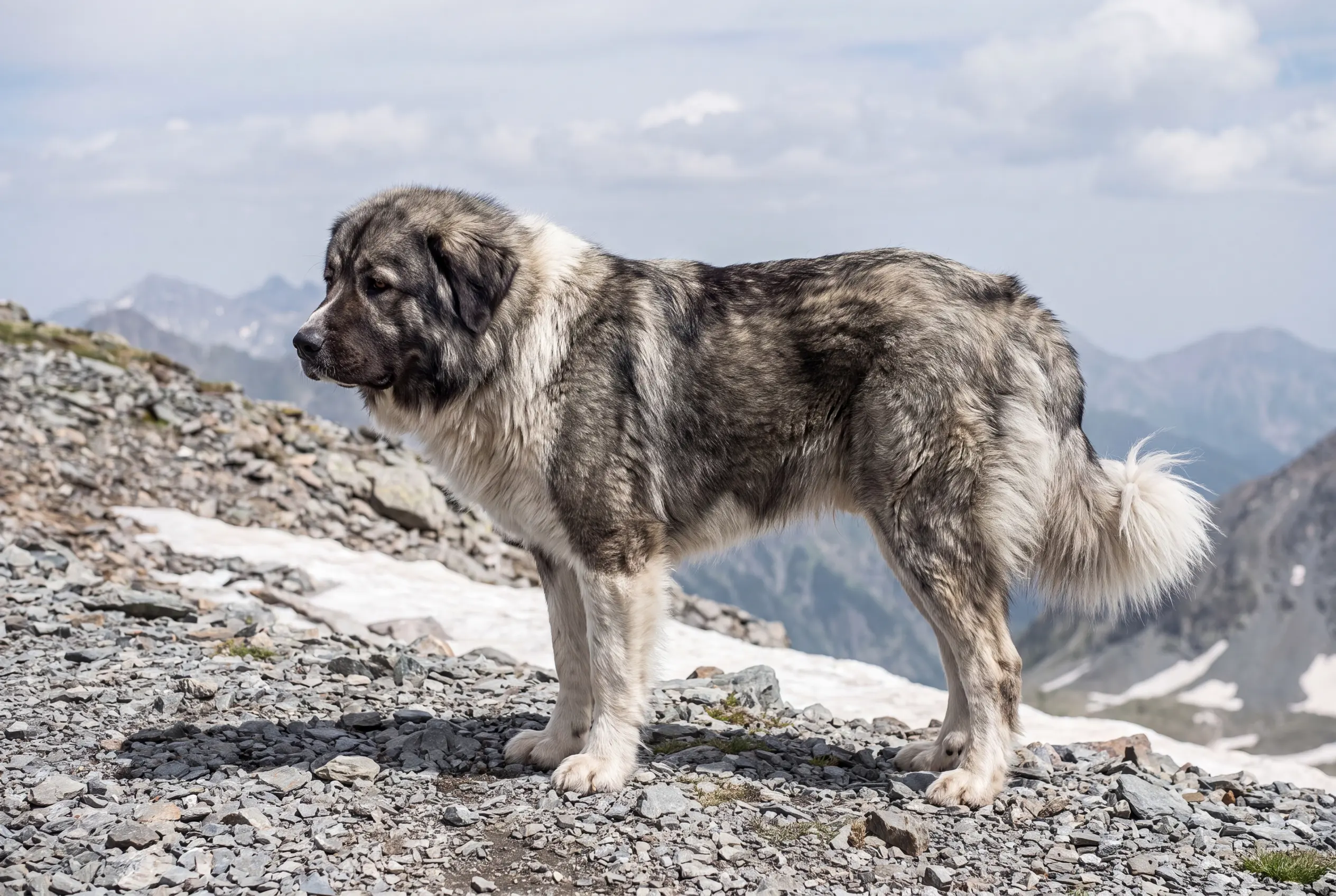
Kavkazskaïa Ovtcharka
Built for Caucasus winters, and for making the call alone.
Vital stats
| Size | Giant · males minimum 68 cm, desirable 72–75 cm · females minimum 64 cm, desirable 67–70 cm |
| Weight | A floor, not a range · minimum 50 kg males, 45 kg females · no upper limit |
| Life expectancy | 10–12 years |
| Energy | Low — unhurried by design, and it spends nothing it does not have to |
| Shedding | Heavy — guard coat and undercoat both over 5 cm, dropped hard twice a year |
| Coat | Straight, coarse, stand-off double coat · any colour except black in any variation |
| Group | Working · Mountain Dog (FCI №328, Group 2) |
| Origin | The Caucasus Range and the steppes of southern Russia |
Breed traits
Friendliness
Care
Mind
Temperament
The standard's own list runs steady, active, self-confident, fearless and independent, then adds a devoted attachment to its master. Independent is not a softening word here. This is a dog bred to hold a mountain pasture at night with the shepherd asleep, work out for itself what a sound on the edge of the ground means, and act on it without being told. It does not check in, and it will not hand the decision back to you. What the standard is just as clear about is that it does not want a nervy dog. Lack of self-confidence sits among the severe faults, and dogs that are aggressive or overly shy are disqualified outright. A correct Kavkaz is slow, hard to rattle and slow to escalate, and then entirely committed once it has decided something is a threat. Day to day that reads as a dog lying where it can see the way in, ignoring whatever it has already filed as harmless, and treating each new arrival as a question it will answer itself unless you answer it first. Warmth goes to its own household and stops there. Dogs of the same sex are a common flashpoint. And the ground it claims is the ground you live on, which is rarely the same shape as the ground you fenced.
Habits & quirks
The coat is written as a number
Most standards describe a coat. This one measures it: guard hair and undercoat not less than 5 cm, straight, coarse and standing off the body, with brushes on the ears, a mane at the neck and trousers behind the thighs. The history section explains why, listing a dense waterproof coat among the qualities Soviet breeders selected for so the dog could work in the most severe conditions. A Kavkaz is comfortable outdoors in weather that sends most breeds inside, and correspondingly miserable in a warm flat in August.
Thick skin, no folds
The skin clause reads thick, sufficiently elastic, without any folds and wrinkles. That is unusual wording for a molossoid, and it is why this one does not trail water across the kitchen. There is no dewlap to keep dry and no hanging lip to wipe. Among the giant guardians it is one of the tidier dogs to live with, once you have got past the hair.
Black is the one colour it cannot be
Any solid colour is allowed, along with piebald and spotted dogs, which covers most of the greys, fawns, reds and creams you will see. Black is the exception, and the standard is thorough about it: black in any variation, whether solid, diluted, piebald, spotted or carried as a saddle, is a disqualifying fault, as is tan marking on a black, blue or brown dog. A black mask is fine. A black Caucasian Shepherd advertised as rare is a dog that could not be shown.
The ears tell you where it was bred
Naturally the ears are moderate, thick, triangular and pendant, set high and wide. The standard notes that they are traditionally cropped in the country of origin and states plainly that natural ears are of equal value. Cropping is banned across most of Europe, so a cropped adult in a European litter photo is worth asking about.
Care
| Exercise and growth | Far less than the size suggests, and nothing fast. The standard describes free, elastic, unhurried movement with the trot as the typical gait, and an adult does well on an hour or so of steady walking spread across the day, on ground rather than pavement. Growth is where the damage gets done. A puppy putting on this much weight this quickly needs stairs, jumps and forced distance kept off the menu well past its first birthday, and a giant-breed growth diet with nobody trying to make it look impressive early. |
| Grooming | Two coats, both over 5 cm, and a big dog under them. A weekly session with a rake and a slicker keeps it honest; through the seasonal drops it becomes a daily job, and the undercoat comes away in handfuls. The mane, the trousers and the brushes behind the ears are where mats form, so check them by hand rather than by eye. Never clip the coat down to cool the dog, because it insulates both ways. Manage heat with shade, water, and walking early and late. |
| Fencing and visitors | This is the part that decides whether the dog works out. Plan on solid fencing at least 1.8 m high, dug in at the base, with self-closing gates that latch and a way of reaching your front door that does not cross the dog's ground. Nobody should ever be let in while the dog is loose, so build a routine now: dog behind a door, guest in, dog introduced on lead if at all. Rehearse it until it is dull. All of the handling has to be taught at 25 kg, because at 70 kg there is no physical override available to anyone. Reward-based work is the only approach that goes anywhere; force produces a bigger problem in the same body. Socialise hard through the first two years, then keep managing introductions for the rest of the dog's life, because this is not a behaviour that gets trained away. It gets housed. |
| Health | Hip and elbow scores on both parents, non-negotiable at this weight, plus a cardiac check. Eyes deserve a proper look: entropion is a disqualifying fault in the standard, and slack eyelids and haw sit among the severe faults, which tells you where the breed has form. A chest this deep carries real gastric torsion risk, so split meals, keep exercise away from them and learn the signs before you need them. Budget honestly too, since anaesthesia, medication and food all scale with the dog. |
Common questions
Should a first-time owner consider a Caucasian Shepherd Dog?
No, and there is no useful way to soften that. The problem is not that the breed is difficult to train, though it is. It is that everything you get wrong is attached to 70 kg of dog that was selected to decide things without a handler present. A first dog is where you learn to read body language, misjudge a greeting, discover your fence has a gap, and find out what your dog does when a delivery driver walks in unannounced. Those are ordinary, survivable mistakes with a spaniel. With a Kavkaz they involve a hospital or a court. There is also the paperwork: the breed is banned outright in Denmark and restricted elsewhere, and insurance, rented housing and travel all get harder. People who do well with this breed have usually kept a large guardian breed already, have land rather than a garden, have neighbours at a distance, and want this dog specifically rather than a big impressive one. If what you actually want is a large, calm, family-friendly dog, several breeds will give you that without asking for any of the above.
Did Caucasian Shepherds guard the Berlin Wall?
Some did, and the popular version of the story overstates it badly. East German border troops used Caucasian Shepherds among their service dogs on the inner-German border and in Berlin, and after 1989 dogs from that programme went into German households, which is part of why the breed has a foothold in Germany at all. German reporting on the Grenztruppen describes the animal welfare federation arranging the placement of roughly 2,500 of the remaining dogs. What does not hold up is the figure repeated across English-language breed pages, that 7,000 Caucasian Shepherds guarded the Wall. German sources put the whole border service-dog population at around 6,000 across the entire frontier, not just Berlin, and name the German Shepherd as the main breed, with rottweilers, great danes and giant schnauzers alongside it. Real breed, real deployment, wrong number. Anywhere you see the 7,000 figure, assume it was copied rather than checked.
Is it legal to own one?
It depends where you live, and it is worth checking before you get attached to the idea. Denmark prohibits the breed under its Act on Dogs, where the Caucasian Shepherd is one of thirteen breeds listed since 1 July 2010; dogs owned before the law took effect are covered by transitional provisions. Several other countries and jurisdictions restrict rather than ban it, typically through muzzle and lead requirements in public, compulsory liability insurance, registration, or a handler competence test. The rules change, they are set nationally or regionally rather than internationally, and secondary lists circulating online are often years out of date. Ask your national kennel club and your local authority directly, and ask your insurer and your landlord before you ask a breeder. Import rules are a separate question again, and a legally bred dog in one country can be an illegal import in the next.