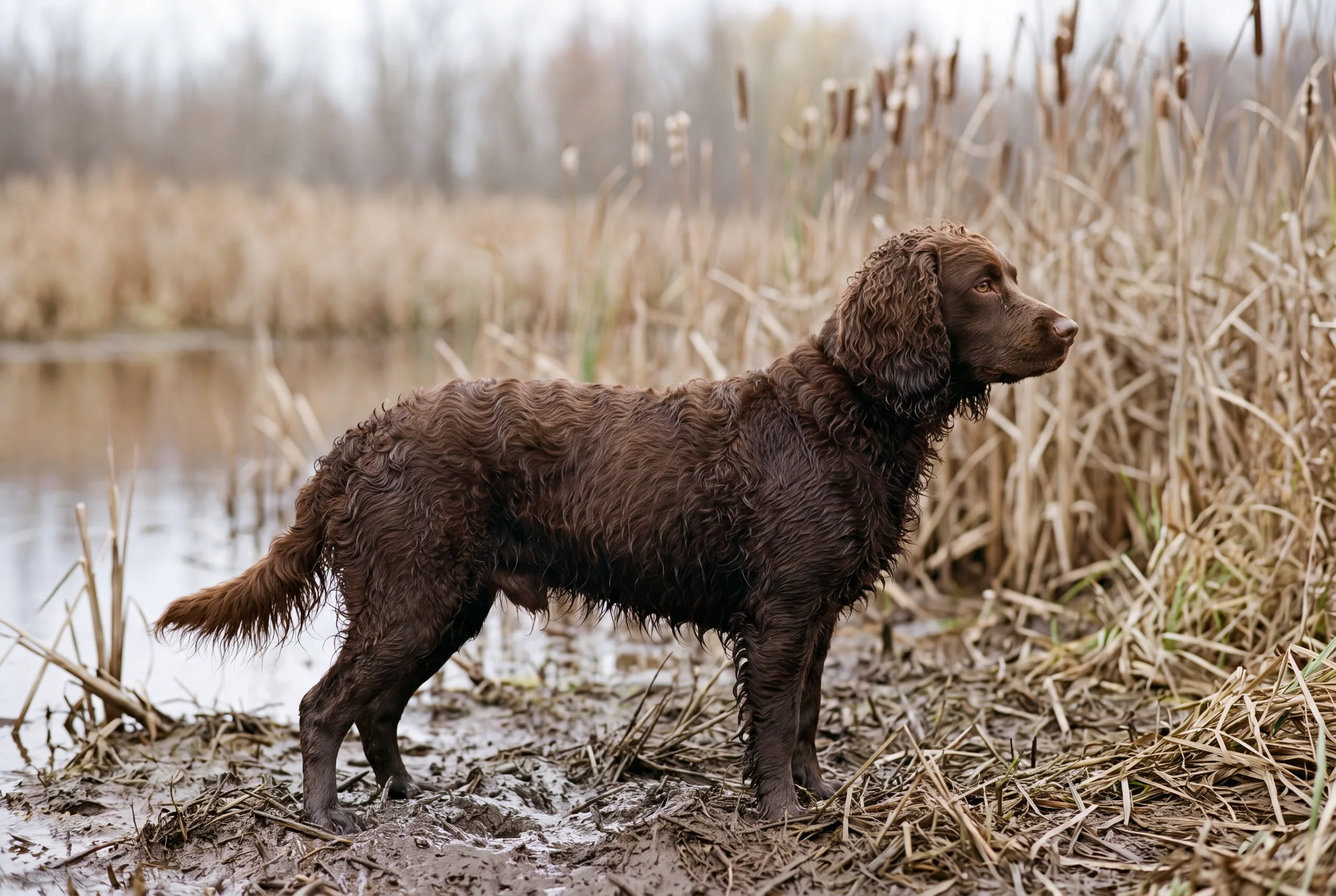
American Water Spaniel
Built to fit a duck skiff, and to get back in with the bird.
Vital stats
| Size | Medium · 38–46 cm |
| Weight | 11–20 kg |
| Life expectancy | 10–14 years |
| Energy | High — a full day's hunting dog in a 20 kg frame |
| Shedding | Low to moderate — the curls hold on to the hair |
| Coat | Marcel wave to close curl over dense undercoat · solid liver, brown or dark chocolate |
| Group | Sporting · Water Dog (FCI №301, Group 8) · AKC |
| Origin | Fox and Wolf river valleys, Wisconsin, USA |
Breed traits
Friendliness
Care
Mind
Temperament
The FCI standard describes intelligence, eagerness to please and a friendly demeanour, then adds the line that matters: great energy and eagerness for the hunt, yet controllable in the field. That is the breed in one sentence. An AWS wants to work with someone rather than be sent off to work alone, and the drive stays switched on without running away with the dog. Indoors it is a close-range companion that follows you from room to room and copes badly with long days by itself; leave one shut in and you come back to barking, digging and a chewed door frame. It is much warmer with its own family than with visitors, where the AKC's own description settles on aloof. Some lines are stubborn about repetition and some guard a food bowl, and both are far easier to head off at ten weeks than at two years.
Habits & quirks
Sized around a boat
Everything about the dog was fixed by the skiff: 38–46 cm, 11–20 kg, light enough to shift its weight without rocking the hull, with webbed feet and a rocker-curved tail. It is the one gundog that was designed by the vehicle it worked from.
Works close
It quarters inside gun range and keeps checking back instead of casting out to the far hedge. Handlers who have run pointers usually find the AWS almost too attached, which is exactly what a man alone in a canoe wanted.
Has plenty to say
Barking at the door, grumbling at the postman and a low running commentary while it works are all normal here. It is not a breed for a flat with thin walls unless somebody teaches an off switch in the first year.
Prefers November to July
The undercoat exists for cold water, and a lot of owners find their dog visibly happier in the wet months. Dock diving, gundog training and scent work all land well; a hot afternoon on a lawn does not.
Care
| Exercise | An hour to ninety minutes a day, and it should involve water, retrieving or nosework rather than pavement loops. A bored American Water Spaniel finds its own work, usually in the flower beds. |
| Grooming | Brush the curls out twice a week and check behind the ears, which mat first and hide the ear canal. The coat carries a natural oil that keeps the undercoat dry and can smell frankly doggy by the end of a wet week; washing it often strips that protection, so most owners bath a few times a year and live with it. |
| Training | Reward-based and short. The breed learns quickly, switches off under heavy handling, and a fair number will guard a bowl or a stolen sock if nobody worked on it as a puppy. Socialise widely and early: reserve with strangers is normal for the breed, nervousness is not. |
| Health | The AKC parent club, the American Water Spaniel Club, asks breeders for a hip evaluation, a cardiac exam and an eye certificate from a board-certified ophthalmologist. Cataracts and progressive retinal atrophy are the two to ask about by name; hypothyroidism and skin allergies also turn up in the breed. |
Common questions
Is an American Water Spaniel a sensible pet if I never hunt?
It can be, as long as you replace the job. This is a dog bred to spend a cold morning working for one person, and the brain and drive that made it useful in a marsh do not switch off in a living room. Owners who do gundog training, scent work, dock diving or long daily walks with retrieving games get an affectionate, biddable, medium-sized companion that fits a normal house. Owners who leave it alone from eight until six get barking, digging and destroyed furniture, because the breed handles separation badly. Company is not an optional extra with an AWS.
Does the coat really smell?
A bit, and that is the coat doing its job. The oil in a curly water dog's coat is what keeps the undercoat dry in cold water, and after a wet week the dog smells like a dog. Brushing twice a week, drying it properly after swimming and keeping on top of the ear canals handles most of it. Frequent shampooing strips the oil and the coat takes weeks to come back, so breeders generally advise a handful of baths a year rather than a monthly routine.
How hard is one to get hold of?
Hard, and harder outside the United States. The AKC registers fewer than 200 a year and ranks the breed 167th of 202; estimates put the whole population near 3,000 dogs, concentrated in Wisconsin and the upper Midwest. Waiting lists of a year are ordinary and most litters go through the American Water Spaniel Club's breeder referral. In Europe the numbers are small enough that you are realistically looking at an import. Anyone offering AWS puppies straight away is more likely selling a brown curly crossbreed.