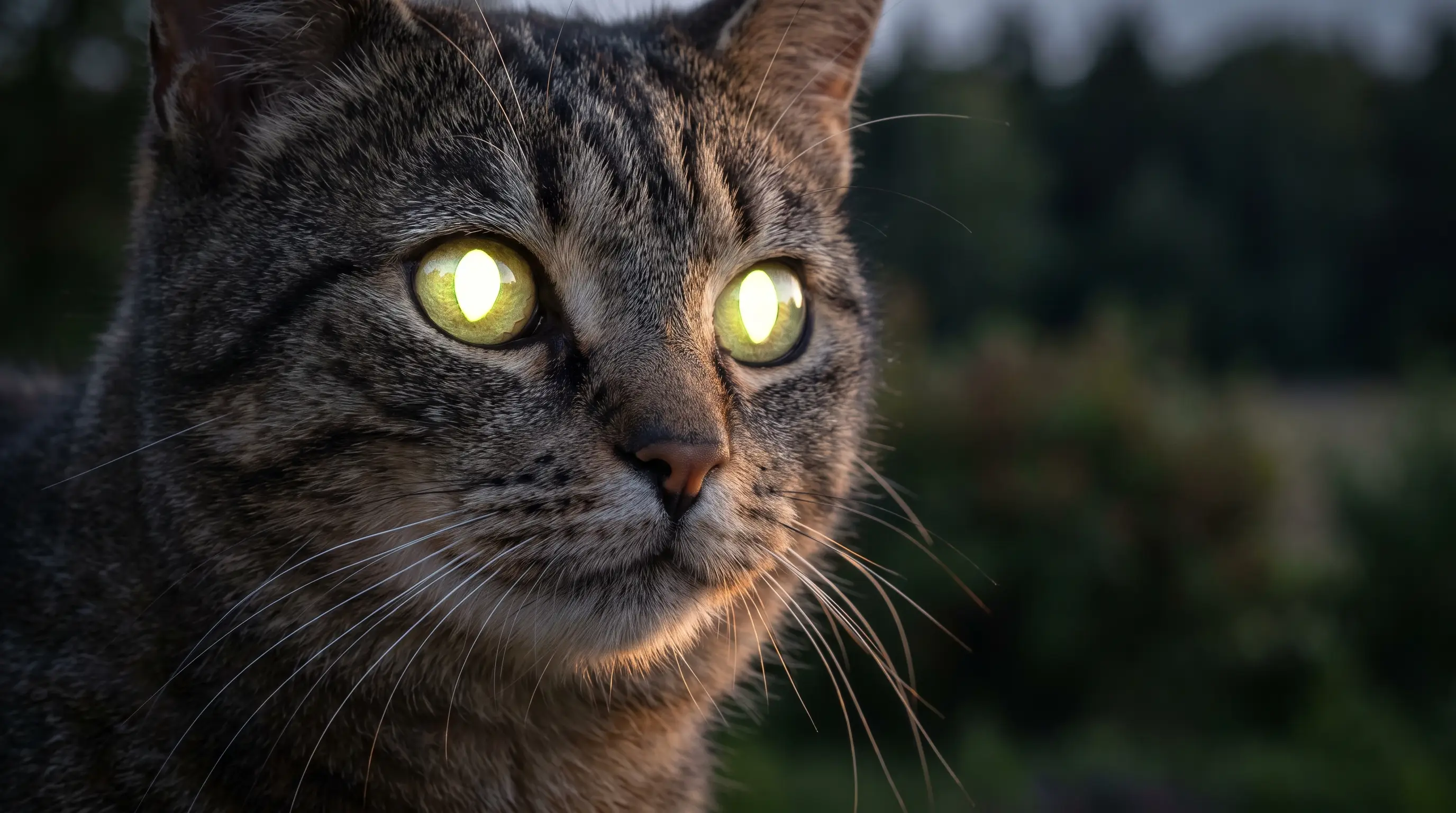
Why cats' eyes glow in the dark, and what they see
Cats' eyes glow in the dark because of the tapetum lucidum, a mirror-like layer behind the retina that bounces light back through the eye's light-sensing cells. Any light the cat didn't catch on the way in gets a second pass on the way out, and the fraction that escapes back toward you is the glow, or eyeshine, that you see. It roughly doubles the light a cat's eye can use in dim conditions. What it does not do is let a cat see in pitch black.
The tapetum lucidum
The tapetum lucidum is a reflective layer of cells sitting just behind the retina, and it works like a mirror aimed back at the eye's photoreceptors. Light enters the pupil, passes through the retina, and normally most of what the photoreceptors miss would be absorbed and lost at the back of the eye. In a cat, the tapetum reflects that leftover light straight back through the retina, giving the rods and cones a second chance to catch photons they missed the first time. Researchers describe this double pass as roughly doubling the eye's sensitivity in low light. The reflective pigment in a cat's tapetum is built partly from riboflavin, a B vitamin, which is one reason the returned light skews toward a specific green-gold wavelength. Humans have no tapetum, which is why our eyes never do this, and why a camera flash gives us red-eye instead: with no mirror, the flash bounces off the blood-rich retina and comes back red.
The eyeshine you notice at night is simply the small share of that reflected light that leaves the eye pointed back at the light source, whether that's a car's headlights, a phone torch, or a flash.
Eyeshine colors
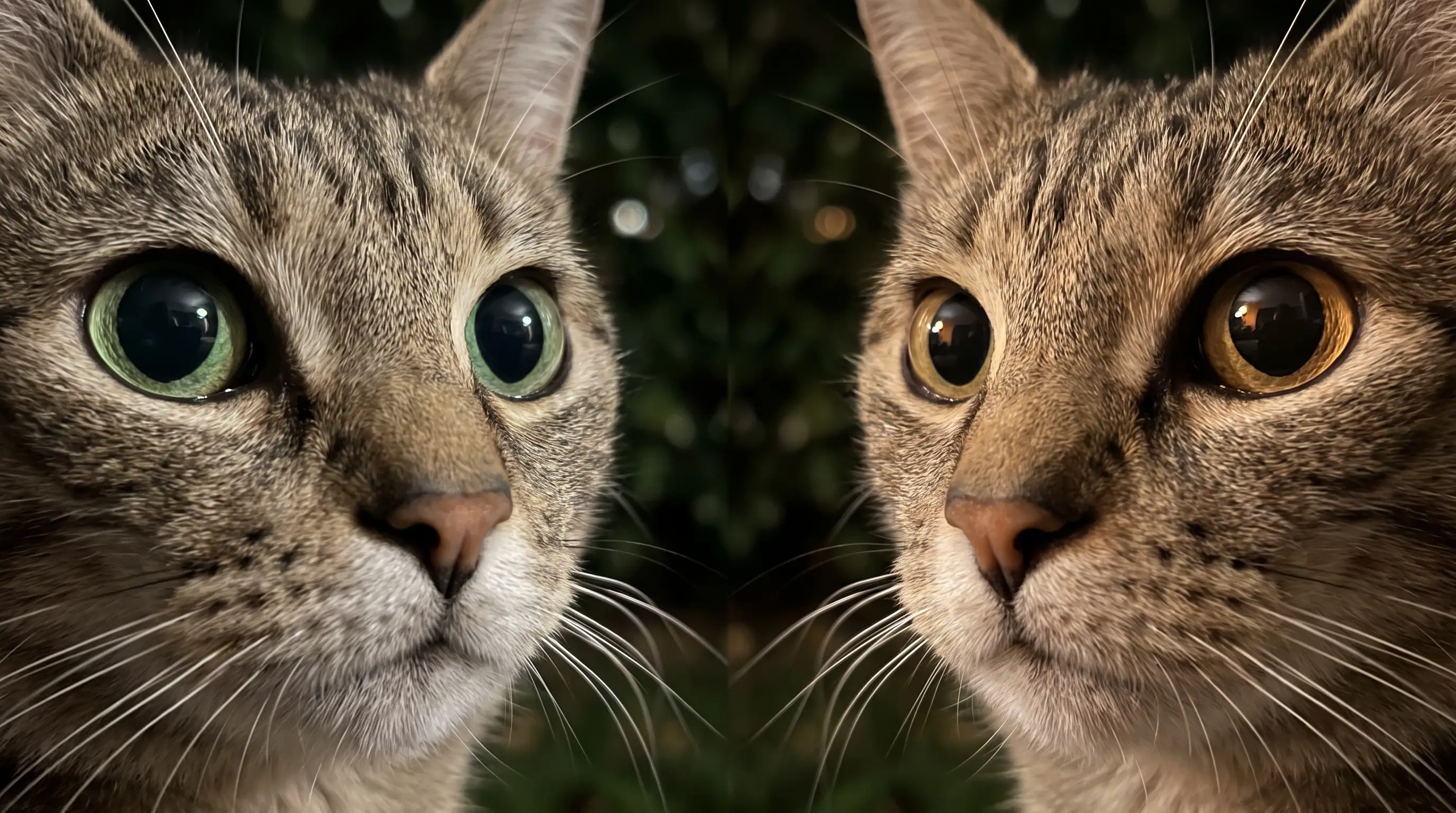
Eyeshine is usually green or gold, sometimes closer to yellow, and occasionally reddish, and the color depends on the cat rather than a trick of the light. The exact hue comes from the pigments and cell structure in that individual's tapetum, and it can shift with the angle the light hits. Kittens often flash a bluish or violet shine that settles toward yellow-green as they mature. The odd exception is red eyeshine: some cats, particularly blue-eyed white cats and certain colorpoint breeds like the Siamese, have a poorly developed tapetum or none at all, so instead of a mirror-bright glow you see red light bouncing off the blood vessels of the retina, the same effect that gives people red-eye in photos. So if your cat's eyes flash red in a photo while another cat's flash green, that's normal variation, not a health problem on its own.
How well cats see in the dark
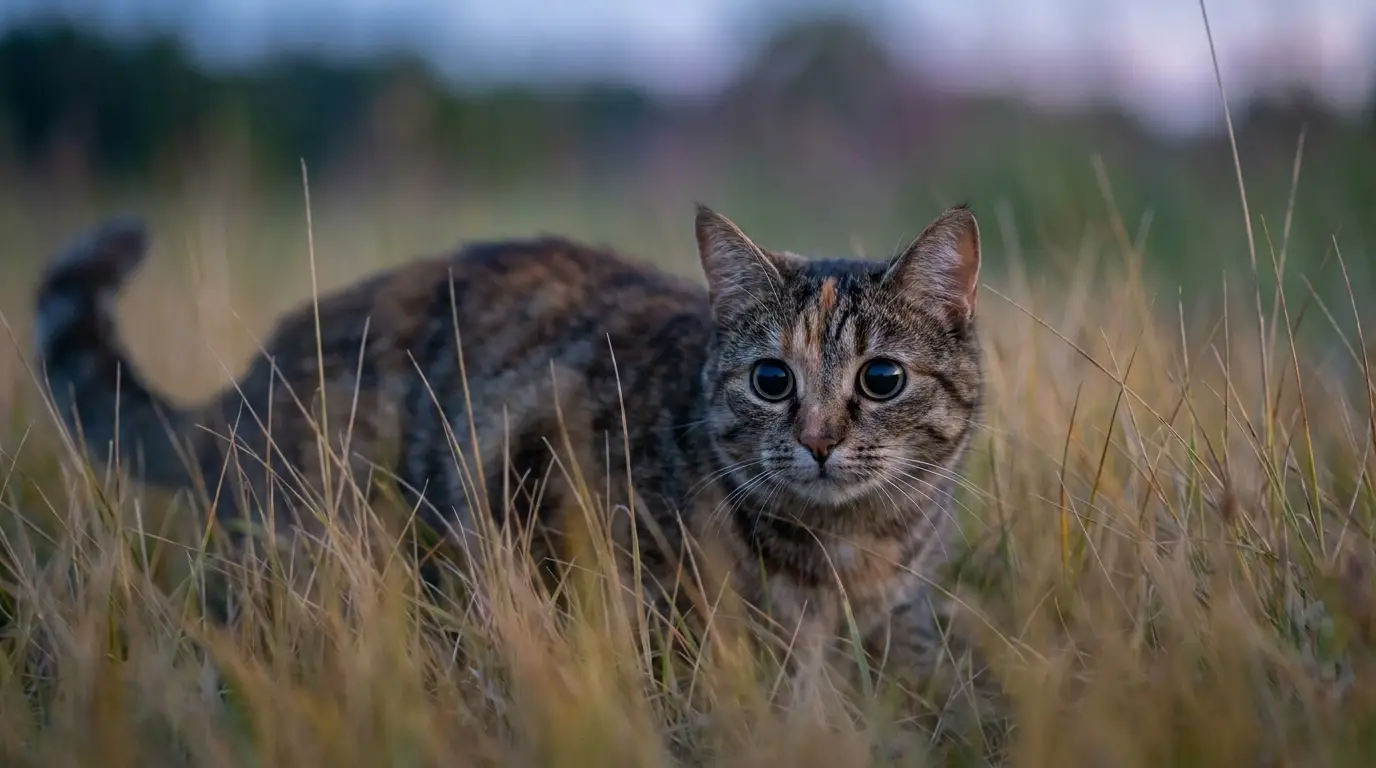
Cats see roughly six to eight times better than humans in dim light, needing only about one-sixth of the illumination we do to make out a scene. Two things drive this: the tapetum recycling light, and a retina packed with far more rod cells than ours. Rods handle low light and motion, and cats carry them in bulk, which suits an animal built to hunt at dawn and dusk. Cats are crepuscular, most active in the low, slanting light of those twilight hours, exactly when the tapetum earns its keep and prey is on the move. But the popular claim that cats see in total darkness is false. Vision, feline or human, needs photons to work with, and no mirror can reflect light that isn't there. Put a cat in a truly sealed, lightless room and it is as blind as you are, falling back on whiskers, hearing, and smell. Their wild relatives run on the same hardware, as the wild cats they descend from show.
What cats actually see
Cats see a muted, blue-and-yellow version of the world with soft detail, not the sharp, full-color picture people imagine. They are dichromats, with two types of cone cells rather than our three, so they read blues and yellows fairly well but see reds and pinks poorly, often as a dull gray or greenish tone. It is a washed-out palette, not black-and-white. The bigger trade-off is sharpness. A cat's visual acuity runs somewhere around 20/100 to 20/200, meaning detail a person sees clearly at 100 to 200 feet a cat has to be within about 20 feet to resolve. Distant things look soft. They also can't focus sharply on anything right in front of their nose, which is part of why whiskers matter so much for judging close objects and prey. What cats give up in color and detail they get back in coverage and motion: a field of view near 200 degrees against our 180, and an eye tuned to catch the smallest, fastest twitch. A breed bred toward that hunting build, like the Bengal, shows the instinct plainly, locking onto a flick of movement most people would miss.
Slit pupils
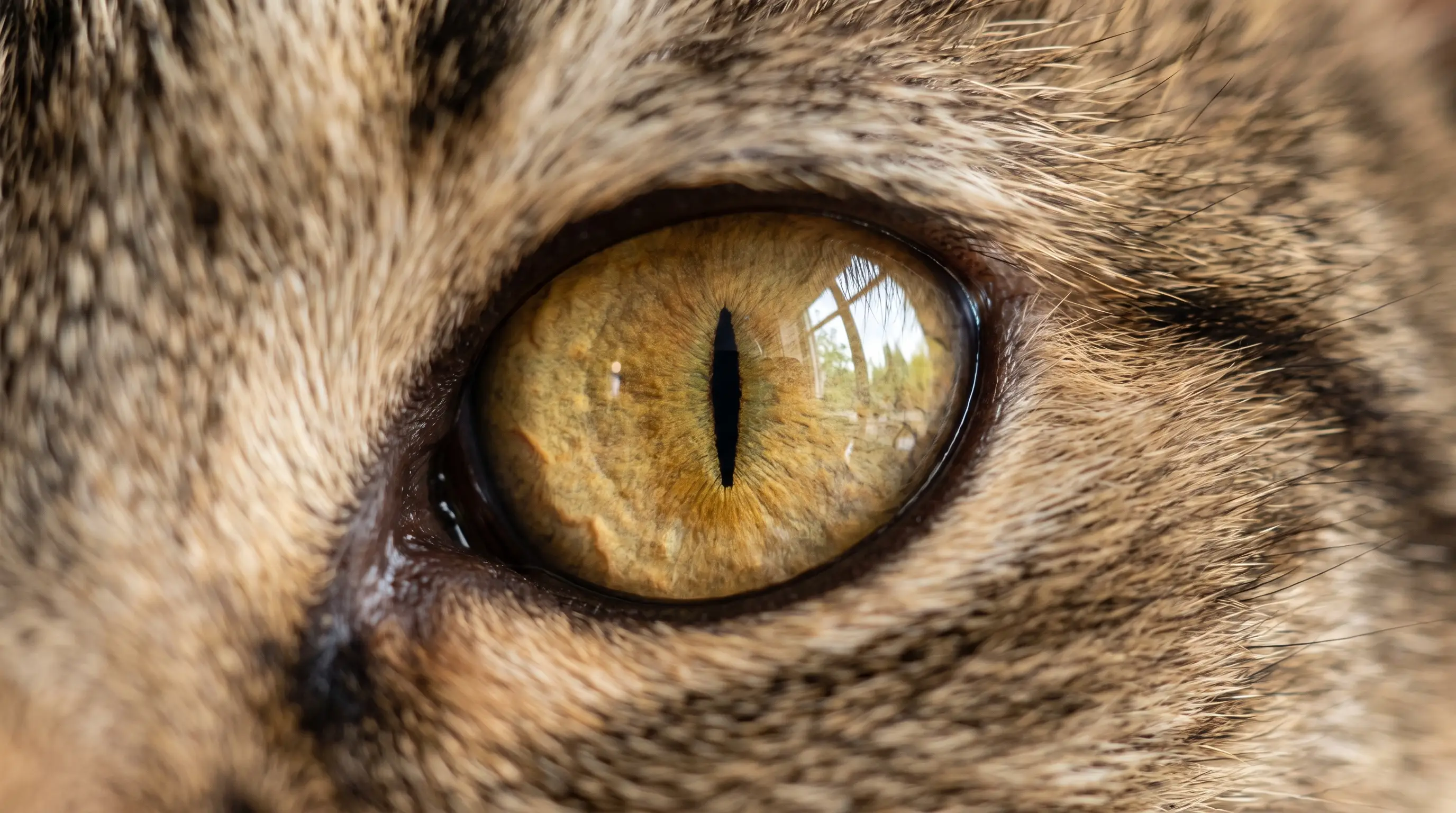
A cat's vertical slit pupil is a light valve that opens far wider and clamps down far tighter than a human pupil can. In dim light it dilates to an almost perfect circle, swallowing the eye to pull in every available photon and feed the light-hungry rods behind it. In bright light it closes to a thin vertical slit, cutting the incoming light to protect a retina that evolved for darkness and is easily overwhelmed. The range is dramatic: a cat's pupil area can change up to about 135-fold between its widest and narrowest, where a human pupil manages roughly 15-fold. That slit shape, combined with the tapetum, is the whole reason a cat can hunt comfortably at dusk and then nap in a sunbeam without being dazzled. Watch your cat's eyes shrink to slits at a window and blow wide open the moment the lights go down, and you're watching the same system that makes the eyes glow doing its day job.
Common questions
Why do cats' eyes glow in the dark?
They glow because of the tapetum lucidum, a reflective layer behind the retina that bounces unabsorbed light back through the eye's photoreceptors. The share of that light that escapes back toward you is the glow, and it also gives the cat a second chance to use dim light.
How do cats see in the dark?
Cats see about six to eight times better than humans in low light, needing roughly one-sixth of the illumination we do. They manage this with a retina rich in rod cells plus the tapetum lucidum, which recycles light that would otherwise be lost.
Can cats see in total darkness?
No. Cats cannot see in complete darkness, because vision needs some light to work with and no reflective layer can amplify light that isn't there. In a truly lightless room they rely on whiskers, hearing, and smell instead.
What colors can cats see?
Cats are dichromats and see mainly blues and yellows, with reds and pinks appearing dull or greenish. It is a muted, washed-out palette rather than true black-and-white.
What does my cat see when it looks at me?
A cat sees you in soft focus and limited color, since its acuity is around 20/100 to 20/200 and it reads blues and yellows better than reds. It also picks up the smallest movements you make far more readily than fine detail.
Why do cats' eyes turn red in photos?
Red eyeshine appears in cats with a weak or absent tapetum lucidum, often blue-eyed white cats and some colorpoint breeds. Instead of the usual green-gold mirror glow, the flash reflects off the blood vessels of the retina and comes back red.
More in Cats
Can you take your cat to the beach? An honest guide
Most cats should skip the beach, and a few can go safely. The honest, vet-checkable guide to heat, sun, saltwater, harnesses and who stays home.
What Catnip Really Does to a Cat
The honest, myth-busting guide to catnip: what nepetalactone does, why 1 in 3 cats ignore it, and what to try instead.
You Found a Stray Cat: What to Actually Do
A friendly cat on your doorstep may already have a home. Here is the honest, welfare-first order of steps before you take it in.