
Sandflies and leishmaniasis: what protects a dog
Canine leishmaniasis is spread by a sandfly two to three millimetres long that feeds in silence at dusk. Italians call it the pappatacio, roughly "it eats and keeps quiet", which tells you why nobody swats it. The mistake that costs dogs most is assuming an existing flea and tick product covers it. Most do not. Only topical pyrethroids repel a sandfly before it feeds, and a product that kills an insect after it has bitten is too late when a single bite can deliver the parasite. Here is what the insect does, what the disease does, and what genuinely reduces the risk.
The insect you never hear
A phlebotomine sandfly is 1.5 to 3.5 millimetres long, hairy, with big black eyes and long spindly legs, and it holds its wings up at an angle when it rests. Only the females take blood. They feed mostly at dusk and through the night, when the temperature drops and the humidity rises, and they will also bite indoors during the day in a darkened room. They fly badly, usually staying within a few hundred metres of where they hatched, and light wind is enough to keep them down.
Two details undo a lot of common advice. Sandflies do not breed in standing water, so emptying buckets and saucers, which is sound mosquito advice, does nothing for them; they lay in damp soil and rotting organic matter, in leaf litter, compost, wall cracks, animal pens and rubble. And they are small enough to pass straight through ordinary insect screens, which are made for mosquitoes; you need a mesh finer than a millimetre to stop them.
In temperate Europe the adults are only around in the warm months, roughly April to November depending on latitude. The traditional map, Mediterranean and no further, is out of date: sandfly vectors are established further north and higher up than they were a generation ago, with cases now recorded in northern Italian regions that used to be considered clear, and colonies confirmed in Ticino in southern Switzerland. Add the volume of dogs adopted from Spain, Greece, Portugal and Romania into Germany, the Netherlands and beyond, and this is no longer only a holiday-risk disease.
Your flea and tick product is probably not covering this
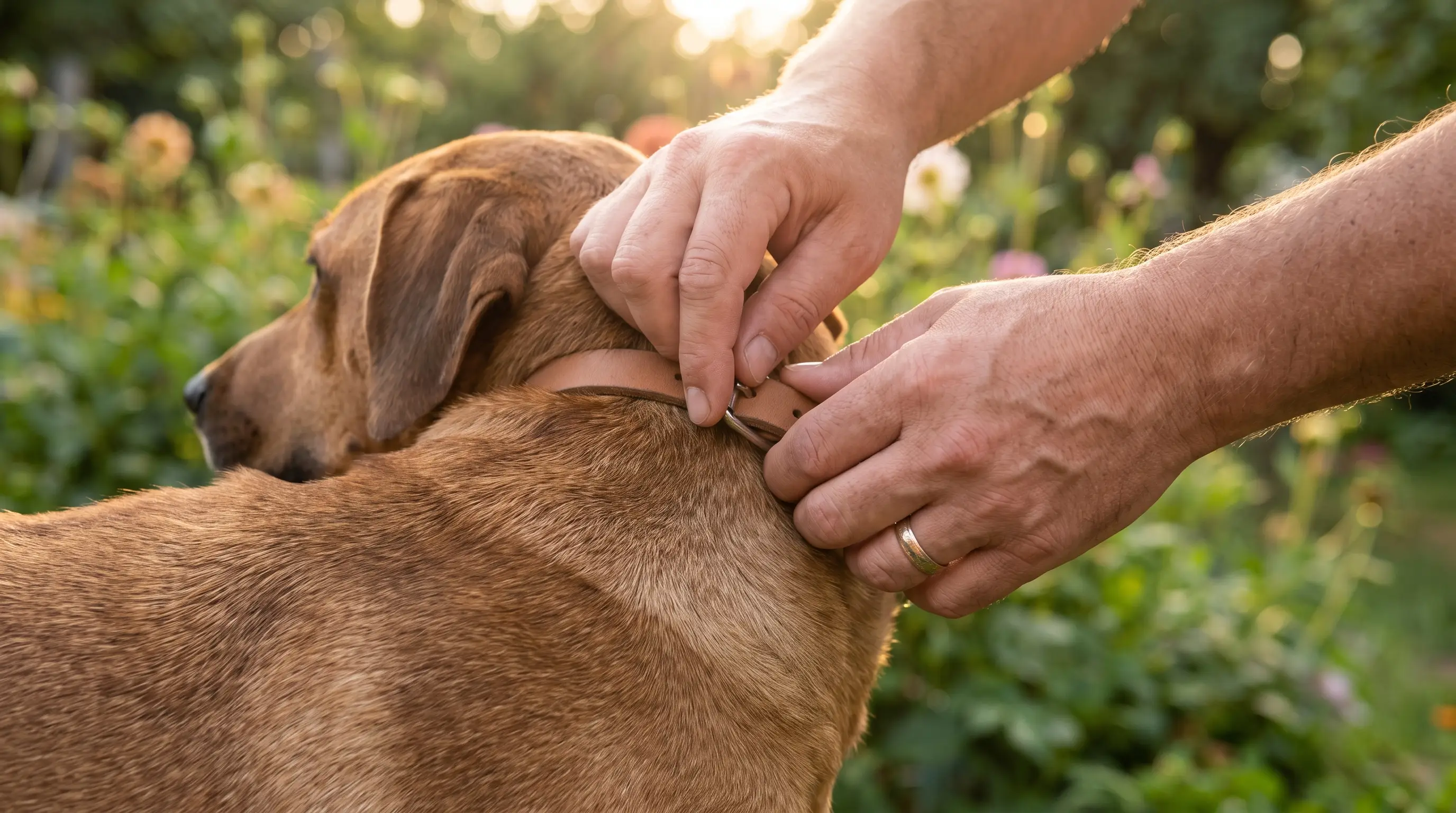
This is the part worth reading twice, because it is the most common and most expensive misunderstanding in the subject. Protection against leishmaniasis depends on stopping the bite, not on killing the insect. A modern oral chew is extremely good at killing fleas and ticks, and useless here, because the sandfly bites and then dies. The parasite is already delivered. Studies of oral isoxazolines are explicit that they do not prevent transmission to the individual dog and have no repellent effect.
What works is a topical pyrethroid with a stated repellent claim: permethrin, deltamethrin or flumethrin. A permethrin spot-on repels for about three to four weeks, so it needs reapplying every three weeks through the season, and it should go on at least two days before exposure. A deltamethrin collar should be fitted one to two weeks ahead and lasts months, up to a year for one product. An imidacloprid and flumethrin collar has shown reduced infection risk for up to eight months. In a field trial in an endemic area, a permethrin spot-on and a deltamethrin collar each cut infection risk by around 84% against untreated dogs.
So the practical test is to read the label for a repellent claim against sandflies or Phlebotomus, rather than assuming that because a product handles fleas and ticks it must handle this. If your dog lives outdoors in an endemic area, a livestock guardian like a Maremma Sheepdog sleeping out through summer nights is the highest-exposure animal there is, and the one for whom the collar-versus-chew distinction matters most.
One hard rule: permethrin must never be used on a cat, and should not be used on a dog that lives with one. Cats cannot process pyrethroids and the result can be tremors, seizures and death. A cat does not even have to be treated to be poisoned; grooming a freshly treated dog is enough. In a mixed household, choose a deltamethrin or imidacloprid-flumethrin collar and keep the animals apart until any topical has dried.
What the disease does, and on what timetable
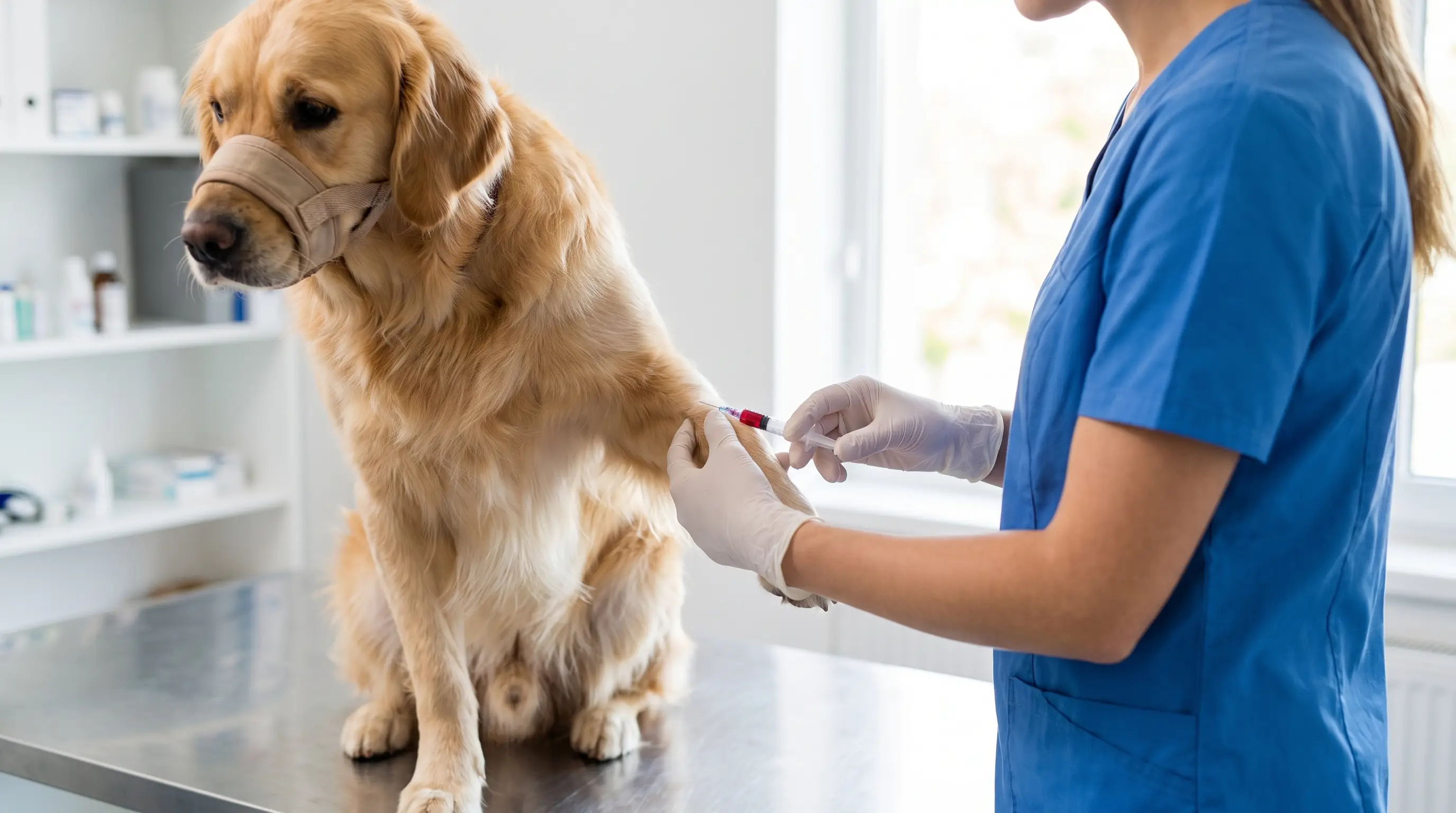
Leishmaniasis is slow, and that is what makes it hard to connect to a bite. The incubation period runs from months to years, so a dog bitten on an August holiday can turn up ill the following spring or two summers later. Infection is also not the same as illness: plenty of dogs in endemic areas carry the parasite without ever becoming clinical cases, held in check by their own immune response.
When it does declare itself, it usually starts on the skin. The classic picture is flaky, thinning hair around the eyes, muzzle and ear margins, giving a spectacled look, along with non-healing sores, nodules and abnormally long, brittle, overgrown claws. Beyond the skin: enlarged lymph nodes, weight loss and muscle wasting despite a normal appetite, lethargy, nosebleeds, and eye inflammation including uveitis.
The organ that decides the outcome is the kidney. Immune complexes damage the glomeruli, and the resulting kidney failure is believed to be the main cause of death. The version of that an owner can actually spot is a dog that suddenly drinks a great deal and asks to go out at night. If your dog lives in or has travelled to an endemic area, treat new heavy drinking as a reason to test, not to buy a bigger water bowl.
Diagnosis is a blood test, quantitative serology first, with PCR to measure parasite load. In endemic areas the guidance is to screen healthy dogs once a year; a dog that has travelled to one should be tested six months after the trip, because testing too early misses it. Seropositive dogs must never be used as blood donors.
It is not contagious the way owners fear
Your dog cannot give you leishmaniasis by licking you, sharing your bed or drinking from the same bowl, and it cannot give it to the other dog in the house that way either. The parasite has to complete part of its life cycle inside a sandfly before it can infect anything. That is the answer to the question everyone with children asks, and Germany's public health institute, which is careful about this, puts the human risk from imported dogs as very low.
The honest footnote is that there are documented routes that skip the insect, and they are worth knowing because they are the ones you can act on: blood transfusion, mother to puppies before birth, and mating. None of them is everyday household contact. Direct dog-to-dog spread has been reported as likely in a handful of cases and remains unproven, so the accurate line is not by ordinary contact, rather than impossible.
A positive test is also not a death sentence, and it is emphatically not a reason for euthanasia; the 2025 international veterinary consensus rejects putting dogs down for public-health reasons, and culling seropositive dogs has never been shown to reduce infection rates in dogs or people. Treatment, usually an antileishmanial drug alongside allopurinol for six to twelve months or longer, produces clinical remission rather than a cure. Most treated dogs still carry the parasite and can relapse, so they need monitoring every three to four months in the first year and then for life. Many live well for years, which is why an adopted dog from Spain or Greece with a positive result, a Ibizan Hound for instance, is a dog to manage rather than a dog to refuse.
The vaccine, honestly
There is a vaccine, and it does less than its name suggests. It does not stop sandflies biting and it does not prevent infection. What it is licensed to do is reduce the risk that an infected dog goes on to develop active disease. In the two-year field trial behind the current European product, 4.7% of vaccinated dogs developed clinical leishmaniasis against 10.2% of controls, which is a genuine and useful reduction, not a shield.
That is why the guidelines treat vaccine and repellent as two halves of one plan rather than alternatives. Repellents cut the chance of infection sharply but do nothing once a dog is infected; the vaccine does nothing about bites but lowers the chance that an infection becomes an illness. Vaccination also requires a dog that is not already infected, so a test comes first, and it needs a booster every year.
Two things to correct if you read older advice. CaniLeish, the vaccine most articles still name, was withdrawn from the European market in 2021 for commercial reasons and formally discontinued in 2023; the current product does not interfere with routine antibody testing, which its predecessor did. And no leishmaniasis vaccine is licensed in the United States.
Cats: common infection, rare illness
Cats are bitten and infected far more often than the literature's silence suggests. A 2024 multicentre study across the Mediterranean found 17.3% of more than two thousand cats carrying antibodies, from 12.6% in Italy to 24.7% in Portugal. Set against that, the entire published record of clinical feline leishmaniasis amounted to 63 cases. The gap between those two numbers is the story: infection is ordinary, disease is rare.
The cats that do get ill are mostly cats whose immune systems are already busy. Two-thirds of the published cases had another condition, with FIV in nearly four in ten and FeLV in around one in thirteen. Signs mirror the canine picture, skin lesions most often, then systemic and ocular disease. Diagnosis is harder because cats mount weaker antibody responses, so vets lean more on cytology and biopsy.
For prevention there is no feline vaccine, and the dog options mostly do not transfer: an imidacloprid and flumethrin collar has been studied in cats and is the sensible route for an outdoor cat in an endemic area. Everything else reduces to the same rule as the rest of this piece, only stricter. Never a dog's permethrin product on a cat, and never a cat grooming a dog that was treated this morning.
Common questions
Can I get leishmaniasis from my dog?
Not by ordinary contact. The parasite has to develop inside a sandfly before it can infect anyone, so licking, sharing a bed or sharing a bowl does not pass it on. Human cases in Europe come from sandfly bites, and public health authorities rate the risk from living with an infected dog as very low.
How is leishmaniasis transmitted to dogs?
Through the bite of an infected female sandfly, a 2 to 3 millimetre insect that feeds silently at dusk and overnight. Routes that skip the insect exist but are not everyday ones: blood transfusion, mother to puppies before birth, and mating. Direct dog-to-dog spread by contact remains unproven.
I already use a flea and tick product. Does it protect against sandflies?
Usually not. Protection here depends on repelling the insect before it feeds, and most modern flea and tick products, especially oral chews, kill only after a bite, by which point the parasite is delivered. You need a topical pyrethroid with a stated repellent claim against sandflies: permethrin, deltamethrin or flumethrin.
Can leishmaniasis in dogs be cured?
Treatment usually brings the disease under control rather than clearing it. Most treated dogs stay infected, can relapse, and need lifelong monitoring, typically every three to four months in the first year and then every six to twelve. Many live well for years on that basis, so a positive test is a management plan, not a verdict.
How long can a dog with leishmaniasis live?
Many dogs live for years, and some stay infected without ever becoming ill. The outlook depends mainly on the kidneys, since kidney failure is the usual cause of death, so it hinges on how early the disease was caught and how well it is monitored. A dog diagnosed at an early stage with normal kidney values has a good outlook.
Can cats get leishmaniasis?
Yes, and infection is more common than most owners realise: about 17% of cats tested across the Mediterranean carried antibodies. Actual illness is rare and concentrated in cats with FIV, FeLV or other immune-suppressing conditions. There is no feline vaccine, and dog permethrin products must never be used on a cat.
More in Dogs

Reading the pet food ingredient list: meat, meal and by-product
'Chicken' first isn't the win it looks like, and 'by-product' isn't the villain. How to read an ingredient panel the way the people who write it do.

Human-grade vs feed-grade pet food, decoded
'Human-grade' is one of the few pet-food terms with a legal meaning — and one of the most stretched. Here's what it really requires, and whether it's worth paying for.

Pet food quality words, decoded: what the label really promises
Human-grade, holistic, natural, premium, single protein. Most of it is marketing, some of it is law. Here's what each word actually guarantees — and the one claim that really matters.