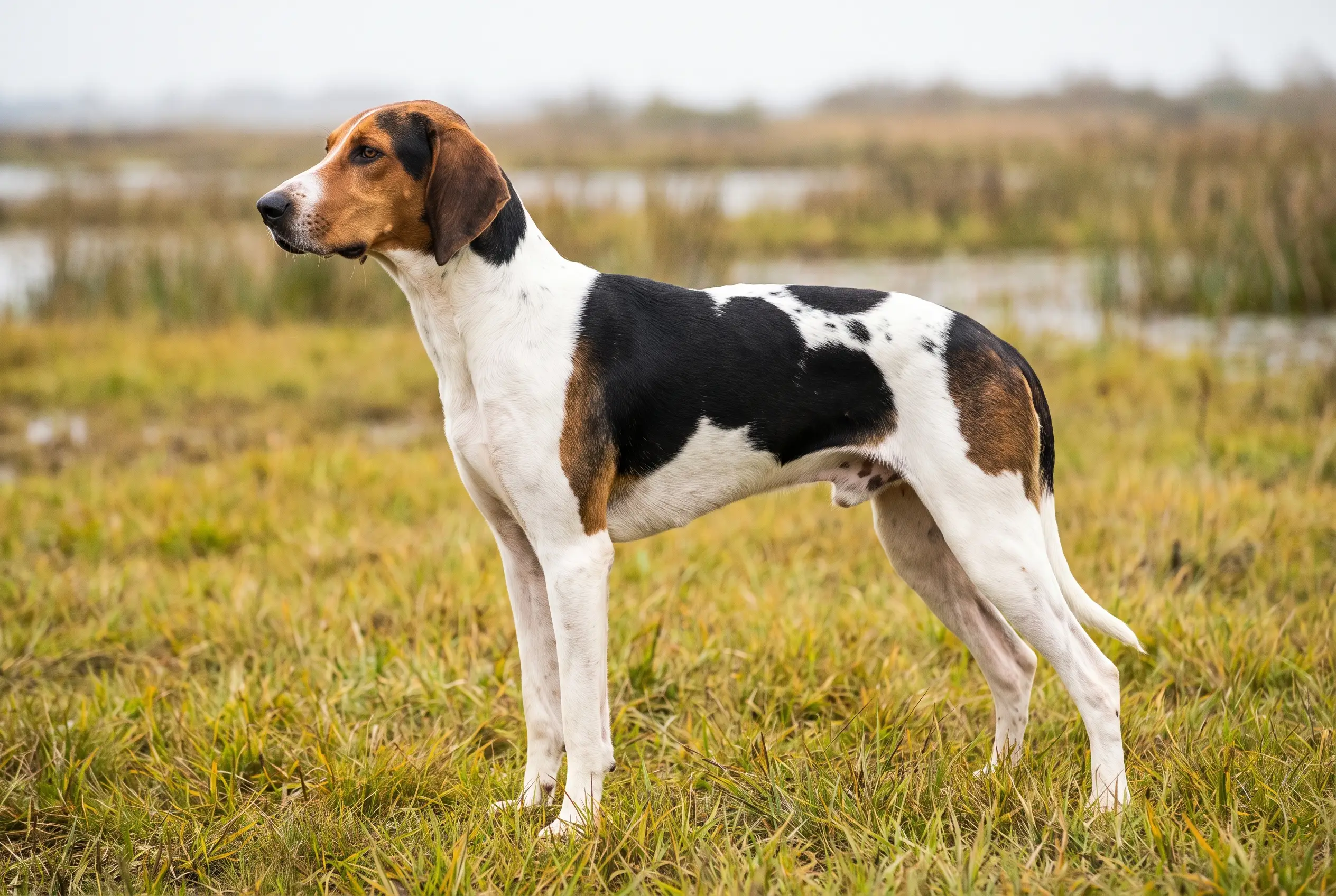
Poitevin
Built to run down wolves across the marshes of Poitou; the wolves are gone, so it hunts deer and boar instead.
Vital stats
| Size | Large · 62–72 cm (dogs), 60–70 cm (bitches) |
| Weight | 20.5–30.5 kg — breed literature; the standard sets no weight |
| Life expectancy | 10–12 years — no breed-specific figure published; estimated from comparable large French scenthounds, not survey data |
| Energy | Very high — bred to gallop for hours; called the fastest of France's pack hounds |
| Shedding | Low — short, glossy coat |
| Coat | Short and glossy · tricolour with black saddle or large black patches, sometimes bicolour white-and-orange, wolf-coloured hair "quite frequent" |
| Group | Hound · Large-sized Hounds (FCI №24, Group 6) |
| Origin | Poitou, France |
| FCI group | 6 — Scent hounds and related breeds · FCI 24 |
Breed traits
Friendliness
Care
Mind
The Poitevin by the numbers
The Poitevin facts owners search for most — price, lifespan, weight, shedding and colours, in one place.
Less common, so expect a waitlist and some travel to a reputable breeder — which pushes the price up. Ongoing costs run high — more food, bigger doses at the vet, and pricier insurance.
We don't quote a single figure: the real price swings with breeder, region, bloodline and health testing — and a rescue costs a fraction of a breeder's litter. Adopting is almost always the cheapest route.
Temperament
The Poitevin's own standard is oddly quiet on the subject: unlike almost every other French scenthound in this catalogue, it carries no dedicated behaviour or temperament clause, and no line about voice either, despite giving tongue on a trail being the entire point of a pack hound. The nearest thing to an official character reference sits inside the disqualifying faults, where "aggressive or overly shy" rules a dog out of the ring — stated only as a thing to avoid, never as a thing to aim for. Everything else comes from the people who actually run the breed. French hunting writers call it persevering, tireless and very affectionate; English-language sources are franker about the flip side, describing it as more aloof than most hounds and a dog that does not settle once kept apart from other dogs. Both descriptions fit the same animal: warm inside its pack, closed off outside it, uninterested in being anyone's only dog.
Habits & quirks
Rebuilt twice from almost nothing
The line begins with the Marquis de Larrye, who crossed English Staghounds gifted to the French crown in 1692 with local hounds and hunted wolf with the result for a century — then lost his head in 1793 during the Terror, and his pack was scattered with him. Two brothers, Émile and Arthur de la Besage, gathered what remained and rebuilt it, only for rabies to tear through their own kennels in 1842 and leave a handful of hounds standing. Those survivors were saved by crossing in English Foxhound blood, worked in carefully enough that it had all but vanished from the look of the dog within three generations. The Second World War forced the same repair a second time.
A foot named for the job it used to do
The standard describes both the front and back feet the same way: the "wolf-foot," rather long and very resistant — a shape built for the distance covered chasing wolves across Poitou. France's last wild wolves were killed off in the 1930s, around the same years the breed itself nearly disappeared a second time, and the Poitevin's work simply moved on to deer and boar, hunted the same way: on scent, in a pack, behind a huntsman's horn.
Every colour but two
The standard allows a real range: tricolour with a black saddle, tricolour with large black patches, an occasional white-and-orange bicolour, and hair the standard itself calls quite frequent when it comes out wolf-coloured. What it will not allow is a dewlap or a black-and-white coat; either one is a disqualifying fault, full stop, no matter how correct the rest of the dog.
Built for lightness, not bulk
Where the standard's opening line promises "strength, elegance and lightness," the body sections back it up in detail: a deep, narrow chest built more for depth than width, long ribs, a shoulder set long and close against it, and a tail the standard insists stay "fine, smooth" with none of the coarser offstanding hairs some related French hounds carry near the tip. The result, per the standard's own gait clause, is a dog that "gallops easily, bounding lightly and passing well through undergrowth" — built to outrun the ground it's hunting, not just to survive it.
Care
| Exercise | This is built to be the fastest of France's pack hounds, with a deep chest for hours of galloping without running out of breath — a lead walk isn't in the same category of exercise. It needs serious daily distance, ideally alongside other dogs, and the standard's own gait clause, a dog that "gallops easily... passing well through undergrowth," describes a hunting day, not a park loop. |
| Grooming | The short, glossy coat asks for almost nothing: an occasional brush covers it, and shedding stays light. The ears are set low and only medium length, nowhere near the exaggerated hanging ears of some related French hounds, but they still deserve a regular check. |
| Training | The Poitevin was built to answer a huntsman's horn as part of a pack, not to sit for one person in a living room, and breed literature is blunt that it does not settle once kept apart from other dogs. Recall and any kind of independent obedience need real, early, patient work if it's ever kept outside a working pack — and even then, expect a dog whose actual home base is the pack, not the house. |
| Health | Neither the standard nor breed literature documents a widely recognised breed-specific disorder. The standard's own health language is general — only functionally and clinically healthy dogs, of breed-typical conformation, should be used for breeding — and its deep, narrow chest carries the same bloat risk as other large, deep-chested hounds. With so few dogs bred outside working packs, ask about pedigree depth wherever a litter turns up at all. |
Life expectancy
This breed has a typical life expectancy of 10–12 years — no breed-specific figure published; estimated from comparable large French scenthounds, not survey data.
Similar breeds
Breeds with a similar build and background — worth a look if this one isn't quite the fit.
Breeds that look like this
Common questions
Is the Poitevin the same breed as the Grand Anglo-Français Tricolore?
No, though the confusion is fair — both are French tricolour scenthounds built partly on English Foxhound blood, and both trace ancestry back through the same 19th-century packs. The Poitevin is FCI standard No. 24, recognised in 1963, the older and rarer of the two, with its own lighter build and its own wolf-coloured coat option the Anglo-Français doesn't carry. The Grand Anglo-Français Tricolore is FCI standard No. 322, a separate breed recognised twenty years later, in 1983, purpose-built to fix the black-white-tan tricolour pattern with foxhound blood written directly into its own standard rather than inherited secondhand through a rescue crossing.
Why does the Poitevin no longer hunt wolves?
Because its country ran out of them. France's last wild wolves were killed off within a few years either side of 1940, decades before Italian wolves recolonised the Alps on their own in the 1990s. The Poitevin's whole reason for existing had to shift with them, and it moved onto deer and boar, hunted the same way: in a pack, on scent, under a huntsman's horn. That change landed in almost the same years the breed itself nearly went under a second time, in the crossbreeding scramble that followed the Second World War.
Can I get a Poitevin as a family pet, outside a hunting pack?
In practice, barely. The breed survives almost entirely inside a handful of French hunting packs, bred and kept by the hunters who run it, and breed literature describes it as more aloof than most hounds and a dog that does not adapt well once separated from other dogs — this is not a dog built for a quiet house and a single owner. Anyone drawn to how it looks should go in knowing that a real one will want its pack back.
Does the Poitevin shed a lot?
Not much. The Poitevin is a low-shedding breed, so loose hair around the home stays minimal. It still needs regular grooming, but you won't be fighting drifts of fur.
Is the Poitevin hypoallergenic?
No dog is truly hypoallergenic, but the Poitevin comes closer than most: its low-shedding coat releases less of the dander that triggers allergies. Many allergy sufferers manage well with this breed, but spend time around one before committing.
Is the Poitevin easy to train?
They can be a challenge. The Poitevin is intelligent but independent, and would rather make its own decisions than take orders. Reward-based training and patience work best; expect recall in particular to take time.