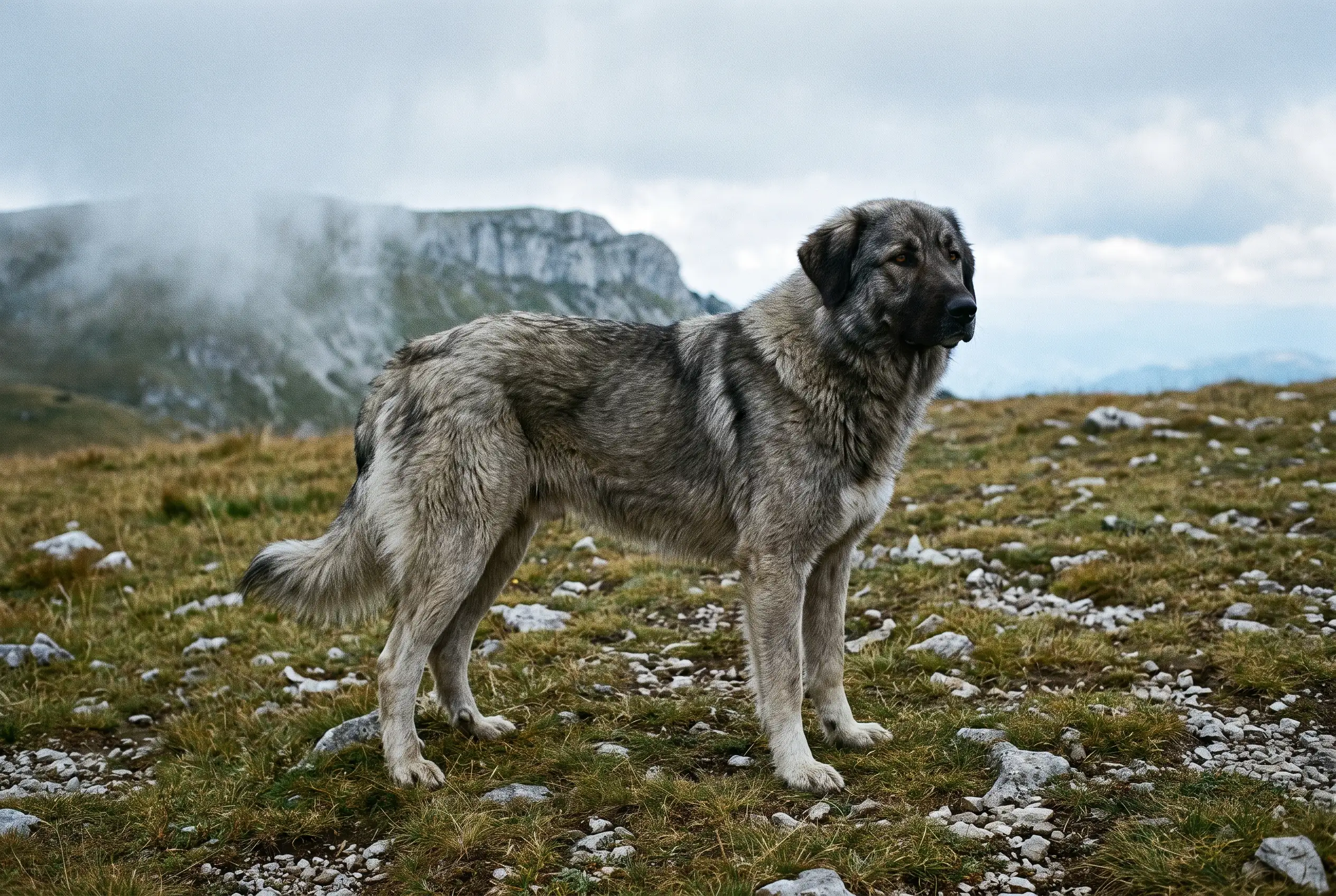
Romanian Carpathian Shepherd Dog
Wolf-grey, and disqualified if it looks like a mastiff.
Vital stats
| Size | Large · 65–73 cm (dogs), 59–67 cm (bitches), ±2 cm |
| Weight | Not given in the standard — breed sources put it at 32–45 kg |
| Life expectancy | 12–14 years — breed literature, not survey data |
| Energy | Moderate — a patrolling guardian rather than a runner, but it patrols all night |
| Shedding | Heavy · a soft dense undercoat under a harsh topcoat, dropped hard twice a year |
| Coat | Harsh, dense, straight, of moderate length · pale fawn overlaid with black (wolf-grey), white allowed on muzzle, forehead, neck, chest, limbs and tail |
| Group | Herding · Sheepdogs, without working trial (FCI №350, Group 1) |
| Origin | Carpathian Mountains, Romania |
| FCI group | 1 — Sheepdogs and Cattledogs · FCI 350 |
Breed traits
Friendliness
Care
Mind
The Romanian Carpathian Shepherd Dog by the numbers
The Romanian Carpathian Shepherd Dog facts owners search for most — price, lifespan, weight, shedding and colours, in one place.
Less common, so expect a waitlist and some travel to a reputable breeder — which pushes the price up. Ongoing costs run high — more food, bigger doses at the vet, and pricier insurance.
We don't quote a single figure: the real price swings with breeder, region, bloodline and health testing — and a rescue costs a fraction of a breeder's litter. Adopting is almost always the cheapest route.
Temperament
The standard describes a natural guardian, courageous, with an instinctive and unconditional attachment to the herd and to its master, and it uses three more words that matter: dignified, calm and stable. Lethargy is a disqualifying fault, and so is aggression. What that adds up to in practice is a dog that does almost nothing for hours and then makes a decision without consulting anybody. A Carpatin on its own ground reads the boundary, files everything that crosses it, and escalates in stages — it looks, it moves, it barks, and only then does it commit. Off its ground it is usually indifferent rather than reactive. It is affectionate with its own family in a low-key, undemonstrative way, and it does not perform. What it will not do is take an instruction that contradicts what it has already worked out, because a guardian that waited for the shepherd's opinion was no use in a Carpathian night.
Habits & quirks
Not allowed to look like a mastiff
Most European livestock guardians drifted heavier as they became show dogs. This standard blocks that on purpose: a subject clearly untypical with molossoid type appearance is disqualified, the head is specified as lupoid, and heavy construction is a severe fault. The dog is meant to still be quick after twelve hours of nothing.
Escalates before it commits
The working pattern is a series of warnings — position, voice, then contact — and shepherds rely on the earlier stages doing the job. A guardian that goes straight to the last step is a liability with a flock, and the standard's 'calm and stable' is what selects against it.
Works the boundary at night
Predator pressure is nocturnal, so the dog is nocturnal. In a house or a village this becomes barking at three in the morning at things that are genuinely there — a fox, a cat, someone walking home — and nothing about it is a fault to be trained out.
Wolf-grey and nothing else
Pale fawn overlaid with black in any tone, lighter down the flanks and darker over the back, with white permitted only on the muzzle, forehead, neck, chest, limbs and tail. Brown, brindle, yellow or a coat flecked with those colours disqualifies, as does a missing undercoat.
Care
| Exercise | Not a distance dog and not a sport dog. What it needs is ground: a securely fenced area it can walk the edges of, and a couple of long, slow outings where it gets to look at things. Lead walks in a busy street satisfy nothing and make everything harder. If it has livestock, or even poultry, that is the whole exercise plan. |
| Grooming | A working double coat that mostly maintains itself, plus two moults a year that fill a bin. Brush weekly out of season and daily while it is dropping, paying attention to the ruff, the trousers and the tail, where the coat is longest. It is never clipped: the undercoat is what the standard is protecting, and losing it is a disqualifying fault. |
| Training | Socialise hard and early, and accept what the breed is. It is intelligent and it is not obedient in the trial sense; you are shaping judgement, not installing commands. Recall is the honest weak point, because a guardian that comes back when called has been overruled on the one decision it was bred to make. Fencing, not optimism. Harsh methods produce a dog that stops telling you what it is thinking. |
| Health | No breed health survey exists. It is a working landrace with an unusually large gene pool for a rare FCI breed, and Romanian breeders generally report a sound, slow-maturing dog. Screen hips and elbows on the parents as for any large breed, watch for bloat as with any deep-chested dog, and be realistic that a guardian carrying full coat in a warm climate needs shade and water more than it needs a coat trim. |
How much should I feed a Romanian Carpathian Shepherd Dog? →
Life expectancy
This breed has a typical life expectancy of 12–14 years — breed literature, not survey data.
Similar breeds
Breeds with a similar build and background — worth a look if this one isn't quite the fit.
Breeds that look like this
Common questions
What is the difference between the Carpathian and the Mioritic?
Colour, coat and size, mainly. The Carpatin is wolf-grey with a harsh coat of moderate length and stands 65–73 cm in males. The Mioritic is white, or white with grey or black patches, carries a coat of at least 10 cm, and stands a minimum of 70 cm in males with 75 cm as the ideal. Both are Romanian, both are livestock guardians from the Carpathians, both went provisional with the FCI on the same day in 2005 and were recognised definitively on the same day in 2015 — and the FCI files both as sheepdogs.
Is it a guard dog or a herding dog?
A guardian. It does not gather, drive or shed stock; it lives with the flock and keeps predators off it, which is why the standard talks about defending the herd rather than moving it. The FCI puts every non-Swiss shepherd's dog into Group 1, so the Carpatin shares a group with the Border Collie and shares almost nothing else. Around the house that distinction is the whole difference between a dog that wants a task and a dog that has appointed itself to one.
Can it live in a city?
It can be kept in one, badly. It needs a boundary it can patrol, it barks at night on purpose, it is 65 cm and upwards of 30 kg, and it makes its own decisions about visitors. Romanian owners keep them on land, and the breed's ordinary life is a yard, a gate and a job. If you want the look without the terms, look at a breed that was bred to be told what to do.
Does the Romanian Carpathian Shepherd Dog shed a lot?
Yes — the Romanian Carpathian Shepherd Dog is a heavy shedder, dropping hair year-round or in big seasonal moults. Brush it several times a week and expect regular vacuuming; it isn't the coat for you if loose fur is a dealbreaker.
Is the Romanian Carpathian Shepherd Dog hypoallergenic?
Not really. No dog is truly hypoallergenic, and the Romanian Carpathian Shepherd Dog's shedding coat releases plenty of the dander that sets off allergies. If someone at home is allergic, this isn't the easiest breed to live with — spend time around one first.
Is the Romanian Carpathian Shepherd Dog good with children?
It depends. The Romanian Carpathian Shepherd Dog tends to be more reserved, so it suits older, calmer children better than boisterous toddlers. Early socialisation and careful, supervised introductions matter more with this breed.
Is the Romanian Carpathian Shepherd Dog easy to train?
They can be a challenge. The Romanian Carpathian Shepherd Dog is intelligent but independent, and would rather make its own decisions than take orders. Reward-based training and patience work best; expect recall in particular to take time.