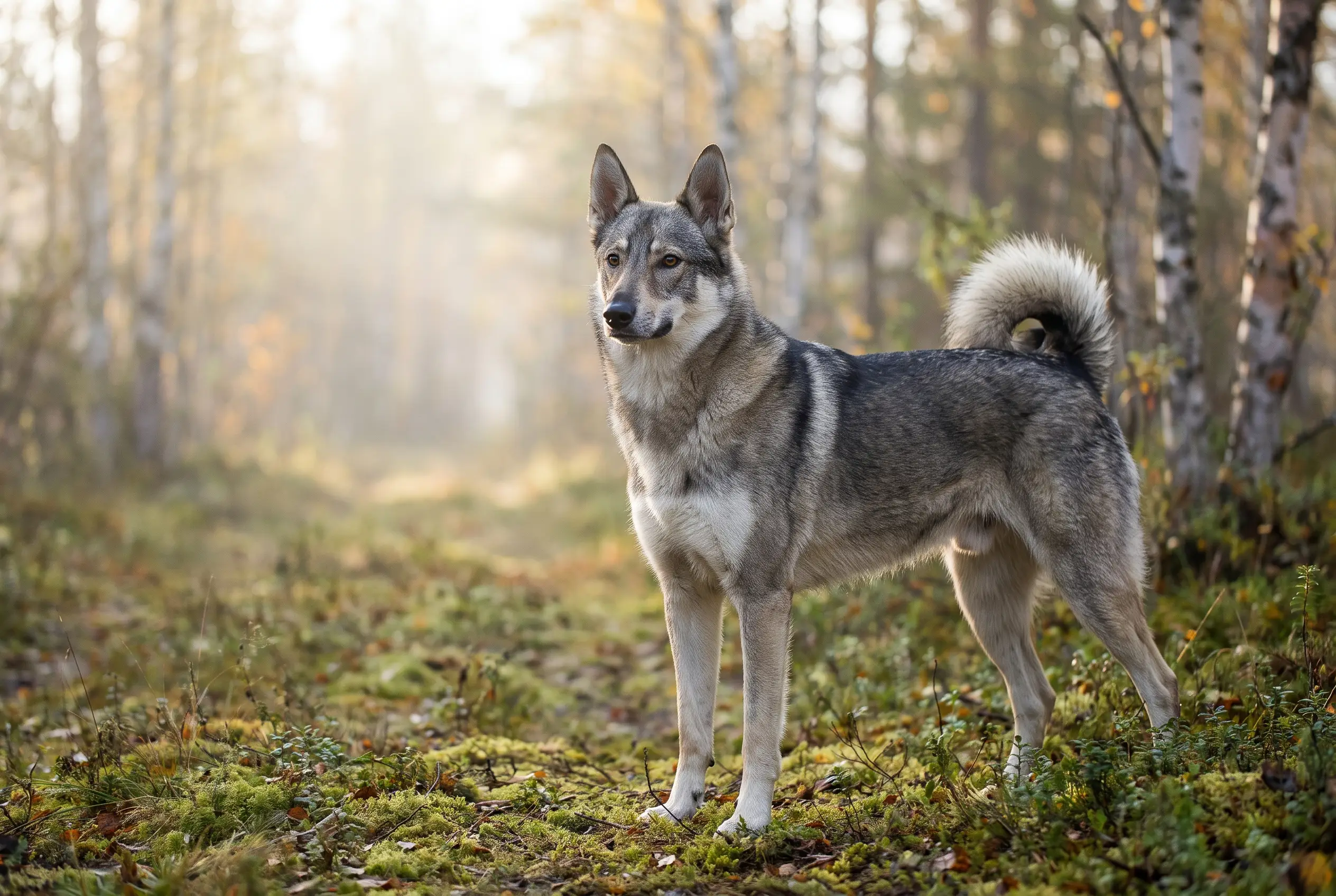
West Siberian Laika
The laika a Russian hunter actually owns: wolf-grey, taiga-bred, and never black.
Vital stats
| Size | Medium-large · 55–62 cm (dogs), 51–58 cm (bitches) |
| Weight | 18–27 kg — breed literature; the standard sets none |
| Life expectancy | 12–15 years — breed literature, not survey data |
| Energy | Very high — an all-round hunting spitz, two hours a day and more |
| Shedding | Heavy, with two seasonal blows |
| Coat | Dense harsh topcoat over a woolly undercoat, with collar and side-whiskers · grey, red, fawn, white or parti-colour, never black |
| Group | Hound · Nordic Hunting Dogs (FCI №306, Group 5) |
| Origin | Ural and West Siberia, Russia |
| FCI group | 5 — Spitz and primitive types · FCI 306 |
Breed traits
Friendliness
Care
Mind
The West Siberian Laika by the numbers
The West Siberian Laika facts owners search for most — price, lifespan, weight, shedding and colours, in one place.
Less common, so expect a waitlist and some travel to a reputable breeder — which pushes the price up. Plan for steady ongoing costs — mid-range food, routine vet care and insurance.
We don't quote a single figure: the real price swings with breeder, region, bloodline and health testing — and a rescue costs a fraction of a breeder's litter. Adopting is almost always the cheapest route.
Temperament
Steady, evenly-tempered is how the standard opens, and it reads almost domestic until the next line: a vigorous dog with a very well developed sense of scent, an alert, sensitive and pronounced passion for hunting, 'equally keen to hunt feathered as furred game'. Then comes the clause that separates this breed from the guarding spitz: self-confident and alert towards strangers, with 'slightly nervous or lacking confidence with strangers' listed among the faults. A West Siberian is supposed to meet the world with its head up, neither suspicious nor clingy. At home that makes a calm, watchful dog that saves its intensity for the forest. The intensity is real. This is a dog selected for generations to work one animal single-mindedly until the hunter arrives, so cats, squirrels and free-range chickens register as unfinished business, and a bored one will find its own game to hold. Give the drive an outlet and the rest of the dog is quieter than its reputation.
Habits & quirks
Points with its voice
The work is bark-pointing: find game by scent, stop it, and hold it there with noise until the hunter arrives, whether that means a squirrel treed or an elk bayed. The standard asks for a dog 'equally keen to hunt feathered as furred game', and a laika that goes silent on a find has stopped doing its job.
Any colour but black
Grey with reddish-brown, red, fawn, reddish-brown of any shade, pure white, or white patched with those colours. A black or black-and-white coat is a severe fault, and genetic brown, blue, brindle and albino disqualify outright. If the laika in front of you is black and white, you are looking at the Russo-European.
Two tribal strains, one breed
The Mansi (Vogul) and Khanty (Ostyak) laikas were standardised separately in the early twentieth century, then united in 1947 because the strains were so closely related; the joint standard followed in 1952. Breed people still say they can spot the difference, a longer head from the Mansi lines, a broader one from the Khanty.
Deep-set eyes, snowshoe feet
The standard sets the eyes fairly deep, and adds its own comparison: more so than in the other laika breeds. Below, the feet carry a protective growth of brush-like hair between the toes, and the neck wears a collar of longer coat with side-whiskers on the cheekbones. Every clause is a winter-forest clause.
Care
| Exercise | Two hours a day is the floor, and forest beats pavement. This is a dog bred to cover taiga at a short trot broken by gallop, working scent the whole way, and a leashed march around the block does not touch that. Scentwork, tracking, carting, long off-road outings and, where legal, actual hunting are the right shapes. Off-lead in open country is a calculated risk: a fresh line of scent outranks you. |
| Grooming | Cheap to run for most of the year: a harsh straight topcoat that sheds dirt on its own, a weekly brush, no trimming. Twice a year the woolly undercoat lets go all at once and wants a rake most days for a couple of weeks. Never clip it; the standard disqualifies a coat that is too short or too long, and the double coat is the dog's insulation in both directions. |
| Training | Steadier and more biddable than the primitive-breed reputation suggests, because it was always bred to work with a hunter, not merely near one. It learns fast, gets bored faster, and makes its own decisions the moment it believes you have stopped making good ones. Short sessions, real rewards, and a job. Teach a stop cue for the voice early, and treat recall as a lifelong project rather than a solved problem. |
| Health | A hardy dog from a huge working population, still bred mainly for function in its home country, and with no breed-wide health survey to cite. Buying outside Russia usually means a small import base, so ask about hip and eye screening on both parents and look at how many dogs actually stand behind the pedigree. The 12–15 years in breed literature is an estimate, not a study. |
Life expectancy
This breed has a typical life expectancy of 12–15 years — breed literature, not survey data.
Similar breeds
Breeds with a similar build and background — worth a look if this one isn't quite the fit.
Breeds that look like this
Common questions
How is it different from the East Siberian and Russo-European Laikas?
Three Russian breeds, three FCI standards: Russo-European 304, East Siberian 305, West Siberian 306, all in Group 5, Section 2. The West Siberian came from just two closely related tribal strains, the Mansi and Khanty dogs, which is why it is the most uniform of the three, and it is the most numerous by a wide margin. The Russo-European is the compact black-and-white one from the forests west of the Urals; the West Siberian stands taller and leggier, and cannot be black at all. The East Siberian, drawn from a broader mix of native dogs further east, is the biggest and was standardised from the widest base.
What does a West Siberian Laika hunt?
Nearly everything the taiga offers. The standard calls it a hunting dog for all-round purposes, equally keen on feathered and furred game, and in Russia the same dog may be used on squirrel and sable for fur, capercaillie in the trees, and elk, boar and bear at bay. The method barely changes with the size of the animal: find it, stop it, and keep it busy with voice until the hunter arrives.
Can it live as a family pet?
It can, in a household that hunts, mushes, runs or trains, and it is steady, even-tempered and self-confident by written requirement. The honest list of costs: a prey drive that makes cats and small pets a genuine problem, a voice built to carry through forest, two hours of real work a day, and a recall that stays negotiable for life. In Russia this dog overwhelmingly lives with hunters, and it is happiest where at least part of that life survives.
Does the West Siberian Laika shed a lot?
Yes — the West Siberian Laika is a heavy shedder, dropping hair year-round or in big seasonal moults. Brush it several times a week and expect regular vacuuming; it isn't the coat for you if loose fur is a dealbreaker.
Is the West Siberian Laika hypoallergenic?
Not really. No dog is truly hypoallergenic, and the West Siberian Laika's shedding coat releases plenty of the dander that sets off allergies. If someone at home is allergic, this isn't the easiest breed to live with — spend time around one first.
Is the West Siberian Laika easy to train?
Reasonably. The West Siberian Laika is trainable with consistency and rewards, though it isn't the quickest study. Keep sessions short and positive, and be patient with the basics like recall.