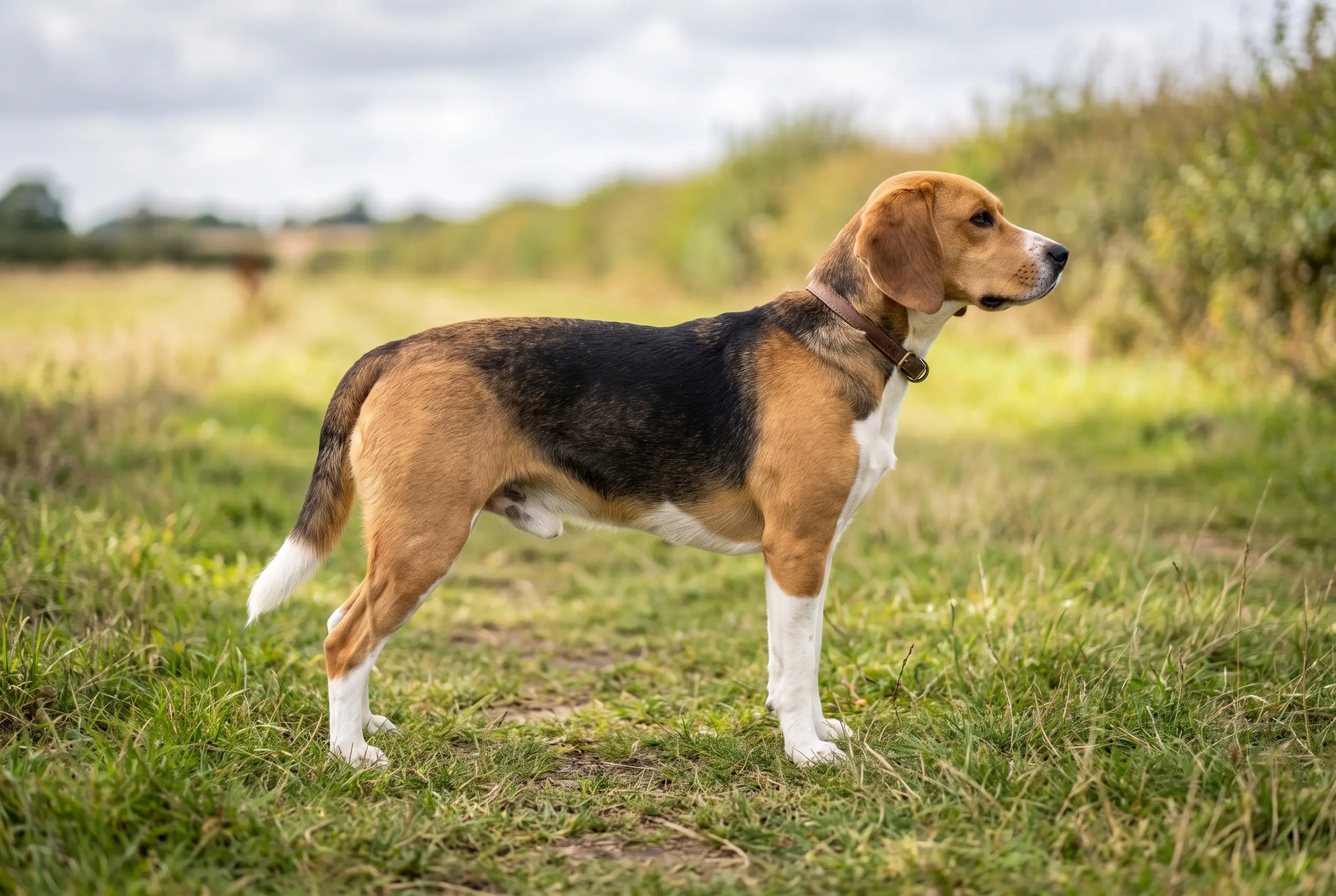
Beagle-Harrier
A French hound built on purpose from Beagle and Harrier stock, and bred true for more than a century.
Vital stats
| Size | Medium · 45–50 cm — between the Beagle's 33–41 cm and the Harrier's 48–55 cm |
| Weight | 19–21 kg — breed literature; the standard sets no weight |
| Life expectancy | 12–13 years — breed literature, not survey data |
| Energy | High — daily distance work, ideally with a hunting job |
| Shedding | Low — short, flat coat, sheds lightly year-round |
| Coat | Short, thick, flat · always tri-colour (fawn, black blanket, white) |
| Group | Hound · Medium-sized Scenthound (FCI №290, Group 6) |
| Origin | France |
| FCI group | 6 — Scent hounds and related breeds · FCI 290 |
Breed traits
Friendliness
Care
Mind
The Beagle-Harrier by the numbers
The Beagle-Harrier facts owners search for most — price, lifespan, weight, shedding and colours, in one place.
Less common, so expect a waitlist and some travel to a reputable breeder — which pushes the price up. Plan for steady ongoing costs — mid-range food, routine vet care and insurance.
We don't quote a single figure: the real price swings with breeder, region, bloodline and health testing — and a rescue costs a fraction of a breeder's litter. Adopting is almost always the cheapest route.
Temperament
The current FCI standard, revised in 2023, has no separate behaviour or temperament section at all — worth noting on its own, since most hound standards give one. What it does say sits in the eyes: "well open, dark in colour, of a frank, lively and intelligent expression." The fault list fills in the rest by exclusion — a "frightened appearance, soft or unintelligent" costs points, and "aggressive or overly shy dogs" are disqualified outright. Read together, that is a standard demanding steadiness and confidence and ruling out both extremes. Breed literature, closer to the ground, describes a dog that is affectionate, enthusiastic, intelligent, inquisitive and playful, and good with children — friendlier and more biddable day to day than its more standoffish Harrier parent, while keeping the same single-minded nose once a trail opens up.
Habits & quirks
Sized on purpose, not by accident
The standard fixes height at 45–50 cm, a gap deliberately cut between the Beagle and the Harrier that made the breed — the exact trait Baron Gérard crossed them to get.
Grey is allowed, oddly
Most tri-colour hounds are fawn, black and white and nothing else. This standard carves out a named exception: because grey Harriers exist in the ancestry, a grey tri-colour or white-grey Beagle-Harrier is not penalised for that colour alone.
Curled ears read as a warning sign
One listed fault is oddly specific: "curled ears, recalling and infusion of French blood." It flags dogs drifting toward the older French running hounds sometimes used to refresh the line — proof that holding the type steady still takes active selection.
Almost nobody outside France has one
It lives almost entirely in French hunting kennels, working hare, deer and other game in packs. A few hundred dogs exist worldwide, nearly all of them in France, and finding one anywhere else is genuinely hard.
Health
No breed-specific illness shows up in the standard or in the breed literature, and the 12–13 years usually quoted rests on kennel experience rather than any survey — so with the Beagle-Harrier, health is mostly the basics done well. It is a working scenthound with drop ears that trap warmth and damp, so check and wipe them dry after wet or muddy outings and you head off most ear trouble before it starts. The bigger question is the breeder: almost the whole breed lives in French hunting kennels, the gene pool is small, and a good breeder will talk openly about pedigree depth and what runs in their lines. Keep him lean and properly worked and you have covered the ground that actually matters.
Nutrition
| Exercise | Built to gallop after hare all day in a pack; plan on long daily distance with real scent work, not a lead-walk around the block. Hunting, tracking or long off-lead country walks all fit — a bored Beagle-Harrier will find its own trail regardless of your plans. |
| Grooming | The short, thick, flat coat needs only an occasional brush and sheds lightly year-round — closer to the Beagle's low-maintenance coat than to anything demanding. |
| Training | Breed literature has it more biddable than many scent hounds — affectionate, playful, food-motivated — but the nose still runs the show once a trail opens. Start recall early and never trust it off-lead near open scent. |
| Health | Neither the current standard nor wide breed literature documents a breed-specific disorder, and the usual 12–13 years quoted has no survey behind it. With so few dogs bred outside France, ask any breeder about pedigree depth. |
This is a hound built to gallop after hare all day, with a nose that never really switches off, which makes for a dog easily led by its stomach. Feed to the work the dog is actually doing — a kennel hound in the hunting season and a companion on country walks are not the same animal — weigh the meals, and count every training treat into the day's total, because a food-motivated scenthound will happily talk you into a second dinner. Aim for ribs you can feel under the flat coat, and keep him lean: it is the single easiest thing you can do for a working dog's joints and wind.
Puppy guide
A Beagle-Harrier puppy is friendly, busy and already ruled by its nose, and the first year is where you either build a partnership or lose one to the trail. Get recall on board early, reward it lavishly, and practise it long before you ever trust him near open country — the instinct to follow a scent is stronger than any command once it kicks in. Socialise him widely so the confident, steady temperament the standard asks for actually develops, keep early exercise varied rather than punishing while the body fills out, and teach him that coming back is the best game there is.
Training
For a scenthound, the Beagle-Harrier is unusually easy to work with — affectionate, playful and genuinely food-motivated, more biddable day to day than the standoffish Harrier behind it. The catch is the nose: once a trail opens up, the dog is a hound first and your student second, and no amount of drilling fully overrides that. So make recall the thing you train hardest, keep sessions short, upbeat and paid in food, and be honest about the off-lead risk — near live scent, a long line is not a failure, it is just sense.
Life expectancy
Beagle-Harriers live 12–13 years — breed literature, not survey data. That figure comes from kennel experience rather than a health survey, so treat it as a guide, not a guarantee. What keeps a working hound at the top of its range is not exotic: a lean weight, ears kept clean and dry, teeth and vaccinations stayed on top of, and enough real exercise to satisfy the drive it was bred for. Because so few are bred, and almost all in France, a breeder who knows their lines deeply is worth more here than any single test result.
Similar breeds
Breeds with a similar build and background — worth a look if this one isn't quite the fit.
Breeds that look like this
Common questions
Is the Beagle-Harrier just a Beagle-Harrier mix, a crossbreed?
No. Despite the name, it is a standalone FCI breed, No. 290, not a first-generation cross. Baron Gérard crossed Beagles and Harriers in 19th-century France to fix one exact trait, an in-between size, and the result has bred true for well over a century. A litter of Beagle x Harrier puppies today would be a crossbreed; a Beagle-Harrier from a breeder working within the standard is not.
How is a Beagle-Harrier different from a Beagle and a Harrier?
Size is the clean way to tell them apart, and it's also the reason the breed exists. The Beagle (FCI No. 161) stands 33–41 cm; the Harrier (FCI No. 295) stands 48–55 cm; the Beagle-Harrier (FCI No. 290) sits in between at 45–50 cm — big enough to keep pace with hare all day, small enough for a hunter on foot to keep up. All three are tri-colour scenthounds and easy to mix up by eye; the FCI number on the pedigree is the only sure way to know which one you actually have.
Are Beagle-Harriers good family pets outside hunting?
Possible, but the breed barely exists outside French hunting kennels — a few hundred dogs worldwide, almost all of them working hare, deer or other game in packs. Breed literature describes a dog that's affectionate and good with children, but its build and drive expect daily scent work; a family taking one on needs to supply real exercise and mental work, and finding a breeder outside France in the first place is the harder problem.
Does the Beagle-Harrier shed a lot?
Not much. The Beagle-Harrier is a low-shedding breed, so loose hair around the home stays minimal. It still needs regular grooming, but you won't be fighting drifts of fur.
Is the Beagle-Harrier hypoallergenic?
No dog is truly hypoallergenic, but the Beagle-Harrier comes closer than most: its low-shedding coat releases less of the dander that triggers allergies. Many allergy sufferers manage well with this breed, but spend time around one before committing.
Is the Beagle-Harrier easy to train?
Reasonably. The Beagle-Harrier is trainable with consistency and rewards, though it isn't the quickest study. Keep sessions short and positive, and be patient with the basics like recall.