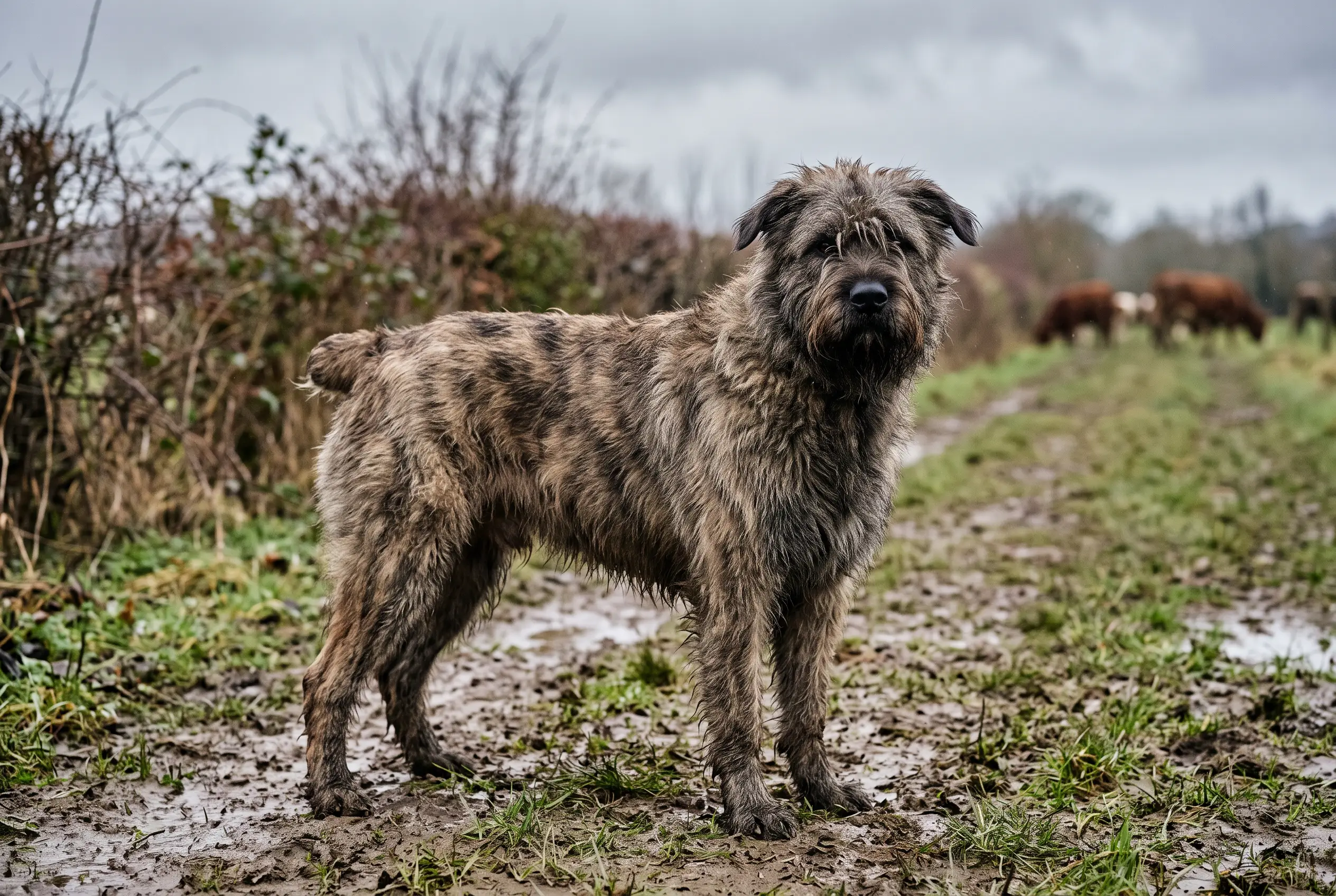
Bouvier des Ardennes
The Belgian cattle dog that everyone had written off.
Vital stats
| Size | Medium · 56–62 cm (dogs), 52–56 cm (bitches) |
| Weight | 28–35 kg (dogs), 22–28 kg (bitches) |
| Life expectancy | 12–14 years |
| Energy | High — built for a full working day outdoors |
| Shedding | Moderate — dense undercoat, heavier in winter |
| Coat | Dry, harsh, tousled, about 6 cm · every colour except white |
| Group | Herding · Cattledogs, with working trial (FCI №171, Group 1) |
| Origin | Ardennes, Belgium |
| FCI group | 1 — Sheepdogs and Cattledogs · FCI 171 |
Breed traits
Friendliness
Care
Mind
The Bouvier des Ardennes by the numbers
The Bouvier des Ardennes facts owners search for most — price, lifespan, weight, shedding and colours, in one place.
Less common, so expect a waitlist and some travel to a reputable breeder — which pushes the price up. Ongoing costs run high — more food, bigger doses at the vet, and pricier insurance.
We don't quote a single figure: the real price swings with breeder, region, bloodline and health testing — and a rescue costs a fraction of a breeder's litter. Adopting is almost always the cheapest route.
Temperament
The standard asks for endurance and energy, and for a dog that is playful, curious, agile and sociable; it names adaptability as the main quality, meaning the dog should be able to settle into any situation it is dropped into. The same text also calls it obstinate, and extremely courageous when it comes to defending its people, its belongings and its territory. That mix is what a hill farm needed: enough nerve to move a cow that has decided not to move, and enough sense to get on with the day afterwards. In practice you get a dog that is bold and forward with stock, watchful with people it does not know, and openly bored without a job. Aggression and nervousness are both disqualifying faults and timid or sluggish dogs are penalised, so a correct one is neither sharp nor soft. Left in a garden as a pet it goes noisy and inventive.
Habits & quirks
Walks you in arcs
Off the lead it tends to swing out around its owner in wide semi-circles instead of trotting alongside. The standard describes exactly this: the droving habit shows even when there is nothing to drive.
Often born with no tail
Most of the breed is naturally short-tailed and a fair number arrive with no tail at all. Docking is banned across most of Europe now, so what you see on a Belgian-bred puppy is what it was born with.
Ignores the weather
The coat exists to let the dog live outdoors and keep working in whatever the Ardennes throws at it. Rain, sleet and mud register as nothing much; the mud dries on the harsh outer coat and falls off.
Takes the gate personally
It reads the yard as its own and announces anything crossing the boundary. Good ones sound off, place themselves between the visitor and the house, and then stand down when told.
Health
No breed club has published a disease profile for the Bouvier des Ardennes, and the population is so small that the usual screening databases hold nothing useful — so with this breed the gene pool itself is the health question. Everything was rebuilt from a tiny number of founders, which makes inbreeding the risk that actually matters. Ask the breeder for hip scores, the litter's inbreeding coefficient and the full pedigree, and take the one who volunteers all three. Beyond that it's a hardy outdoor worker: keep it lean, keep it busy, and let the harsh, weatherproof coat do its job.
Nutrition
| Exercise | An hour or two of real activity a day, with something for the head folded in: herding, tracking, mantrailing, obedience, long hikes. It was selected for stamina on rough ground, so distance alone rarely settles one. |
| Grooming | Low, and deliberately so. A weekly brush through the harsh outer coat and the undercoat is the whole routine, plus a rinse of the beard after meals. Trimming of any kind is a disqualifying fault in the ring — this coat is not meant to be shaped. |
| Training | Fair, consistent and short beats drilling, because obstinate is in the standard and it means it. Socialise widely from puppyhood so the natural wariness of strangers stays wariness. Expect it to make its own decisions around livestock, and expect a young one to try herding whatever is moving, including children. |
| Health | No breed-specific disease profile has been published, and with a population this small none of the usual screening databases hold useful numbers. The gene pool itself is the health question: ask the breeder for hip scores, the litter's inbreeding coefficient and the full pedigree, and take a breeder who volunteers all three. |
This is a herding dog bred for a full day's work on rough ground, so feed to what the dog actually does — a hard-working adult and a quieter one at home don't need the same bowl. Weigh the meals, count training treats into the day's total, and aim for ribs you can feel under the thick coat. Keep it lean: extra weight steals the stamina the breed exists for.
Puppy guide
A Bouvier des Ardennes puppy comes with a herding brain already switched on, and how you spend the first year shapes the adult. Socialise it widely and early so the breed's natural wariness of strangers stays plain wariness and never tips into nervousness. Keep growth steady and the hard exercise sensible while the joints are still forming, teach an off switch as deliberately as you teach a sit, and expect a youngster to try to herd anything that moves, children included — redirect it onto a game before the habit sets.
Training
Obstinate is written into the breed standard, and it isn't a figure of speech. Fair, consistent, short sessions beat drilling every time, and reward-based work holds this dog far better than repetition. Socialise from puppyhood, expect it to make its own decisions around livestock, and give it a real job rather than a walk — bored, a Bouvier des Ardennes goes noisy and invents its own work. Train the head and the manners follow.
Life expectancy
Bouviers des Ardennes live 12–14 years. This is a hardy, weatherproof working dog, and you keep it at the top of that range the same way you keep it sound: a lean weight, real daily work for body and mind, and — because the whole breed was rebuilt from a handful of dogs — parents from health-tested, low-inbreeding lines. Ask for the hip scores and the pedigree, and buy from someone breeding for that.
Similar breeds
Breeds with a similar build and background — worth a look if this one isn't quite the fit.
Breeds that look like this
Common questions
How is it different from a Bouvier des Flandres?
Two separate Belgian cattle breeds that get mixed up constantly. The Flandres (FCI standard 191) comes from the Flemish lowlands, stands 59–68 cm at 27–40 kg, wears a long, abundant coat that is washed and shaped for the show ring, and is bred in the thousands worldwide with AKC recognition. The Ardennes (FCI standard 171) comes from the hills of Liège and Luxembourg provinces, stands 52–62 cm at 22–35 kg, and carries a short, dry, tousled coat that no one is allowed to trim. It is the rougher, lighter and far rarer of the pair, its ears are preferred erect rather than dropped, and its standard accepts every colour except white where the Flandres standard does not.
Did the breed really nearly die out?
Yes. It was drawn up as a breed in 1913 by a Liège society, given a definitive standard by Belgium in 1923 and published by the FCI in 1963, and then the thing it was built for disappeared. Small Ardennes farms closed, milking herds shrank, and by the 1970s and 1980s the breed was widely assumed extinct. It came back through chance: around 1985 people going farm to farm collecting colostrum spotted a few dogs that still looked like the old type, breeders started working from them around 1990, and a line that had been moved to the north of the country in about 1930 surfaced in 1996. Everything alive today descends from that handful.
Is it a good family dog?
For an active rural or semi-rural household that can give it work, it can be very good — the standard calls it sociable and adaptable, and it is genuinely attached to its own people. It is a poor fit for a flat, for a household away all day, or for a first-time owner who wants an easy dog. It is wary with strangers, it will try to move anything that runs, and puppies are rare enough that you should expect a waiting list and a breeder who asks you as many questions as you ask them.
Does the Bouvier des Ardennes shed a lot?
Moderately. The Bouvier des Ardennes sheds a fair amount, steadily through the year with heavier seasonal patches. A weekly brush keeps most of the loose hair off your floors and clothes.
Is the Bouvier des Ardennes hypoallergenic?
Not really. No dog is truly hypoallergenic, and the Bouvier des Ardennes's shedding coat releases plenty of the dander that sets off allergies. If someone at home is allergic, this isn't the easiest breed to live with — spend time around one first.
Is the Bouvier des Ardennes easy to train?
Reasonably. The Bouvier des Ardennes is trainable with consistency and rewards, though it isn't the quickest study. Keep sessions short and positive, and be patient with the basics like recall.