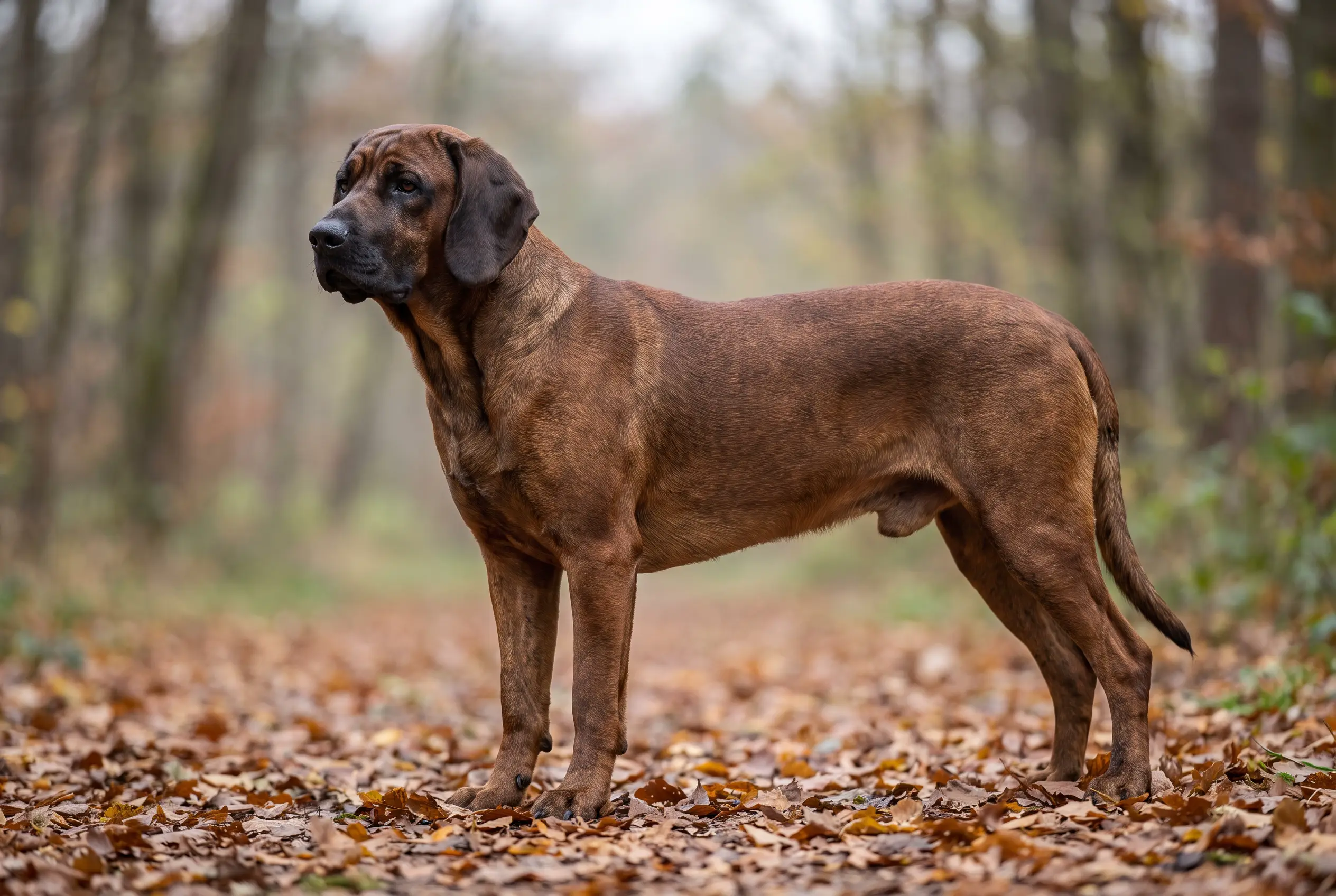
Hannoverscher Schweisshund
A leash hound bred to follow a wounded animal's blood trail for hours, sometimes days, until it is found.
Vital stats
| Size | Medium · 50–55 cm (dogs), 48–53 cm (bitches) |
| Weight | 30–40 kg (dogs), 25–35 kg (bitches) |
| Life expectancy | 10–14 years — breed literature, not survey data |
| Energy | High — built for hours of sustained leash-tracking work |
| Shedding | Low to moderate — short, coarse coat |
| Coat | Short, thick, coarse to harsh · deer-red, pale fawn to dark brindle |
| Group | Hound · Leash Hound, blood-tracking specialist (FCI №213, Group 6, Section 2) |
| Origin | Germany |
| FCI group | 6 — Scent hounds and related breeds · FCI 213 |
Breed traits
Friendliness
Care
Mind
The Hannoverscher Schweisshund by the numbers
The Hannoverscher Schweisshund facts owners search for most — price, lifespan, weight, shedding and colours, in one place.
Less common, so expect a waitlist and some travel to a reputable breeder — which pushes the price up. Ongoing costs run high — more food, bigger doses at the vet, and pricier insurance.
We don't quote a single figure: the real price swings with breeder, region, bloodline and health testing — and a rescue costs a fraction of a breeder's litter. Adopting is almost always the cheapest route.
Temperament
The standard's own behaviour clause reads: "Calm and assured temperament, at the same time sensitive with his handler, choosy and discerning with strangers," and adds that the dog brings "high capabilities of concentration in any tracking work with strong loyalty to the hunter in charge." Read plainly, this describes a dog built to work one trail with one person for hours at a stretch, not to make friends along the way — choosy and discerning with strangers is the standard's measured way of saying it does not warm to people it doesn't know. German and Austrian breed clubs place puppies almost entirely with hunters and professional gamekeepers who commit to a dedicated tracking-dog handler's course before taking one home; that is club policy, not a line in the standard, but it reflects what the dog actually is. Breed literature is direct that it makes a poor ordinary family pet, particularly around small children. This is a specialist built around a single working relationship, and everything else in a household sits second to it.
Habits & quirks
A duty, not just a hunt
The standard's utilization clause calls this "a highly specialised hunting dog for the tracking of wounded game." The breed's own club, Verein Hirschmann e.V., states its purpose even more plainly on its website: to preserve the breed and deploy capable dogs to prevent animal suffering and promote ethical hunting. In Germany, following up wounded game (Nachsuche) is treated as a duty of the hunt rather than an optional extra, and several state hunting laws make it an explicit legal one. This breed exists to do that job.
Wrinkle by design
The standard doesn't just tolerate loose skin, it asks for it: "thick, rather loose, mostly wrinkled on the head, and occasionally at the throat, too," with "slight dewlap permissible" at the neck. Paired with the "slightly wrinkled forehead" the standard credits for the breed's serious expression, this is a dog whose face is built to look faintly worried at rest, and to shrug off the branches and undergrowth of a day spent nose-down in cover.
Heavier than the dog it produced
This breed is the direct ancestor of the Bavarian Mountain Scent Hound (FCI №217): after 1870, Baron Karg-Bebenburg crossed Hannoverian Scenthounds with red mountain hounds because the Hannoverian, at 30–40 kg and 50–55 cm for a male, proved too heavy for steep alpine ground. The Bavarian standard sets its males at an ideal 20–30 kg and 47–52 cm — a genuinely lighter dog, bred from this one for terrain the original couldn't cover as well.
Built long, low and deep-chested for the miles
The standard fixes the shape in ratios: body length to height at withers of 1.4 to 1, chest depth to height of 0.5 to 1. That's a long-cast, low-slung dog with a deep chest built, in the standard's own words, to provide "ample room for the lungs" and "enable long, strenuous chases" — engineered for hours on a trail, with the walk or the gallop named as its preferred working gaits.
Health
The breed club's own rules screen every dog for hip dysplasia, elbow dysplasia and lumbosacral transition before it is allowed to breed — a formal programme, not a suggestion, so ask any breeder to show you the results. Breed literature adds the general hip and elbow tendency common to working hounds this size, plus ear infections from the long, close-hanging ears that trap moisture after a day in cover. The standard's own loose, wrinkled skin needs a look too: check the folds on the head and the slight dewlap at the throat for irritation.
Nutrition
| Exercise | This is not a breed exercised by a loop around the block. It was built for hours of sustained leash-tracking work over rough ground, and its proportions assume a working life: a deep chest for endurance, hindquarters angulated for drive. Without real scent work to do, give it long daily distance and, ideally, actual tracking training — a bored specialist is a frustrated one. |
| Grooming | The short, thick, coarse coat needs only an occasional brush and sheds lightly to moderately. The real maintenance is the standard's own wrinkles: check the loose skin on the head and the slight dewlap at the throat for irritation, and look under the medium-length, close-hanging ears regularly, since they trap moisture after a day working cover. |
| Training | The standard's "choosy and discerning with strangers" is the honest starting point — early, careful socialisation matters more here than with an easygoing breed. Its own club requires anyone taking a puppy to complete a dedicated tracking-dog handler's course, which is as much an admission that ordinary pet training doesn't cover what this dog needs as it is a breeding requirement. |
| Health | The breed club's own breeding rules screen every dog for hip dysplasia, elbow dysplasia and lumbosacral transition before it can be bred from — a formal programme, not a suggestion. Breed literature adds a general tendency toward the same hip and elbow problems common to medium-large working hounds, plus ear infections from the hanging ears, and puts life expectancy at 10–14 years; none of this comes from the standard itself, and no breed-wide survey backs the years figure. |
This is a substantial, hard-working hound — 30–40 kg on a male — so feed it to the work it does and keep it genuinely lean, because the joints the club screens for do better under less weight. Weigh the meals, count any tracking-reward treats into the day's total, and aim for ribs you can feel under the short, thick coat. A dog built for hours on a blood trail earns its food on the days it works, and doesn't need to be fed like it every day.
Puppy guide
A Hanoverian Scenthound puppy is a specialist in the making, and the breed clubs treat it that way — they place puppies almost only with hunters and gamekeepers who commit to a tracking-dog handler's course first. Whatever the home, early and careful socialisation matters more here than with an easygoing breed, because the standard already describes an adult that is choosy and discerning with strangers. Keep the hard exercise light while the joints are still forming, and start building the one close working bond this dog is wired for.
Training
The standard's own "choosy and discerning with strangers" is the honest starting point: this is not a dog that warms to everyone, and early, patient socialisation counts for more than obedience polish. It bonds hard to one handler and brings real concentration to a trail, so reward-based tracking work is where it shines. The breed's own club requires anyone taking a puppy to complete a dedicated tracking-dog handler's course — as much an admission that ordinary pet training doesn't cover what this dog needs as it is a breeding rule.
Life expectancy
Hanoverian Scenthounds live 10–14 years — breed literature, not survey data. That figure comes from breed literature rather than a breed-wide survey, so treat it as a guide. What you can control points the usual way: lean weight, parents screened for hips and elbows through the club programme, ears kept clean, and a working life that keeps this specialist occupied. A Hanoverian Scenthound with real tracking work to do is a settled, sound dog.
Similar breeds
Breeds with a similar build and background — worth a look if this one isn't quite the fit.
Breeds that look like this
Common questions
Is a Hannoverscher Schweißhund the same as a Bloodhound?
No — the German name causes the confusion on its own. "Schweißhund" translates literally as "sweat hound," but in German hunting language Schweiß is the specific word for a wounded animal's blood, not perspiration; English sometimes renders the breed as "Hanoverian Bloodhound," which invites exactly this mix-up. The actual Bloodhound is FCI standard No. 84, an unrelated Belgian-and-English breed built for scent trailing rather than leash-worked blood tracking. The Hannoverscher Schweißhund is FCI standard No. 213, German, and built specifically to trail wounded game on a lead.
How is it different from the Bavarian Mountain Scent Hound?
They're close relatives doing the same job on different ground. The Bavarian Mountain Scent Hound, FCI No. 217, was bred down from Hannoverian Scenthound stock after 1870 specifically because the heavier original struggled on steep alpine terrain — its males run an ideal 20–30 kg against the Hannoverian's 30–40 kg. Both work a long leash to trail wounded game and both sit in FCI Group 6, Section 2, but the Hannoverian is the older, heavier dog built for lowland and rolling forest country, and the Bavarian is the lighter descendant built for the mountains.
Can I get one as an ordinary family pet?
It's possible in theory and rare in practice. The standard itself calls the temperament "choosy and discerning with strangers," and German and Austrian breed clubs place puppies almost entirely with hunters and gamekeepers committed to real tracking work — a club policy built around what the breed needs, not a rule in the standard. A dog bred for hours of concentrated, one-handler leash work doesn't convert easily into a general household companion, and breed literature is candid that it's a poor fit for families with small children.
Does the Hannoverscher Schweisshund shed a lot?
Moderately. The Hannoverscher Schweisshund sheds a fair amount, steadily through the year with heavier seasonal patches. A weekly brush keeps most of the loose hair off your floors and clothes.
Is the Hannoverscher Schweisshund hypoallergenic?
Not really. No dog is truly hypoallergenic, and the Hannoverscher Schweisshund's shedding coat releases plenty of the dander that sets off allergies. If someone at home is allergic, this isn't the easiest breed to live with — spend time around one first.
Is the Hannoverscher Schweisshund easy to train?
Reasonably. The Hannoverscher Schweisshund is trainable with consistency and rewards, though it isn't the quickest study. Keep sessions short and positive, and be patient with the basics like recall.