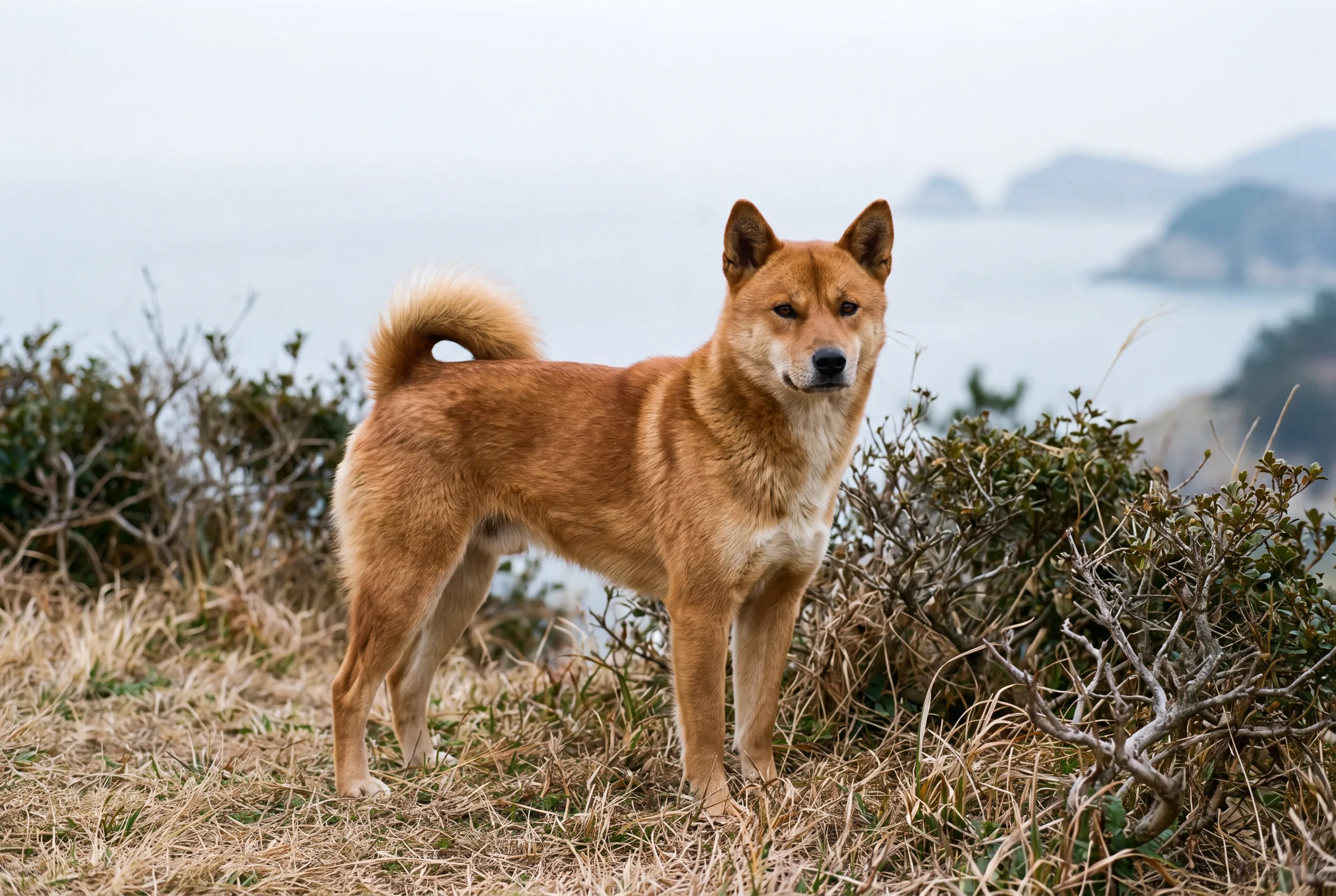
Korean Jindo
Korea's national dog — one owner, one answer, and a gate you will have to rethink.
Vital stats
| Size | Medium · 45–55 cm |
| Weight | 15–23 kg |
| Life expectancy | 12–15 years |
| Energy | High — a hunter that also patrols |
| Shedding | High in season — two heavy moults a year |
| Coat | Dense double coat · red fawn, white, black, black and tan, wolf grey or brindle |
| Group | Non-Sporting · Asian Spitz (FCI №334, Group 5) |
| Origin | Jindo Island, South Korea |
| FCI group | 5 — Spitz and primitive types · FCI 334 |
Breed traits
Friendliness
Care
Mind
The Korean Jindo by the numbers
The Korean Jindo facts owners search for most — price, lifespan, weight, shedding and colours, in one place.
Less common, so expect a waitlist and some travel to a reputable breeder — which pushes the price up. Plan for steady ongoing costs — mid-range food, routine vet care and insurance.
We don't quote a single figure: the real price swings with breeder, region, bloodline and health testing — and a rescue costs a fraction of a breeder's litter. Adopting is almost always the cheapest route.
Temperament
Jindo owners tend to describe the same dog. Quiet indoors, house-clean almost from the day it arrives, fixed on one person, and switched on the instant somebody reaches the gate. The standard's word for it is faithful, and the loyalty comes with a catch: a Jindo that has already given itself to someone rehomes badly, and the standard says plainly that it stays attached to a previous owner. Underneath the calm sits the hunting instinct. A cat crossing the garden, a rabbit in the hedge, a deer trail — the dog is committed before you finish the word. It also dislikes dogs of its own sex, which the standard states outright and which multi-dog households confirm year after year. It is not a difficult dog to live with, but it is a dog that makes its own decisions and expects a reason when you overrule one.
Habits & quirks
Knows the way back
In 1993 a white Jindo sold from the island to Daejeon, roughly 300 km away, turned up at her old owner's door seven months later. Jindo County put up a statue of her in 2004. The homing reputation rests on a handful of stories like hers, not on anything measured.
Treats a fence as a first draft
Climbing, digging, testing the latch with a paw — Jindos work a boundary the way they work a hillside, patiently and from every angle. Owners talk about their fences the way other people talk about their cars.
Tidy without being asked
The standard notes that it eats sparingly and keeps itself clean, and owners back it up: little doggy smell, careful about where it puts its feet, house-trained in days. It is the easiest thing about the breed.
Picks a person and stays picked
It will be polite to the whole household and only really work for one of you. Visitors get watched from across the room, not greeted — a Jindo warms up on its own schedule or not at all.
Care
| Exercise | One to two hours a day — long walks, hiking, scent games, a long line in open country. Fencing matters as much as mileage: 1.8 m, dig-proof at the base, no climbable furniture near it. |
| Grooming | Brush the double coat weekly and daily through the two heavy moults, when the undercoat lifts out in sheets. Bathing is rarely needed; the coat sheds dirt on its own. |
| Training | Reward-based, short, and started young, with heavy socialisation before 16 weeks. It learns quickly and complies selectively; recall is the piece most owners never fully win, so plan around a long line rather than hope. |
| Health | Generally sound. Hypothyroidism and skin allergies are the two most reported problems in the breed; ask breeders about hip scores, thyroid testing and eye checks, cataracts included. |
Life expectancy
This breed has a typical life expectancy of 12–15 years.
Similar breeds
Breeds with a similar build and background — worth a look if this one isn't quite the fit.
Breeds that look like this
Common questions
Is a Jindo a hard dog to own?
Harder than most, in three specific ways. Recall is unreliable once prey drive engages, so off-lead freedom is limited to enclosed ground. Escaping is a hobby — secure fencing is a purchase, not a precaution. And same-sex dog intolerance is common enough that a second dog needs planning rather than optimism. What you get back is a clean, quiet, devoted house dog that asks very little else.
Can you export a Jindo from Korea?
Not casually. Only dogs born on Jindo Island can be registered as Jindo by the government, and moving a registered dog off the island requires a transport permit from the county under the Natural Monument protection rules. Puppies of Jindo parents born on the mainland or abroad are not covered by that regime and are what most overseas breeders and rescues actually place.
Do Jindos really find their way home?
Some have, over distances that are hard to explain, and the 1993 case is documented well enough to have made national news. It is a collection of remarkable individual stories rather than a proven breed ability, and nobody has tested it properly. Treat it as folklore with real cases behind it, not as a reason to trust the dog off-lead.
Does the Korean Jindo shed a lot?
Yes — the Korean Jindo is a heavy shedder, dropping hair year-round or in big seasonal moults. Brush it several times a week and expect regular vacuuming; it isn't the coat for you if loose fur is a dealbreaker.
Is the Korean Jindo hypoallergenic?
Not really. No dog is truly hypoallergenic, and the Korean Jindo's shedding coat releases plenty of the dander that sets off allergies. If someone at home is allergic, this isn't the easiest breed to live with — spend time around one first.
Is the Korean Jindo good with children?
They can be. The Korean Jindo is reasonably sociable and can be good with children in the right home, especially when socialised early. Supervise around young kids and teach dog and child to respect each other.
Is the Korean Jindo easy to train?
Reasonably. The Korean Jindo is trainable with consistency and rewards, though it isn't the quickest study. Keep sessions short and positive, and be patient with the basics like recall.