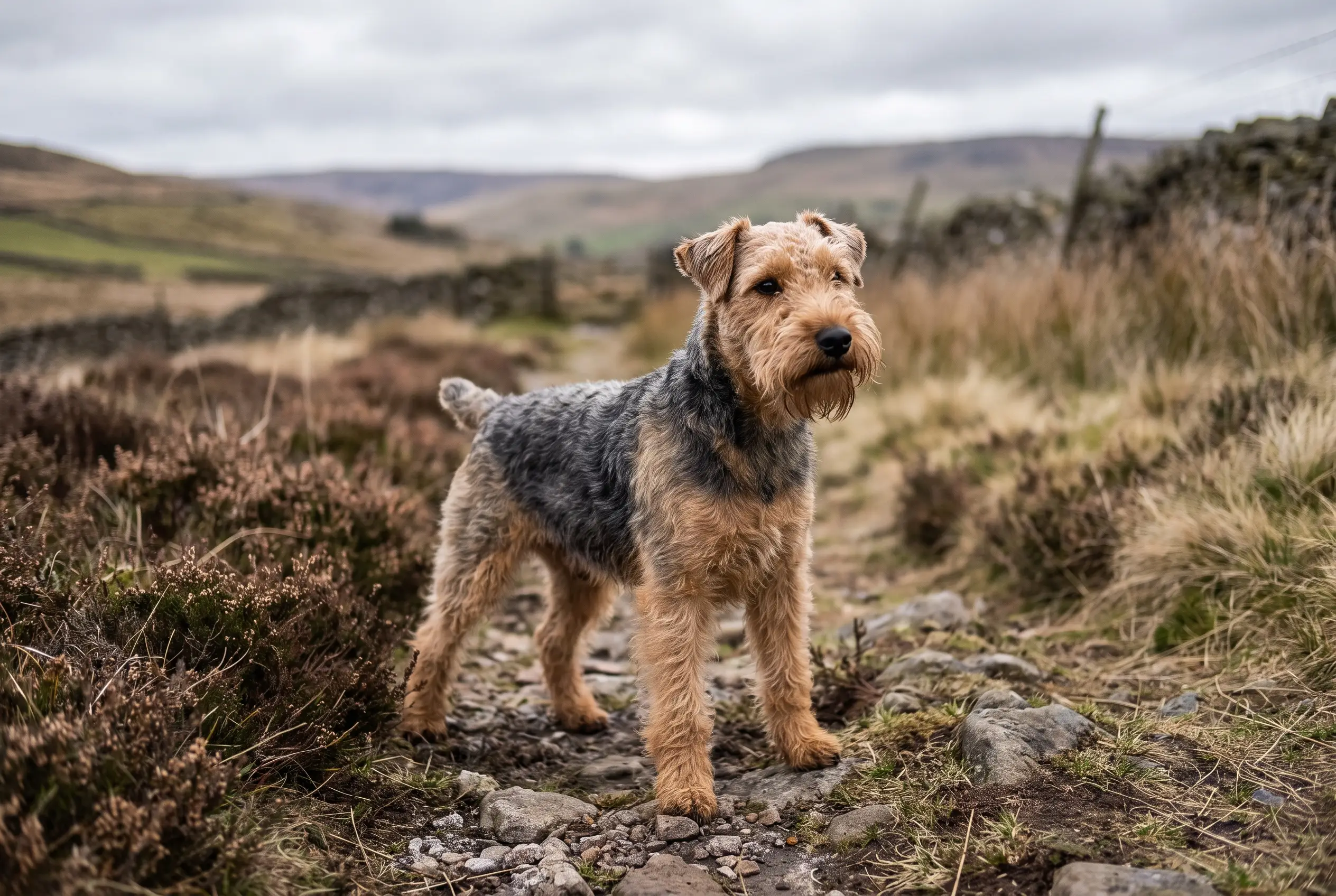
Lakeland Terrier
The fell farmer's fox-proof terrier — small, square and afraid of nothing on the mountain.
Vital stats
| Size | Small · 33–37 cm |
| Weight | 7–8 kg |
| Life expectancy | 12–15 years |
| Energy | High — 60 min/day |
| Shedding | Minimal — wiry coat needs stripping |
| Coat | Hard, wiry topcoat · wheaten, red, black & tan, grizzle, blue |
| Group | Terrier · FCI №70 / AKC |
| Origin | Lake District, England |
| FCI group | 3 — Terriers · FCI 70 |
Breed traits
Friendliness
Care
Mind
The Lakeland Terrier by the numbers
The Lakeland Terrier facts owners search for most — price, lifespan, weight, shedding and colours, in one place.
Widely bred, so you can usually find a litter from a registered breeder without a long wait. Ongoing costs stay modest — it eats little and routine vet care sits at the lower end. Its coat also needs a professional groom every few weeks — a real line in the budget.
We don't quote a single figure: the real price swings with breeder, region, bloodline and health testing — and a rescue costs a fraction of a breeder's litter. Adopting is almost always the cheapest route.
Temperament
Bred to follow foxes into the rock crevices of the Lake District fells — terrain too steep for horses and too tight for bigger terriers — the Lakeland is brave, athletic and admirably sure of itself. At home that translates to a merry, affectionate companion with strong opinions, quick reflexes and zero tolerance for anything rodent-shaped.
Habits & quirks
Fell-walker mode
Rain, wind and rough ground don't register; this dog was built for Cumbrian weather.
The perimeter shout
Anything unusual gets announced with a sharp, confident terrier bark.
Rock-hopping
Walls, boulders and furniture are all terrain — Lakelands climb with startling agility.
The stubborn sit
Ask nicely twice and it complies; demand, and it develops sudden deafness.
Care
| Exercise | A brisk hour daily with off-lead running only in safe, enclosed spaces — recall loses to a fleeing squirrel. |
| Grooming | Hand-strip the wiry coat two or three times a year to keep colour and texture; clipping is easier but softens both. |
| Training | Short, upbeat, reward-based sessions — this terrier works with you, never for you. |
| Containment | A confident digger and climber; check fences at the bottom and the top. |
Life expectancy
This breed has a typical life expectancy of 12–15 years.
Similar breeds
Breeds with a similar build and background — worth a look if this one isn't quite the fit.
Breeds that look like this
Common questions
Do Lakeland Terriers shed?
Very little — the hard, wiry coat holds its dead hair until stripped or clipped out every few months. That makes them a tidy choice for house-proud owners willing to book the groomer.
Are Lakeland Terriers good family dogs?
Yes, for families who enjoy a lively, confident small dog — they're sturdy, playful and less fragile than many small breeds. Teach children to respect the terrier attitude and everyone gets along.
How is a Lakeland different from a Welsh Terrier?
They share the square outline and wiry coat, but the Lakeland is smaller, lighter and comes in more colours than the black-and-tan Welsh. Its fell-hunting past also left it a touch more independent.
Is the Lakeland Terrier hypoallergenic?
No dog is truly hypoallergenic, but the Lakeland Terrier comes closer than most: its low-shedding coat releases less of the dander that triggers allergies. Many allergy sufferers manage well with this breed, but spend time around one before committing.
Is the Lakeland Terrier easy to train?
Reasonably. The Lakeland Terrier is trainable with consistency and rewards, though it isn't the quickest study. Keep sessions short and positive, and be patient with the basics like recall.