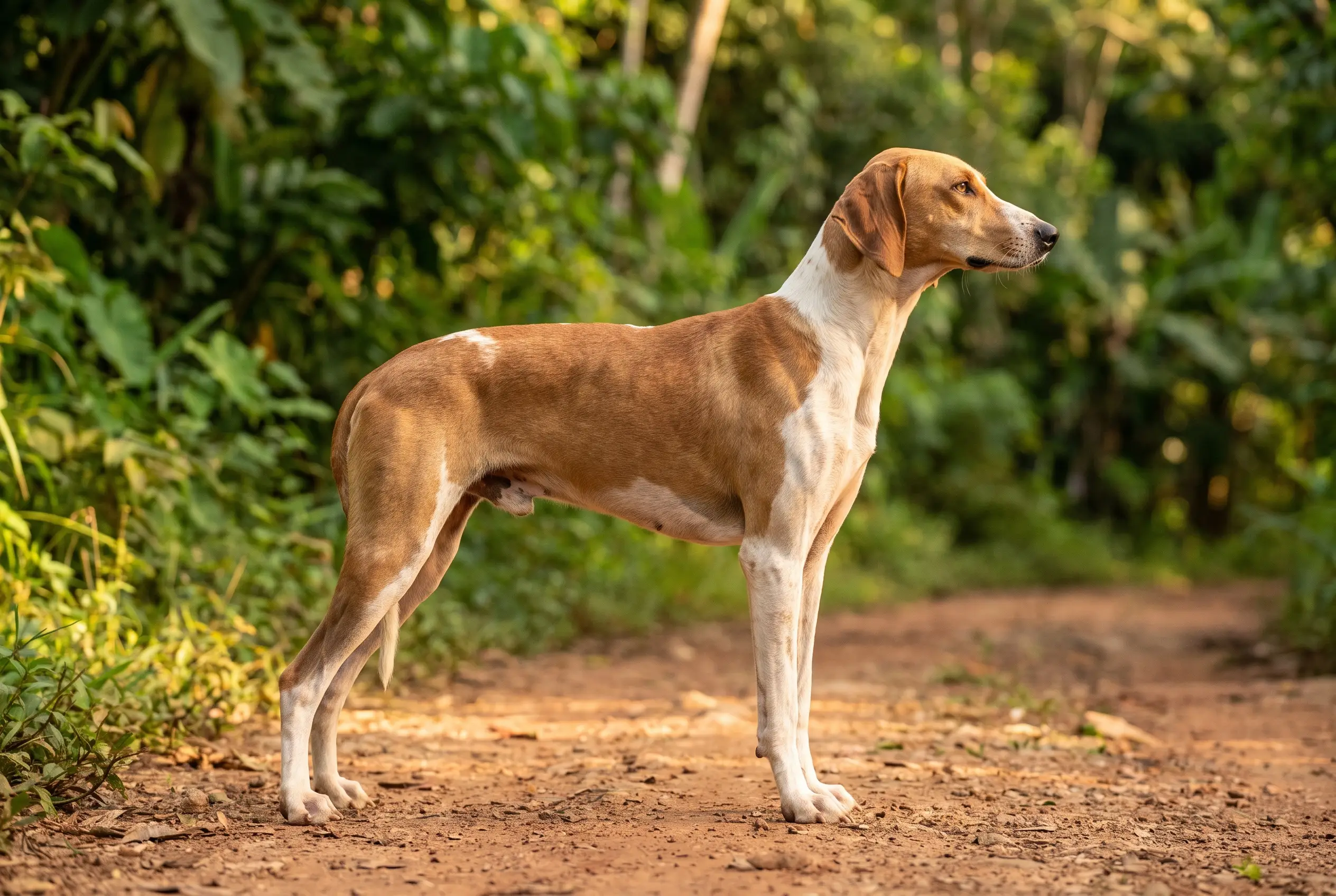
Sabueso Fino Colombiano
Colombia's own hound — provisionally recognised by the FCI only since February 2026, after two centuries of work.
Vital stats
| Size | Medium-large, two varieties · Standard 45–50 cm, Grande 51–58 cm (±2 cm tolerance) |
| Weight | Standard 15–25 kg · Grande 25–35 kg — both figures are in the FCI standard itself |
| Life expectancy | 12–14 years — estimate; no FCI, club or survey source publishes a figure |
| Energy | High — bred to work jungle, mountain and lowland climates alike |
| Shedding | Low to moderate — short or wire coat, no undercoat blowout documented |
| Coat | Short or wire, dense · red, black, brown or grey, with or without white; merle disqualifies |
| Group | Hound · Scent Hounds (FCI №376, Group 6) |
| Origin | Colombia |
| FCI group | 6 — Scent hounds and related breeds · FCI 376 |
Breed traits
Friendliness
Care
Mind
The Sabueso Fino Colombiano by the numbers
The Sabueso Fino Colombiano facts owners search for most — price, lifespan, weight, shedding and colours, in one place.
Less common, so expect a waitlist and some travel to a reputable breeder — which pushes the price up. Ongoing costs run high — more food, bigger doses at the vet, and pricier insurance.
We don't quote a single figure: the real price swings with breeder, region, bloodline and health testing — and a rescue costs a fraction of a breeder's litter. Adopting is almost always the cheapest route.
Temperament
The standard's own behaviour clause reads: "Stubborn in hunting, affectionate at home, and excels as a companion dog. Due to its hunting instincts, it is capable of living in groups with other dogs and is friendly towards strangers." That is a dog built to argue with you on a hot trail and settle down the moment it walks back through the door — the same stubbornness that keeps it working a scent long after a less driven dog would give up. Its tolerance for other dogs traces directly to how it was used: hunted in loose groups rather than worked solo, unlike some of the more solitary Old World scenthounds in its own ancestry. None of that toughness carries over to people it doesn't know; the standard calls it friendly towards strangers outright, not merely tolerant.
Habits & quirks
A newly minted FCI breed
The Colombian kennel club, the Asociación Club Canino Colombiano, had been building a studbook and pedigree records since around 2015; the FCI itself only granted provisional recognition on 11 February 2026. That makes it, as of this writing, one of the newest breeds on the FCI's books anywhere in the world — and provisional status can still be withdrawn or take years to become definitive.
Four names, one dog
Ask for it by region and you get a different word every time: Tinajero in Santander, Chapolo on the Caribbean coast, Bramador in Antioquia, Aullador — literally 'howler' — elsewhere in the country. All of them describe the same dog; 'Fino' is simply the name that stuck nationally.
Sized to the game, not the ring
Colombian breed history ties the standard-sized dog to smaller prey — paca, agouti, capybara and other furred game — and the larger grande variety to deer and tapir. The FCI standard doesn't repeat this rationale itself, but it does keep the two sizes as separate, equally valid varieties rather than ranking one above the other.
Hunting is the one thing it can no longer legally do
Sport hunting has been banned in Colombia since 2019, cutting off the job this breed was built for. Breed advocates are now pitching it for search-and-rescue work instead, on the strength of the same nose that used to trail paca through the jungle.
Care
| Exercise | Bred to work jungle, mountain and lowland heat up to 30°C without slowing down, this is not a dog satisfied by a short walk. Give it real daily distance and, where legal hunting work isn't an option, scent-based games and tracking practice to stand in for it. |
| Grooming | The short-coat variety needs only an occasional brush. The wire-coat variety carries a harder, denser outer coat with an undercoat, plus a small beard and thick eyebrows, and benefits from the hand-stripping care typical of other wire-coated hounds rather than simple brushing. |
| Training | The standard's own word for it on a trail is stubborn; at home, it calls the same dog affectionate and companionable. Expect a dog that argues with a scent it wants to follow and settles easily otherwise — patient, consistent training beats a firm hand. |
| Health | No FCI standard or Colombian club material documents a breed-specific disorder. The breed is young to international registration and still building pedigree depth outside Colombia, with reports of crossbreeding into local beagle and Basset Hound populations diluting the type at home — worth raising directly with any breeder, wherever you find one. |
Life expectancy
This breed has a typical life expectancy of 12–14 years — estimate; no FCI, club or survey source publishes a figure.
Similar breeds
Breeds with a similar build and background — worth a look if this one isn't quite the fit.
Breeds that look like this
Common questions
Has the FCI actually recognised the Sabueso Fino Colombiano yet?
Only provisionally, and only since 11 February 2026 — checked directly against the FCI's own nomenclature page rather than assumed. Provisional recognition means the breed can compete for FCI-sanctioned titles but not for the CACIB award reserved for definitively recognised breeds, and provisional status can take years to convert, or in rare cases lapse. As of today this is a newly and partially recognised breed, not a long-settled one.
Is the Sabueso Fino Colombiano descended from the Sabueso Español (FCI №204)?
Partly, and only as one strand among several. Colombian sources trace it to scenthounds and pointing dogs that arrived from Spain, Britain and North America between roughly 1550 and the nineteenth century, crossed over generations with local criollo dogs. Spanish-origin hounds were part of that founding mix, but so were French and British scenthound lines and early coonhound stock — and the modern Sabueso Español itself wasn't fixed to a written standard until 1982, long after that colonial-era stock had already gone its own way in the Americas. Call it shared ancestry through old, mixed colonial dogs, not a straight line from one breed to the other.
Can you still hunt with a Sabueso Fino Colombiano in Colombia?
Not legally, as sport hunting has been banned nationwide since 2019 — the activity this breed was built for two centuries to perform. Some rural use reportedly continues informally, but the breed's future case is increasingly made as a companion dog and a candidate for search-and-rescue work, trading the field for a different use of the same nose.
Does the Sabueso Fino Colombiano shed a lot?
Moderately. The Sabueso Fino Colombiano sheds a fair amount, steadily through the year with heavier seasonal patches. A weekly brush keeps most of the loose hair off your floors and clothes.
Is the Sabueso Fino Colombiano hypoallergenic?
Not really. No dog is truly hypoallergenic, and the Sabueso Fino Colombiano's shedding coat releases plenty of the dander that sets off allergies. If someone at home is allergic, this isn't the easiest breed to live with — spend time around one first.
Is the Sabueso Fino Colombiano good with children?
Generally yes. The Sabueso Fino Colombiano is a friendly, people-loving breed that usually does well with children when raised and socialised well. As with any dog, teach children to be gentle and supervise around toddlers.
Is the Sabueso Fino Colombiano easy to train?
Reasonably. The Sabueso Fino Colombiano is trainable with consistency and rewards, though it isn't the quickest study. Keep sessions short and positive, and be patient with the basics like recall.