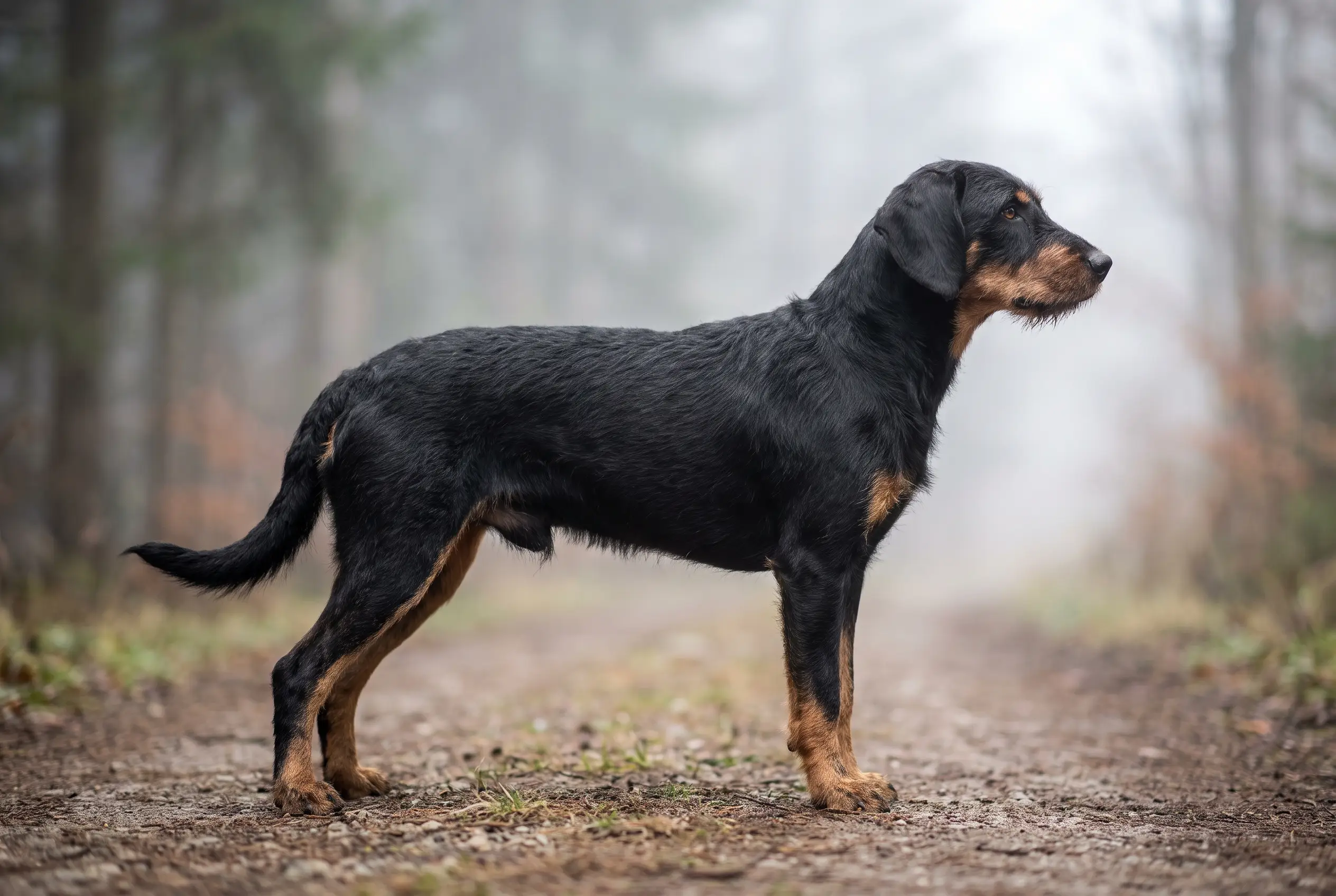
Slovenský Kopov
Slovakia's national hunting dog — always black and tan, built to hold a wild boar rather than back off it.
Vital stats
| Size | Medium · 45–50 cm (dogs), 40–45 cm (bitches) |
| Weight | 15–20 kg · ideal 16 kg |
| Life expectancy | 12–14 years — breed literature, not survey data |
| Energy | High — built for hours-long trailing over rough ground |
| Shedding | Moderate — dense winter undercoat that the standard says must not disappear in summer either |
| Coat | Short-medium, coarse, dense · always black with tan markings |
| Group | Hound · Medium-sized Scenthound (FCI №244, Group 6) |
| Origin | Slovakia |
| FCI group | 6 — Scent hounds and related breeds · FCI 244 |
Breed traits
Friendliness
Care
Mind
The Slovenský Kopov by the numbers
The Slovenský Kopov facts owners search for most — price, lifespan, weight, shedding and colours, in one place.
Less common, so expect a waitlist and some travel to a reputable breeder — which pushes the price up. Plan for steady ongoing costs — mid-range food, routine vet care and insurance.
We don't quote a single figure: the real price swings with breeder, region, bloodline and health testing — and a rescue costs a fraction of a breeder's litter. Adopting is almost always the cheapest route.
Temperament
The standard's own behaviour clause is just two sentences: "Spirited temperament. Extraordinarily developed sense of direction." That's it — short, for an FCI hound clause. The vivid material sits one section up, under Utilization, which credits the breed's "keenness" and notes it is "used in its native country for hunting wild boar and predatory [animals]." The standard's French edition renders that same keenness as mordant — closer to bite, or gameness, than the English word lets on. Read the two clauses together and the standard is describing a dog bred to close on a boar and hold there, not just trail one and give tongue about it. None of that reads as unsound: the standard disqualifies dogs that are "aggressive or overly shy," and its only instruction beyond conformation is that dogs used for breeding be "functionally and clinically healthy." The hardness is switched on for game; Slovak breed sources describe the Kopov at home as loyal and even-tempered rather than difficult.
Habits & quirks
Colour is not negotiable
Black with brown-to-mahogany tan markings on the limbs is the only colour the standard allows. White markings, an unclear boundary between the black and the tan, or any other colour at all are faulted outright — there's no room in the ring for a Kopov that reads any other way.
A tail that reports for duty
Pendant and low at rest, the tail comes up sabre-fashion to about 150° the moment the dog goes to work — the standard gives the angle as precisely as it gives the ear length. Watch the tail and you know whether the dog thinks it's on duty.
The only native Slovak scenthound
Slovak sources call the Kopov the sole scenthound breed that originated on Slovak territory — not an FCI standard claim, but a widely repeated one in Slovak breed writing. Every other homegrown Slovak hound, including the much newer, smaller Tatranský durič (FCI №377), traces back to it.
Built for hours, not minutes
The standard's utilization clause describes "enduring hours-long following of a warm trail or scent while giving tongue" — a dog measured on stamina and voice, not top speed, over ground that runs from flat country up into real mountain terrain.
Care
| Exercise | Hours, not minutes. This is a hound bred for endurance work on a scent, over rough and sometimes mountainous ground; hunting, tracking work, or long off-lead hikes with real distance suit it far better than a lead-walk loop. |
| Grooming | The short-to-medium, dense coat needs a weekly brush; the winter undercoat comes in heavier and needs more attention through the cold months, though the standard is explicit that it must not disappear entirely in summer either. |
| Training | The standard's own bar for disqualification is being "aggressive or overly shy" — which means early, consistent socialisation matters more here than with a soft-natured breed, precisely because the dog is bred to have real nerve around game. Recall work has to start early and stay consistent; a hound bred to hold a trail for hours does not give one up easily. |
| Health | Neither the standard nor breed literature documents a widely recognised breed-specific disorder. The population outside Slovakia is small, so ask about pedigree depth and hip health wherever a litter turns up outside the breed's home country. |
Life expectancy
This breed has a typical life expectancy of 12–14 years — breed literature, not survey data.
Similar breeds
Breeds with a similar build and background — worth a look if this one isn't quite the fit.
Breeds that look like this
Common questions
Is the Slovenský Kopov the same dog as the Tatranský durič?
No, though they're closely related — the Tatranský durič (FCI №377) was bred down from undersized and off-colour Kopov puppies. The Kopov is the older, larger, exclusively black-and-tan breed, standing 40–50 cm and worked loose on a trail, baying as it goes. The durič stands well under that, at 36–42 cm, comes in black-and-tan or solid red, and is classified by the FCI as a leash hound — worked on lead to track wounded game to where it fell, rather than run free giving tongue across open country.
Is a boar-hunting dog safe around a family?
The standard's only word on aggression is a disqualification: dogs that are "aggressive or overly shy" are out, full stop. The hardness bred into the Kopov is switched on for game, and breed sources describe it as loyal and even-tempered at home rather than difficult. That said, this is a working hunting breed with real drive and a very developed nose — it wants a job, and a bored Kopov is not an easy houseguest.
Can I get a Slovenský Kopov outside Slovakia?
It's difficult. The Kopov is Slovakia's national breed with real numbers at home, but it is close to unfindable elsewhere — breeders work almost entirely with hunters, and export outside Central Europe is rare. Anyone outside the region should expect a long search and a breeder asking hard questions back.
Does the Slovenský Kopov shed a lot?
Moderately. The Slovenský Kopov sheds a fair amount, steadily through the year with heavier seasonal patches. A weekly brush keeps most of the loose hair off your floors and clothes.
Is the Slovenský Kopov hypoallergenic?
Not really. No dog is truly hypoallergenic, and the Slovenský Kopov's shedding coat releases plenty of the dander that sets off allergies. If someone at home is allergic, this isn't the easiest breed to live with — spend time around one first.
Is the Slovenský Kopov easy to train?
Reasonably. The Slovenský Kopov is trainable with consistency and rewards, though it isn't the quickest study. Keep sessions short and positive, and be patient with the basics like recall.