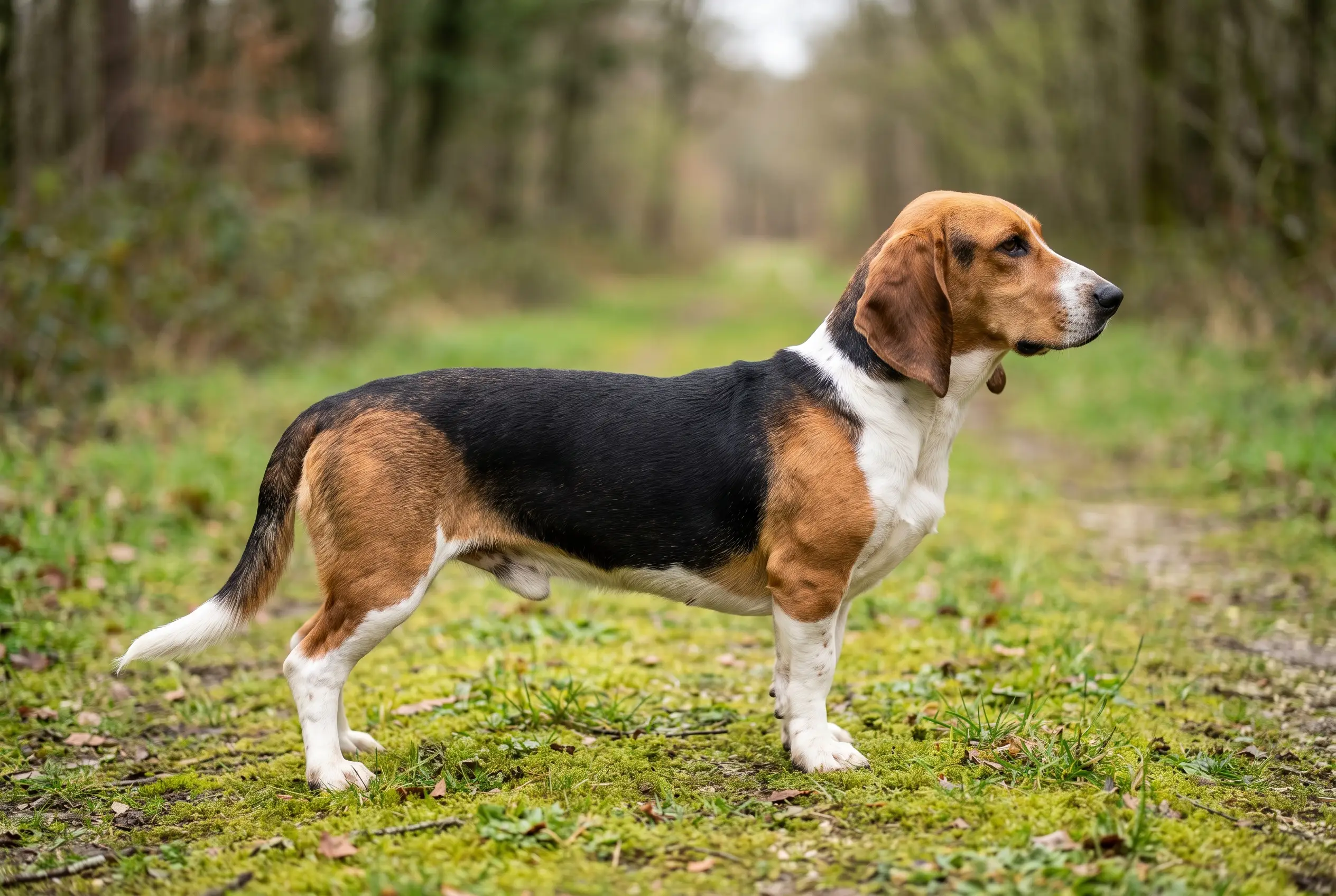
Basset Artésien Normand
The lighter, higher-legged French hound that gave the Basset Hound its name and half its blueprint.
Vital stats
| Size | Small · 30–36 cm (+/-1 cm tolerance for exceptional dogs) |
| Weight | 15–20 kg |
| Life expectancy | 12–14 years — breed literature, not survey data |
| Energy | Moderate-high — built for a full day afield at a working pace, not a sprint |
| Shedding | Low — short, close coat, sheds lightly year-round |
| Coat | Short, close and smooth · tricolour (fawn, black blanket, white) or bicolour (fawn and white) |
| Group | Hound · Small-sized Hounds (FCI №34, Group 6) |
| Origin | France |
| FCI group | 6 — Scent hounds and related breeds · FCI 34 |
Breed traits
Friendliness
Care
Mind
The Basset Artésien Normand by the numbers
The Basset Artésien Normand facts owners search for most — price, lifespan, weight, shedding and colours, in one place.
Less common, so expect a waitlist and some travel to a reputable breeder — which pushes the price up. Plan for steady ongoing costs — mid-range food, routine vet care and insurance.
We don't quote a single figure: the real price swings with breeder, region, bloodline and health testing — and a rescue costs a fraction of a breeder's litter. Adopting is almost always the cheapest route.
Temperament
The standard's own behaviour clause is short: "Gifted with an excellent nose and a melodious voice, persevere but not too fast on the line, he permits his master to fully enjoy the hunting work. Outgoing and of very affectionate nature." Unpack that and it describes a dog built to be followed rather than outrun — it works a line with patience rather than speed, announcing every stage of the hunt with its voice, so the hunter never loses the thread. At home the same "outgoing" and "very affectionate" nature holds; breed literature describes it as sociable with people and other dogs, a habit built over generations of hunting in packs. It is still a hound with a hound's priorities, though — a nose that leads and a voice it likes to use, not a breed that goes quiet on command.
Habits & quirks
A crook, but only half of one
The standard calls for forelegs that are "half-crooked or a little less than half-crooked, provided there is a sufficient principle of crook visible" — not straight, but not exaggerated either. A dog with forelegs "completely straight" is disqualified just as surely as one with an "exaggerated crook with feet turning out excessively" is faulted. The bend exists to widen the stance for working dense cover, not to look dramatic.
Skin kept on a short leash
Compared with the Basset Hound it helped create, this is a tight-skinned dog by design. The standard allows "some folds of skin, without excess" on the pasterns and calls that a quality, lets the neck's dewlap show only "without exaggeration," and permits the haw of the lower eyelid to show "sometimes... without excess." Three separate clauses, each capped at the same phrase — none of it reads like a deep-wrinkled show dog.
Ears sized to the muzzle, not the floor
The ear leathers are set as low as possible and "well curled inwards corkscrew fashion," long enough to reach at least the length of the muzzle and ideally taper to a point. Set above the line of the eye, and it's a fault before a judge even gets to anything else.
A name built from a truce
Two breeders built two different dogs from the same 19th-century Basset stock — Le Couteulx de Canteleu's straight-legged Artois type and Louis Lane's crook-legged Norman type — and only in 1924 did the club settle on one shared name. The standard's own history section quotes the Société de Vénerie's 1930 ruling that the breed "should not be but one stage of transition towards a Norman type, without any trace of Artois" — the Artois side effectively voted itself out. The Chien d'Artois (FCI №28) carries the other half of that split name today, and it's the straight-legged type that lost the argument, not the same dog.
Health
The breed standard covers little beyond general soundness, so there's no official checklist here — but the shape itself asks for some sensible care. This is a long-backed, short-legged hound, and a long spine on short legs does better carrying no extra weight and doing less repeated jumping on and off the furniture, so keeping him lean is the single kindest thing you can do for his frame. The long, low-set ears trap warmth and moisture and want checking and cleaning as a routine, not a rescue mission. And a nose like this comes with its own risk: a hound head-down on a scent will follow it across a road, so a secure garden and a reliable recall are health measures too. Buy from a breeder who health-tests and knows their lines.
Nutrition
| Exercise | This is a hunting hound built for a full outing on foot, not a lapdog with short legs for decoration. Give it real daily distance — a couple of hours split across the day suits it better than one long walk — with a scent trail or open ground to work; the standard's own words, "persevere but not too fast," describe a dog that keeps going rather than sprints. |
| Grooming | The short, close coat needs only a weekly brush. The real routine is the ears — long, low-set and curled in on themselves, they trap moisture and want a regular check and clean — plus an occasional look at the light folds of skin on the cheeks and pasterns the standard itself permits, in case damp or debris collects there. |
| Training | A nose-led hound will always outvote a half-hearted recall, so start early and keep sessions short and reward-based. The standard's promise of an "agreeable" nature holds at home, but this is still a scenthound selected to open on a trail and stay on it — treat a wandering nose as instinct doing its job, not disobedience. |
| Health | Breed-club advice, not the standard: a long back on short legs carries a real risk of intervertebral disc disease, so ask a breeder about back problems in the parents and grandparents, and keep an adult dog lean — every extra kilo is more load on that spine. The standard itself sets no health section beyond the FCI's general soundness clause (functionally and clinically healthy parents, breed-typical conformation), so pedigree depth and a breeder's own health record are what to lean on. |
Feed to keep this hound lean — with a long back and short legs, every extra kilo is weight the spine has to carry, so a visible waist matters more here than on a square-built dog. The catch is that a Basset Artésien Normand is a scenthound to the core, which usually means a persuasive beggar and a talented counter-surfer, and a soft touch at the food bowl adds up fast. Weigh the meals, fold every treat into the day's total, and let the scale, not the pleading, decide the portion.
Puppy guide
A Basset Artésien Normand puppy is long and low from the start, and the growing months are exactly when you protect that frame: keep the exercise gentle and low-impact, and don't let a young pup launch itself off sofas and down full flights of stairs while the joints and the long back are still forming. Otherwise, raise the hound you'll want to live with — socialize him widely, get him used to having those long ears handled and cleaned, and start recall early and make it rewarding, because you're teaching it against a nose that will one day have very different ideas.
Training
Train a Basset Artésien Normand as the independent, nose-led hound it is, not as an obedience prospect. It's affectionate and sociable and takes well to reward-based, upbeat sessions, but it was bred to work a line on its own initiative and give voice while doing it — so a rock-solid recall is the hard part and the important part, and a dog that has caught a scent may simply stop hearing you. Keep sessions short, make coming back pay better than the trail, and accept that some of that voice is part of the deal.
Life expectancy
Basset Artésien Normands live 12–14 years — breed literature, not survey data. The Basset Artésien Normand is a hardy working hound with a good span in front of it, and you hold it near the top of that range by minding the things its build asks for: a lean weight off a long back, ears kept clean, teeth and nails kept up, and enough walking and scent work to keep a busy hound sound in body and mind.
Similar breeds
Breeds with a similar build and background — worth a look if this one isn't quite the fit.
Breeds that look like this
Common questions
Is the Basset Artésien Normand just a French Basset Hound?
No — related, but not the same dog twice. The Basset Artésien Normand is FCI standard No. 34, a lighter, higher-on-the-leg working hound still used to hunt rabbit and hare in France, with far less loose skin and a much more restrained haw and dewlap than its descendant. The Basset Hound is FCI standard No. 163, a heavier dog developed mainly in Britain and America through the 19th century by breeding for more bone, more wrinkle and a lower profile than the original French working type ever called for. Same root stock, two different destinations.
Why does the name combine Artois and Normandy?
Because the breed itself is a merger. Nineteenth-century breeders split a common short-haired Basset stock into two rival types — Count Le Couteulx de Canteleu's straight-legged Artois line and Louis Lane's crook-legged Norman line — and only agreed on the single name Basset Artésien Normand in 1924, after which club chairman Léon Verrier spent the following years pushing the standard further toward the Norman look. The Chien d'Artois (FCI №28) carries the other half of that split name and the straight-legged Artois heritage, but it's a separate breed with its own standard, not a variant of this one.
Is the long back a health risk?
Yes, and it's worth asking about directly. The standard doesn't cover health beyond a general soundness clause, but a long-backed, short-legged breed like this one carries a real risk of intervertebral disc disease, the same concern that applies to Dachshunds and Basset Hounds. That's breed-club advice rather than a standard rule: ask a breeder about back problems in the dog's close relatives, keep the dog lean for life, and go easy on stairs and jumps, especially as a puppy while the spine is still developing.
Does the Basset Artésien Normand shed a lot?
Not much. The Basset Artésien Normand is a low-shedding breed, so loose hair around the home stays minimal. It still needs regular grooming, but you won't be fighting drifts of fur.
Is the Basset Artésien Normand hypoallergenic?
No dog is truly hypoallergenic, but the Basset Artésien Normand comes closer than most: its low-shedding coat releases less of the dander that triggers allergies. Many allergy sufferers manage well with this breed, but spend time around one before committing.
Is the Basset Artésien Normand good with children?
Generally yes. The Basset Artésien Normand is a friendly, people-loving breed that usually does well with children when raised and socialised well. As with any dog, teach children to be gentle and supervise around toddlers.
Is the Basset Artésien Normand easy to train?
Reasonably. The Basset Artésien Normand is trainable with consistency and rewards, though it isn't the quickest study. Keep sessions short and positive, and be patient with the basics like recall.