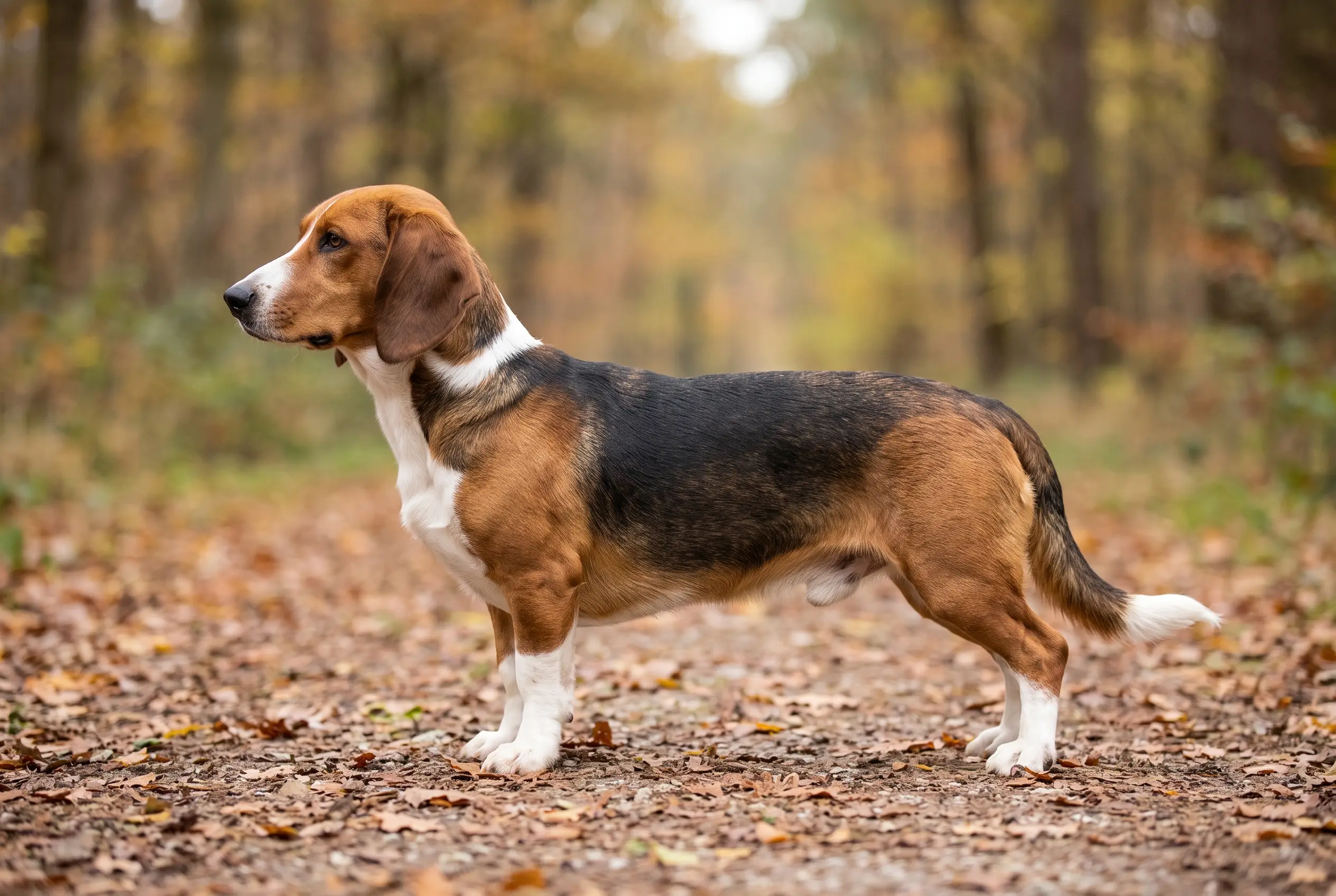
Westfälische Dachsbracke
The short-legged German Bracke, bred so a hunter could keep pace with it on foot — and the dog that became Sweden's Drever.
Vital stats
| Size | Small · 30–38 cm at the withers |
| Weight | 18–24 kg — breed literature; the standard sets no weight |
| Life expectancy | 10–15 years — breed literature, not survey data |
| Energy | High — built to work close cover all day at a walking pace |
| Shedding | Low — short, dense, coarse coat sheds lightly year-round |
| Coat | Short, dense, coarse · red to yellow with black saddle and white Bracken markings |
| Group | Hound · Small-sized Hounds (FCI №100, Group 6) |
| Origin | Germany |
| FCI group | 6 — Scent hounds and related breeds · FCI 100 |
Breed traits
Friendliness
Care
Mind
The Westfälische Dachsbracke by the numbers
The Westfälische Dachsbracke facts owners search for most — price, lifespan, weight, shedding and colours, in one place.
Less common, so expect a waitlist and some travel to a reputable breeder — which pushes the price up. Plan for steady ongoing costs — mid-range food, routine vet care and insurance.
We don't quote a single figure: the real price swings with breeder, region, bloodline and health testing — and a rescue costs a fraction of a breeder's litter. Adopting is almost always the cheapest route.
Temperament
The 1987 standard predates the FCI's now-standard behaviour-and-temperament heading, so the closest thing to one sits inside general appearance: "Facial expression is faithful, friendly, serious and alert." The standard backs that with a hard line at the other end — it disqualifies any dog that is "aggressive or overly shy," so a level, stable nerve is a pass/fail requirement, not a nice extra. Breed-club literature, not the standard itself, fills in the rest: a cheerful, affectionate, playful dog that bonds hard with its family and gets on well with children, carrying real hunting drive and a streak of independence that asks for consistent, early training rather than a soft hand. It is bred, first and always, to work — a Westfälische Dachsbracke content to do nothing all day is the exception, not the rule.
Habits & quirks
The short-legged twin of the Deutsche Bracke
The standard says it outright: this is "the short-legged variety of the German Hound (Bracke)," sharing body shape, coat and colour almost point for point with its taller relative, FCI No. 299. The shortened leg isn't a cosmetic difference — it buys a slower, more deliberate hound that a hunter can follow through close cover on foot, rather than one built to range ahead of him.
Bred for a shrinking Westphalia
As nineteenth-century hunting grounds in Westphalia were split into smaller holdings, hunters needed a hound suited to working them at a walking pace instead of covering open country at speed. Breeders got there by crossing smaller German Brackes with the old Steinbracke, arriving at the compact dog described in the breed's first written record in 1886.
Exported to Sweden, renamed Drever
Westphalians shipped to Sweden from around 1910 were registered there under this breed's own name and put to work tracking deer. In 1947 the larger of the two resulting Swedish size types was given a new name, Drever, and recognised by the FCI in 1955 as its own breed, No. 130 — a direct descendant that still shows the family silhouette and colour pattern.
One of Germany's rarest working hounds
Breed-media estimates put annual registrations at around 35 puppies in Germany, calling it one of the country's most endangered hunting breeds. Puppies go almost entirely to hunters, which keeps the dog close to unknown as a household pet anywhere outside its home region.
Care
| Exercise | This is a hound built to work close cover for a full day at a hunter's own pace, not to sit out a single short walk. Breed literature suggests at least 90 minutes of real daily activity, and scent work or off-lead tracking does more for it than distance alone. |
| Grooming | The short, dense, coarse coat sheds lightly and needs only a weekly brush to stay in order. Check the medium-length, close-fitting ears after a day working wet cover, and keep an eye on weight — the standard's own "strongly developed" build carries no allowance for extra pounds on a working joint. |
| Training | Breed literature describes an intelligent, willing dog with a real streak of independence — it thinks for itself on a trail, which is the point, but it means recall and off-scent obedience need early, consistent work rather than a single round of puppy class. |
| Health | The standard's own closing note restricts breeding to "functionally and clinically healthy dogs, with breed typical conformation." Breed literature flags joint and bone strain from hard fieldwork as the main concern; with such a small population, ask any breeder directly about hip and joint screening and how deep the pedigree runs. |
Life expectancy
This breed has a typical life expectancy of 10–15 years — breed literature, not survey data.
Similar breeds
Breeds with a similar build and background — worth a look if this one isn't quite the fit.
Breeds that look like this
Common questions
Is the Westfälische Dachsbracke just a small Deutsche Bracke?
By the standard's own description, yes and no. It calls the Westfälische Dachsbracke "the short-legged variety of the German Hound (Bracke)," sharing body, coat and colour with the taller Deutsche Bracke (FCI No. 299) almost point for point — but the two carry separate FCI numbers, 100 and 299, because the shorter leg changes the job. It buys a slower, closer-working hound that a hunter can follow on foot through cover, rather than one built to range ahead at pace.
Is this the same dog as Sweden's Drever?
They share a direct line, not an identity. Westphalians exported to Sweden from around 1910 were bred on there as deer trackers under this breed's own name, until the larger of two resulting size types was renamed Drever in 1947 and recognised by the FCI in 1955 as standard No. 130. Since then the Drever has been bred as its own thing in Sweden — still visibly a cousin in silhouette and colour, but a separate breed with its own standard, not a Westfälische Dachsbracke by another name.
Can I get a Westfälische Dachsbracke as a family pet outside Germany?
It's a genuine long shot. The breed is uncommon even at home — breed-media estimates put it at around 35 puppies a year in Germany, almost all of them going to hunters — and it barely exists as a recognised, bred population elsewhere. What you'd be taking on is a working hound bred for a job, with hunting instinct built into it from the standard down; a non-hunting home can work, but finding a breeder at all is usually the first hurdle.
Does the Westfälische Dachsbracke shed a lot?
Not much. The Westfälische Dachsbracke is a low-shedding breed, so loose hair around the home stays minimal. It still needs regular grooming, but you won't be fighting drifts of fur.
Is the Westfälische Dachsbracke hypoallergenic?
No dog is truly hypoallergenic, but the Westfälische Dachsbracke comes closer than most: its low-shedding coat releases less of the dander that triggers allergies. Many allergy sufferers manage well with this breed, but spend time around one before committing.
Is the Westfälische Dachsbracke easy to train?
Reasonably. The Westfälische Dachsbracke is trainable with consistency and rewards, though it isn't the quickest study. Keep sessions short and positive, and be patient with the basics like recall.