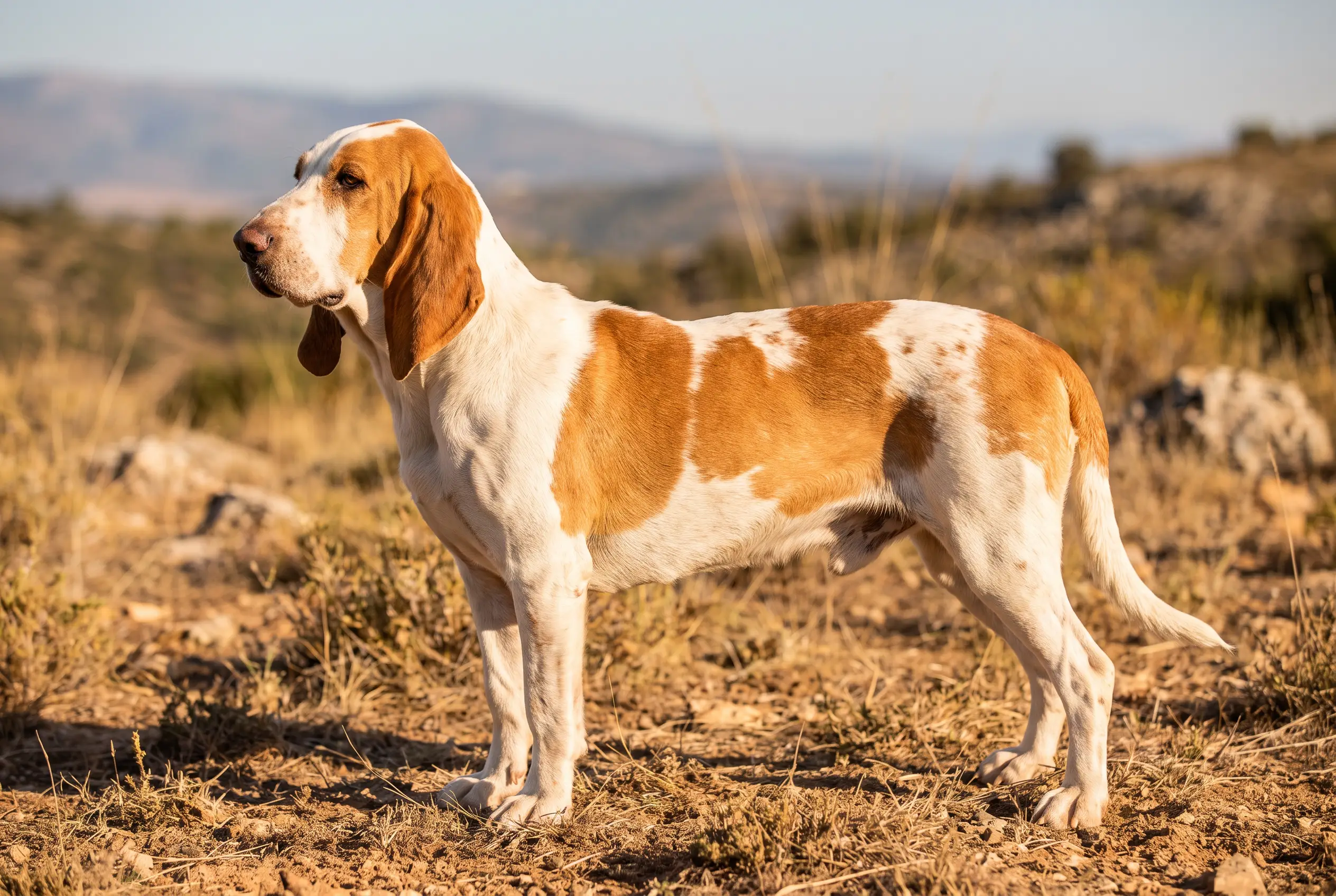
Sabueso Español
White and orange, ears past the nose, built to hunt alone or in twos rather than run in a pack.
Vital stats
| Size | Medium · 52–57 cm (males), 48–53 cm (females); +1 cm tolerated in excellent type |
| Weight | 18–25 kg — estimate; neither the FCI standard nor the RSCE breed page gives a figure |
| Life expectancy | 12–14 years — estimate; no FCI or club source publishes one |
| Energy | High — built for full days on boar, hare and blood-tracking work |
| Shedding | Low — short, fine, flat coat |
| Coat | Short, dense, fine and flat · white and orange in irregular patches, no ticking |
| Group | Hound · Medium-sized Hounds (FCI №204, Group 6) |
| Origin | Spain |
| FCI group | 6 — Scent hounds and related breeds · FCI 204 |
Breed traits
Friendliness
Care
Mind
The Sabueso Español by the numbers
The Sabueso Español facts owners search for most — price, lifespan, weight, shedding and colours, in one place.
Less common, so expect a waitlist and some travel to a reputable breeder — which pushes the price up. Plan for steady ongoing costs — mid-range food, routine vet care and insurance.
We don't quote a single figure: the real price swings with breeder, region, bloodline and health testing — and a rescue costs a fraction of a breeder's litter. Adopting is almost always the cheapest route.
Temperament
The standard's own behaviour clause is short: "He is an affectionate and calm dog which, when out hunting big game, shows extraordinary courage and bravery." Read plainly, that is two different dogs living in one coat — placid at home, and unflinching the moment it is put on a wounded boar. Breed literature adds a detail the standard doesn't spell out: it is generally worked alone or with one or two other hounds rather than run in a large pack, a habit some trace to the broken, rugged ground of northern Spain, where a big pack spreads too thin to stay useful. Whether alone or in a pair, the job stays the same — hold the line and tell the hunter, by voice, exactly what is happening on it.
Habits & quirks
Ears past the nose, corkscrew-twisted
The standard sets a real bar: unstretched, the ear leather has to reach well beyond the tip of the nose, hanging in a loose corkscrew with the vein pattern visible just under the skin. Short ears, or ears that hang straight rather than twist, are exactly the fault the standard was written against.
A running commentary on the hunt
The standard spells out what a hunter should be able to tell from the voice alone: a cold line sounds different from a fresh one, a doubled scent trail different again, and a firm, sustained bay signals the halali — the kill. None of it requires the dog to stay in sight.
White and orange, no third option
Colour is close to binary in the ring: white and orange in irregular patches, with either one allowed to dominate. Any third colour disqualifies outright, and so does tan on the muzzle or legs — a fault the standard names specifically rather than leaving to a judge's discretion.
A working breed by design, not tradition
It is used almost exclusively for hunting with firearms, and the FCI standard still carries a working trial. There is no ring-only or companion-only version of this breed the way there is for many old hunting hounds.
Care
| Exercise | This is an exclusive working breed, still used on wild boar, hare, deer and occasionally wolf across northern Spain, hunting by nose and voice rather than raw speed. Daily distance and real scent work suit it far better than a lead-walk loop around the block. |
| Grooming | The short, fine, flat coat needs only an occasional brush. The real job is the ears: long, hanging and tightly twisted, they trap moisture and are worth a regular check for infection, especially after a day working cover. |
| Training | The standard's own words are calm and brave, not obedient — this is a hunter's dog whose nose and voice were selected for centuries before anyone worried about recall. Early, consistent work on coming back pays off more than any other single lesson. |
| Health | Neither the FCI standard nor the Real Sociedad Canina de España's own materials document a breed-specific disorder. What the RSCE does say, as of 2026, is that it counts the Sabueso Español among sixteen native Spanish breeds it now considers vulnerable — worth asking a breeder about, along with pedigree depth, wherever a litter turns up outside its home region. |
Life expectancy
This breed has a typical life expectancy of 12–14 years — estimate; no FCI or club source publishes one.
Similar breeds
Breeds with a similar build and background — worth a look if this one isn't quite the fit.
Breeds that look like this
Common questions
Is the Sabueso Español the same dog as a Bloodhound?
No. Both are scenthounds prized for tracking wounded game by scent, and both carry long, hanging ears, but they come from separate lineages. The Sabueso Español is FCI standard No. 204, documented in Spain since the late Middle Ages and fixed to a written standard in 1982. The Bloodhound is a much older, larger international breed, FCI standard No. 84 under its own name, Chien de Saint-Hubert, developed in France and Britain by a different route to the same blood-tracking job. The resemblance is functional, not genealogical.
How is it different from Spain's other native hounds, the Podenco and the Galgo?
By body type and job, not just name. The various Podenco types are older, primitive dogs that hunt by sight and scent together, built for rabbit coursing across rough southern ground. The Galgo Español is a pure sighthound, built for a dead sprint over open country. The Sabueso Español is a scenthound in the strict sense — short-legged relative to its length, nose-led and voice-led, built to stay on a cold trail rather than run one down. All three are Spanish; none of them is a variation on the other two.
Is the Sabueso Español an ancestor of the Sabueso Fino Colombiano (FCI №376)?
Indirectly, and only as one strand among several. Colombian sources trace the Fino to scenthounds that Spain, Britain and North America sent to the Americas during the colonial period — sabueso-type dogs among them — crossed over some two centuries with local criollo dogs. That is real Spanish ancestry, but it predates the Sabueso Español's own fixed standard by centuries. The two breeds are cousins through old, mixed colonial stock, not parent and child.
Does the Sabueso Español shed a lot?
Not much. The Sabueso Español is a low-shedding breed, so loose hair around the home stays minimal. It still needs regular grooming, but you won't be fighting drifts of fur.
Is the Sabueso Español hypoallergenic?
No dog is truly hypoallergenic, but the Sabueso Español comes closer than most: its low-shedding coat releases less of the dander that triggers allergies. Many allergy sufferers manage well with this breed, but spend time around one before committing.
Is the Sabueso Español good with children?
They can be. The Sabueso Español is reasonably sociable and can be good with children in the right home, especially when socialised early. Supervise around young kids and teach dog and child to respect each other.
Is the Sabueso Español easy to train?
Reasonably. The Sabueso Español is trainable with consistency and rewards, though it isn't the quickest study. Keep sessions short and positive, and be patient with the basics like recall.