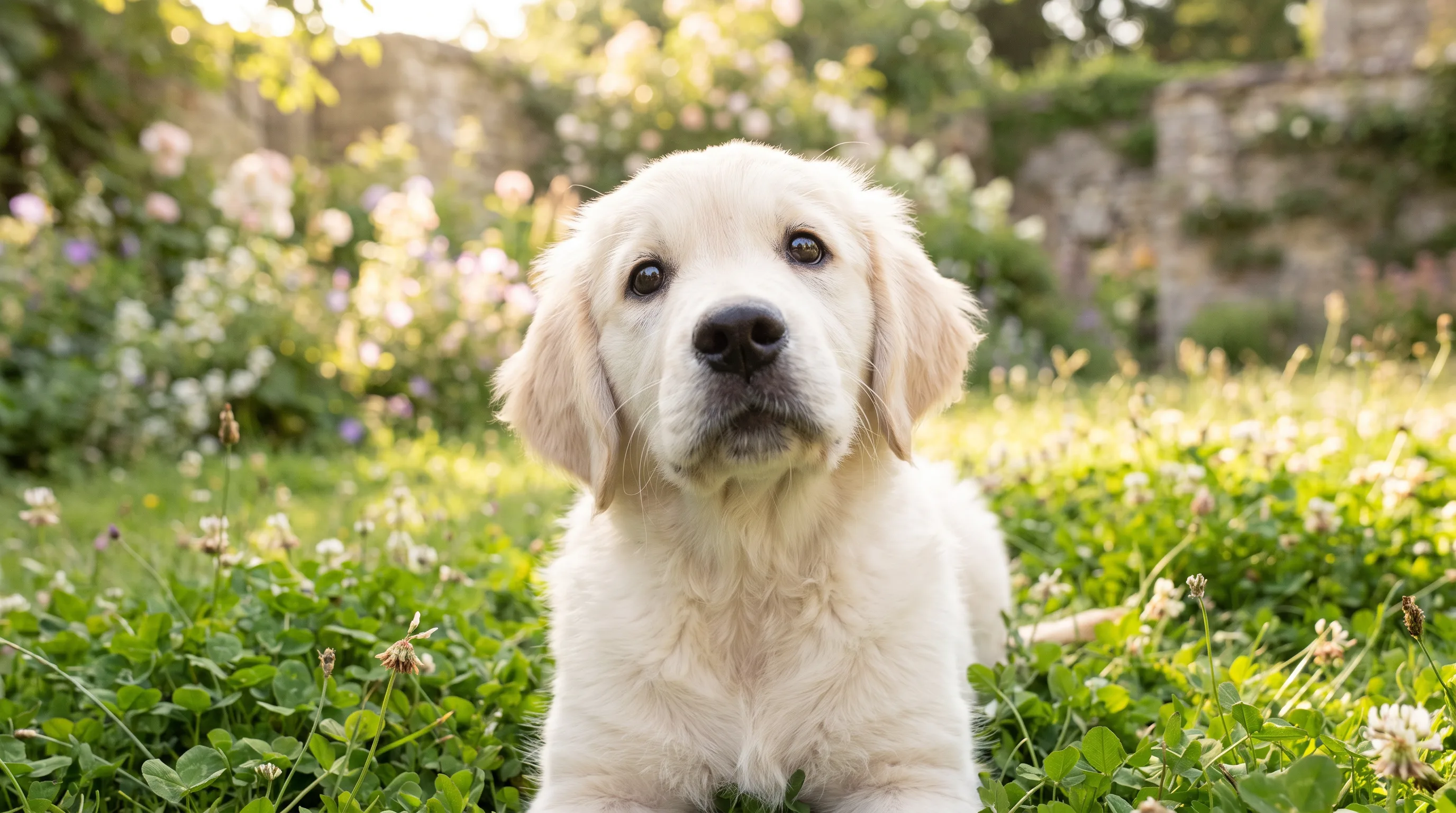
Your puppy's first year: the full timeline
A puppy's first year runs through a predictable set of stages, and knowing what's coming turns a chaotic few months into something you can plan around. From the day you bring an eight-week-old home to its first birthday, the big milestones are vaccinations, the closing socialization window, teething, the teenage phase and the switch to adult food — each on roughly its own schedule. Here's the whole timeline, with the deeper guide for each stage where you'll want it.
8–12 weeks: home, vaccinations and the socialization window
Most puppies come home around eight weeks, and the first job is settling in. Give it a few quiet days to decompress before piling on the world — the 3-3-3 rule is a useful map for those early days and weeks, and our guide to bringing a puppy home covers the practical setup.
Two clocks are ticking at once here. The vaccination course usually starts around 8 weeks with a second dose a few weeks later, and your vet will tell you when your puppy is protected enough to walk on public ground. The other clock is the socialization window, the period up to roughly 12–14 weeks when a puppy most readily accepts new people, dogs, sounds and surfaces as normal. These two pull against each other — you can't yet walk the streets, but you can't waste the window — so socialize safely: carry the pup out to see the world, invite calm vaccinated dogs over, and expose it to household life.
3–4 months: teething and the first training foundations
From around three to six months a puppy loses its baby teeth and the adult set comes through, and it will chew to cope. This is the time for appropriate chew toys and for keeping shoes and cables out of reach, rather than a battle — the urge is physical, not defiance.
It's also when early training pays off most. Housetraining, a reliable name response and the beginnings of recall are worth drilling now, in short, positive sessions, while the puppy is keen and biddable. What you build here is the foundation the harder months lean on.
6–12 months: adolescence, neutering and adult food
Then comes the teenage phase. Somewhere around six months, most puppies hit adolescence, and the biddable pup can turn selectively deaf, test boundaries and forget training that seemed solid. It's normal, it passes, and it's the single most common age dogs get given up — so it's worth knowing it's coming and riding it out rather than taking it personally.
Two decisions land in this window. Neutering timing is no longer one-size-fits-all: many vets now advise waiting until a dog is more physically mature, especially for larger breeds, so this is a conversation to have with yours rather than a fixed date. And the switch to adult food happens as growth finishes — around 12 months for small breeds, later for large and giant ones, which mature more slowly.
When exactly your dog counts as 'grown' depends on its size, and it's worth calibrating your expectations to that rather than the calendar — our guide to dog age milestones by size lays out who finishes growing when.
The one-year mark
By its first birthday a small dog is essentially a young adult, while a large or giant breed is still filling out and maturing mentally for months yet. Either way, the frantic part is behind you: vaccinations are established on a booster schedule, the adult coat and size are close to settled, and the dog in front of you is recognisably the one you'll have for years.
If you're still choosing a breed, or wondering what you signed up for, our guide to choosing a dog by size is the honest place to start.
Common questions
What are the main milestones in a puppy's first year?
The big ones are: coming home and settling (around 8 weeks), the vaccination course and the socialization window (8–14 weeks), teething (roughly 3–6 months), adolescence (from about 6 months), and the switch to adult food as growth finishes (around 12 months for small breeds, later for large ones).
When can a puppy go outside for walks?
Your vet decides this based on the vaccination course — typically a week or two after the second vaccination, often around 12–16 weeks. Before then, socialize safely by carrying your puppy out and inviting calm, vaccinated dogs to visit, so it doesn't miss the socialization window.
When does a puppy calm down?
Not at one year, usually. Puppies get more challenging through adolescence, which starts around 6 months and can run past 18 months, especially in large breeds. Most dogs settle noticeably as they come out the other side of that teenage phase, not on their first birthday.
When should I switch my puppy to adult food?
When growth finishes, which depends on size: around 12 months for small breeds, but 15–24 months for large and giant breeds that mature more slowly. Switching too early can shortchange a still-growing large-breed puppy, so match the timing to your dog's adult size.
When should I get my puppy neutered?
There's no single right age anymore — many vets now recommend waiting until a dog is more physically mature, particularly for larger breeds, rather than a fixed early date. It's a decision to make with your own vet, weighing your dog's breed, size and circumstances.
See also
More in Dogs

When is a dog an adult? Age milestones by size
Small dogs grow up fast and age slowly; giant breeds are seniors at 6. The real age milestones for every size, and why size flips the whole timeline.
The adolescent dog: surviving the teenage phase
Somewhere around six months your trained puppy 'forgets' everything and stops listening. That's adolescence — it's real, it's neurological, and it's when most dogs get given up. Here's how to get through it.

The oldest dog ever and how long dogs really live
Bluey reached 29 years. Bobi's 31-year claim fell apart. Here's the real math on dog lifespan, and how to buy your dog more time.

Senior dog care: what actually changes
An honest guide to a dog's later years: when old age starts, what to watch for, and how to keep the good days coming.

Bringing a puppy home: the first 48 hours
A calm, hour-by-hour plan for a puppy's first two days at home — from puppy-proofing to the first night in the crate.
Puppy vaccinations and the first-year vet timeline
The honest first-year shot schedule, why puppies need a series and not one jab, and how to socialise before the course is finished.