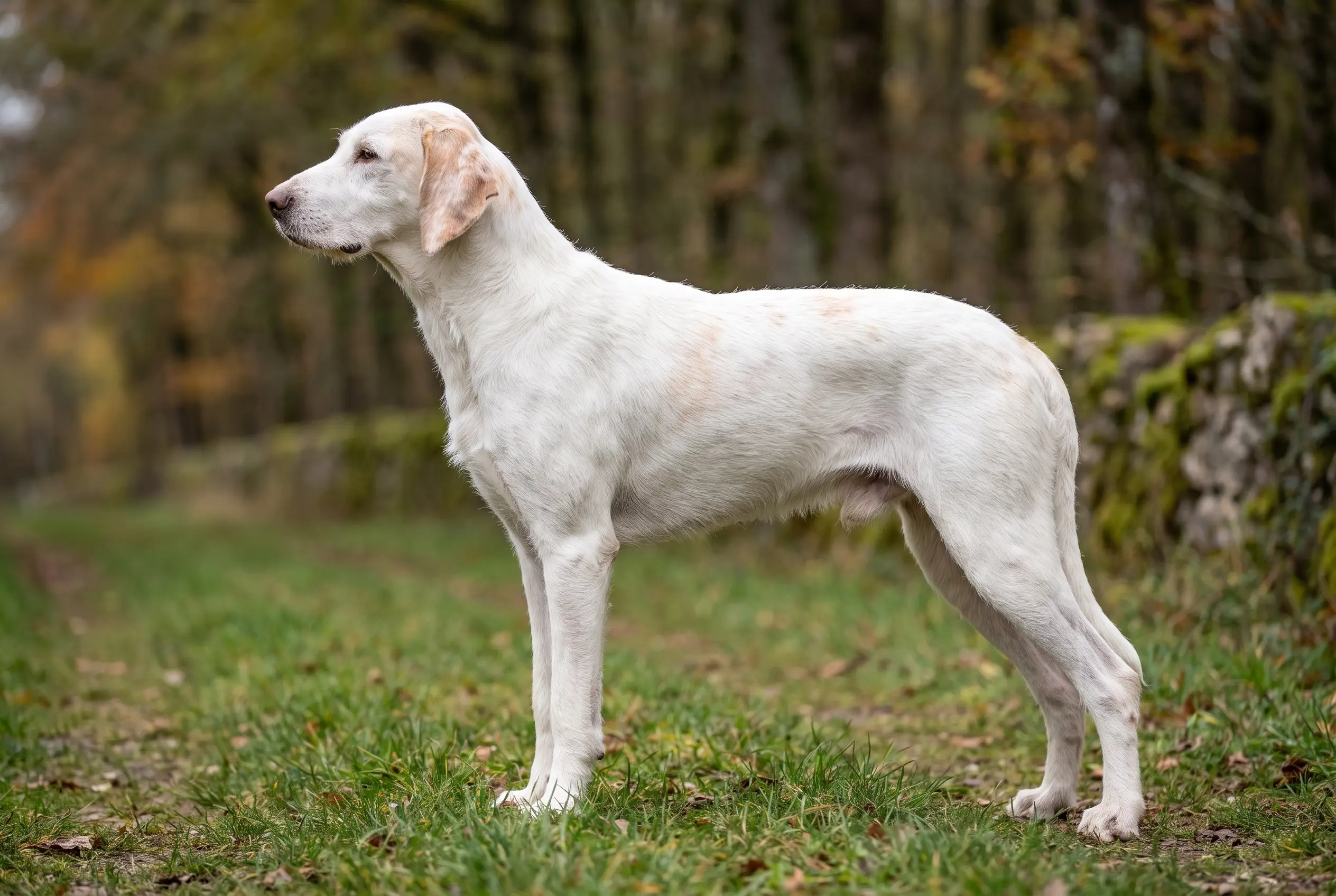
Billy
Built from three strains that no longer exist, at a château in Poitou, then rebuilt from a handful of survivors after two world wars.
Vital stats
| Size | Large · 60–70 cm (dogs), 58–62 cm (bitches) |
| Weight | 23–47 kg — breed literature, estimates vary widely; the standard gives no weight |
| Life expectancy | 10–13 years — breed literature, not survey data |
| Energy | High — bred to cover 40–50 km in a single day's hunt |
| Shedding | Low — short, harsh coat, brushed weekly |
| Coat | Short, harsh, slightly coarse · pure white, milk-coffee white, or white with orange or lemon patches |
| Group | Hound · Large-sized Scenthound (FCI №25, Group 6) |
| Origin | Poitou, France |
| FCI group | 6 — Scent hounds and related breeds · FCI 25 |
Breed traits
Friendliness
Care
Mind
The Billy by the numbers
The Billy facts owners search for most — price, lifespan, weight, shedding and colours, in one place.
Less common, so expect a waitlist and some travel to a reputable breeder — which pushes the price up. Ongoing costs run high — more food, bigger doses at the vet, and pricier insurance.
We don't quote a single figure: the real price swings with breeder, region, bloodline and health testing — and a rescue costs a fraction of a breeder's litter. Adopting is almost always the cheapest route.
Temperament
Billy's standard is an old one, and unlike more recently revised hound standards it has no dedicated behaviour section at all — the closest it comes is a single line under disqualifying faults: "Aggressive or overly shy." Read plainly, that is the FCI ruling out both extremes and saying nothing further; everything else about how the breed actually behaves comes from the hunters who keep it, not from the standard. French hunting writers describe an obedient dog, gentle with children and friendly with the people around it, with one specific and genuinely unusual exception: it is never aggressive except toward its own kind, and that includes dogs in its own pack. For a breed built entirely around pack work, that is an odd trait to carry, and it is the reason Billy packs get managed carefully rather than simply turned loose together. Left without a hunt to run, breed literature has it turning restless and loud rather than destructive — a dog that wants a job, not a cushion.
Habits & quirks
Built from three names that no longer exist
Gaston Hublot du Rivault assembled the Billy at the Château de Billy in Poitou in the 1870s from three hound strains that live on nowhere else today: the Céris, the Montemboeuf and the Larye. He chose the pale coat of the first two over the tricolour pattern of the Larye, and that decision alone is why the breed looks the way it does now.
Rebuilt once already, from a handful of dogs
The original pack broke up in 1927, and the two world wars that followed took the breed further still, down to a small number of survivors by the end of the second one. Du Rivault's son, Anthony, rebuilt it from those few dogs, crossing back to the Poitevin, the Porcelaine and the Harrier — meaning today's Billy carries a genetic bottleneck twice over, not once.
One disqualifying colour: anything but pale
The standard names exactly what's allowed: pure white, milk-coffee white, or white with light orange or lemon patches or mantle. Black or red hair is its own disqualifying fault, listed right alongside a nasal bridge that's too short, too long or too narrow — the pale colour du Rivault selected for is still enforced line by line.
Runs with the pack, argues with its own kind
French hunting writers describe the Billy as obedient and warm with people, with one specific exception: it is never aggressive except toward other dogs, pack-mates included. That's a genuinely strange trait for a breed built entirely around hunting in packs, and it's why a Billy pack is managed rather than left to work out its own order.
Health
The Billy is a big, deep-chested pack hound, and neither its standard nor the breed literature records a signature inherited disease — the honest concerns are the ordinary ones for a dog this size and the unusual one buried in its history. Screen for hip problems, the risk any large hound carries, and check the low-hanging ears every week, since they collect warm damp air and the muck of a day worked through cover. The real thing to ask about is the gene pool: this breed was rebuilt twice from a handful of survivors after the world wars, so anyone looking at a litter should ask how deep the pedigree actually runs. Keep him lean, keep the ears dry, and keep a fence between that nose and the nearest road.
Nutrition
| Exercise | This is a pack hound credited by French hunting literature with covering 40–50 km in a single day's hunt after roe deer and wild boar; a walk around the block does not register. Give it real daily distance, ideally with a scent to follow — hunting, tracking work or long off-lead runs are the only things that come close. |
| Grooming | The short, harsh coat needs only a weekly brush and sheds lightly. Its ears hang low enough to need a regular check and clean, especially after a day spent working through cover. |
| Training | Breed literature calls it obedient and easy around people, but it's also independent enough to lose focus mid-session, so keep training consistent and give it a real reason to listen. Because it does not reliably get along with other dogs outside its own established pack, introductions to unfamiliar dogs need real care rather than the assumption that a pack hound is automatically sociable with every dog it meets. |
| Health | Neither the standard nor breed literature documents a widely recognised disorder beyond what any large, deep-chested hound risks, though hip problems are worth screening for. The more honest concern is the gene pool itself: the breed was rebuilt from a small number of survivors after the world wars, so anyone looking at a litter should ask how deep the pedigree actually runs. |
This is a hunting hound credited with covering 40–50 km in a single day after roe deer and wild boar, and it eats to match — but only on the days it actually works. Feed the dog in front of you: a hard week in the field burns far more than a quiet one at home, and the ration should move with it. Weigh the meals rather than filling the bowl by eye, fold any treats into the day's total, and aim for ribs you can feel under the short, harsh coat. A lean Billy keeps the endurance the breed was built for; a heavy one loses it.
Puppy guide
A Billy puppy is bred for the pack, sweet and biddable with people, and the first year sets the adult you keep. Two things matter most. Get him used to having his low ears handled and cleaned early, so the weekly check is routine rather than a fight; and socialise him widely, because this breed carries an odd streak — it is friendly with people but not reliably friendly with other dogs, its own pack-mates included. Introduce him to unfamiliar dogs carefully rather than assuming a pack hound gets on with everything on four legs. Keep the growing body's exercise sensible on forming joints, teach recall as a well-paid game long before the nose takes over, and give that busy brain a reason to listen.
Training
Breed literature calls the Billy obedient and easy around people, but it is independent enough to drift mid-session, so keep training short, consistent and worth its while. The nose is the competition: this is a dog built to follow a scent for miles, and a cheap reward will always lose to a fresh trail, so pay recall generously every single time and never fully trust it near a road. The one real complication is other dogs — a Billy does not reliably get on with dogs outside its own established pack, so introductions need genuine care rather than the assumption that a pack breed is automatically sociable. Train the recall as if it matters, because one day it will.
Life expectancy
Billys live 10–13 years — breed literature, not survey data. The Billy is a hardy working hound with no long list of breed-specific problems, and you keep it sound the same way you keep it happy: real daily distance with a scent to follow, a lean weight it carries easily, ears checked and dried after every day in the field, and a secure fence so that remarkable nose never leads it somewhere it shouldn't be. Ask a breeder about hip screening and how deep the pedigree runs, and give it the work its body and mind were made for.
Similar breeds
Breeds with a similar build and background — worth a look if this one isn't quite the fit.
Breeds that look like this
Common questions
Why is it called Billy?
After a place, not a person. Gaston Hublot du Rivault bred the dog at his own estate, the Château de Billy, in what is now the commune of Maisontiers in Poitou, and the breed simply took the estate's name. There is no "Billy" the man behind it, and the FCI standard itself lists no alternate title at all.
Is the Billy the same breed as the Porcelaine?
No, though the confusion makes sense — both are pale French scenthounds with orange markings and a history of near-extinction and reconstruction. The Porcelaine (FCI No. 30) is the smaller of the two, 53–58 cm at the withers, with black mottling visible through its white coat and a line that runs back to English Harriers and Swiss hounds. The Billy (FCI No. 25) stands taller, 58–70 cm, and was rebuilt from a different set of vanished French strains at a single estate in Poitou. They're separate breeds that happen to share the same kind of history.
Can I actually get a Billy outside France?
Realistically, no. This is one of the rarest hounds the FCI recognises, kept alive by a small number of French hunting packs and bred almost entirely for pack work rather than pet homes. There is no meaningful export pipeline and no rescue network outside France, and the clubs that exist place puppies with hunters first. Anyone outside French hunting circles who wants one should expect the search itself to be the hardest part of owning one.
Does the Billy shed a lot?
Not much. The Billy is a low-shedding breed, so loose hair around the home stays minimal. It still needs regular grooming, but you won't be fighting drifts of fur.
Is the Billy hypoallergenic?
No dog is truly hypoallergenic, but the Billy comes closer than most: its low-shedding coat releases less of the dander that triggers allergies. Many allergy sufferers manage well with this breed, but spend time around one before committing.
Is the Billy good with children?
They can be. The Billy is reasonably sociable and can be good with children in the right home, especially when socialised early. Supervise around young kids and teach dog and child to respect each other.
Is the Billy easy to train?
Reasonably. The Billy is trainable with consistency and rewards, though it isn't the quickest study. Keep sessions short and positive, and be patient with the basics like recall.