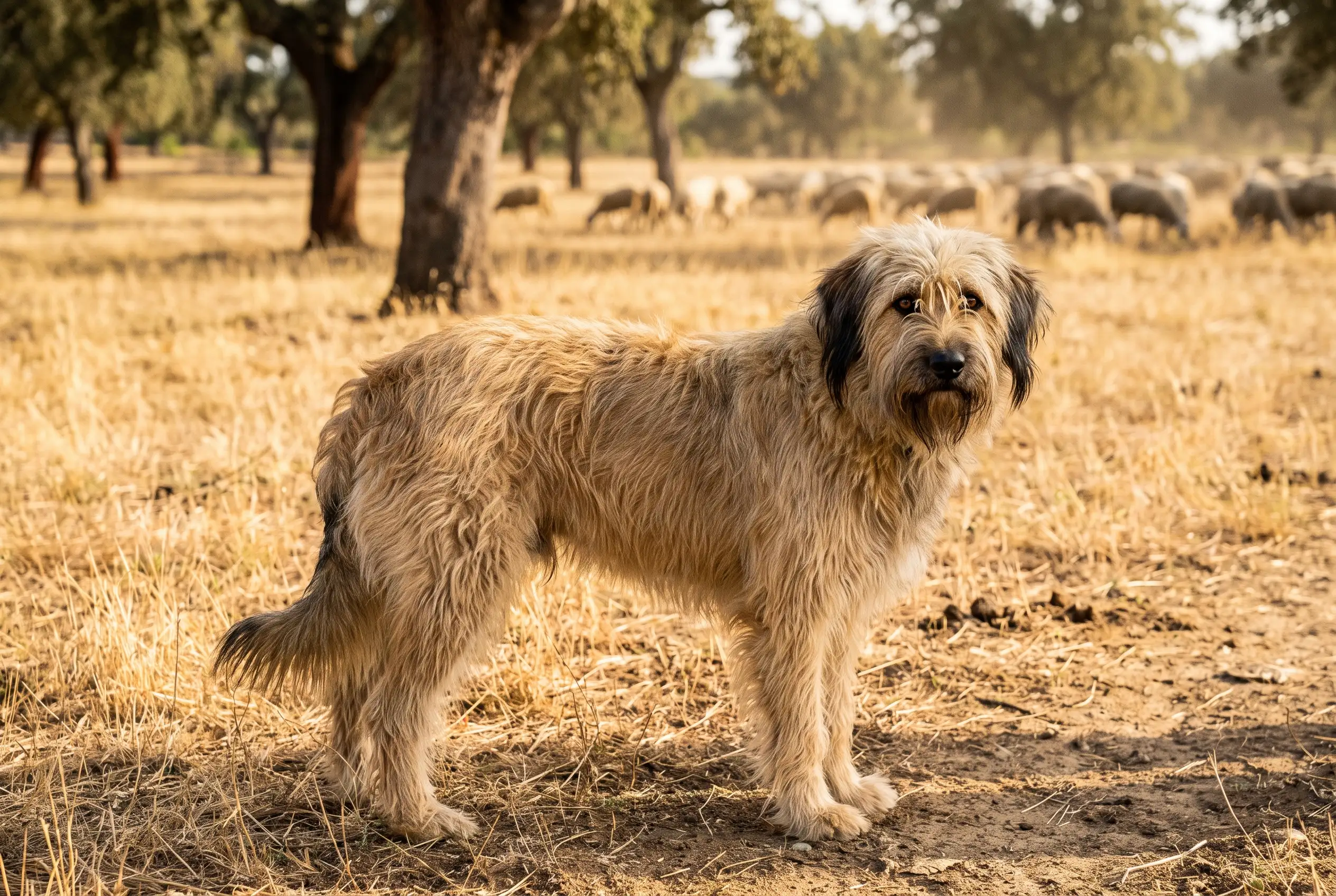
Cão da Serra de Aires
The Alentejo's monkey dog — and the nickname is written into the standard.
Vital stats
| Size | Medium · 45–55 cm (dogs), 42–52 cm (bitches) |
| Weight | 17–27 kg — the standard gives one range for both sexes |
| Life expectancy | 12–13 years — breed literature, not survey data |
| Energy | Very high — bred to cross the Alentejo at a long, suspended trot |
| Shedding | Low — no undercoat, so it drops hair steadily instead of moulting in bulk |
| Coat | Long, straight to slightly wavy, goat-textured, no undercoat · yellow, brown, grey, fawn, wolf-grey or black, with tan markings |
| Group | Herding · Sheepdogs, without working trial (FCI №93, Group 1) |
| Origin | Alentejo, Portugal |
| FCI group | 1 — Sheepdogs and Cattledogs · FCI 93 |
Breed traits
Friendliness
Care
Mind
The Cão da Serra de Aires by the numbers
The Cão da Serra de Aires facts owners search for most — price, lifespan, weight, shedding and colours, in one place.
Less common, so expect a waitlist and some travel to a reputable breeder — which pushes the price up. Plan for steady ongoing costs — mid-range food, routine vet care and insurance. Its coat also needs a professional groom every few weeks — a real line in the budget.
We don't quote a single figure: the real price swings with breeder, region, bloodline and health testing — and a rescue costs a fraction of a breeder's litter. Adopting is almost always the cheapest route.
Temperament
The standard's own words are exceptionally intelligent and very lively, devoted to the shepherd and the herd, somewhat wary of strangers and vigilant at night, and it adds that the work is conducted with joy and pleasure. That last line is doing real work. This is a dog that treats a task as the reward, not the price of the reward, and it will keep offering to do the task long after you have finished asking. At home it is affectionate, physical and noisy in a cheerful way, and it fixes on its own people while keeping a professional distance from everybody else. Left with nothing to organise it organises the household: the children, the other dogs, the vacuum cleaner. It is not a guardian and does not want to be one, but it does notice everything after dark, and it says so. Anyone taking one for the face should take the brain along with it.
Habits & quirks
Tan points are compulsory
In a brown, grey or black adult, missing tan markings is not a fault to be weighed — it is a disqualification, alongside a pied coat or white on the feet. A very small white spot on the chest is the only white the standard will accept, and even that is a severe fault once it gets large.
Goes and fetches the ones that wandered
The standard credits the breed with keeping livestock inside the pasture and with going out to search for strays, which is a different job from driving a flock and needs a dog that works away from the shepherd and thinks.
Herds anything with legs
Sheep, cattle, horses, goats and pigs, all listed in the standard's history. A breed that was expected to read five species is a breed that will read your household, and does.
On duty after dark
It is described as vigilant at night and reliable at announcing a predator near the flock. It will not fight one, and it is not a livestock guardian; it is the dog that wakes the one who does.
Health
The Serra de Aires is a sound, rustic breed with no big health survey behind it, and its two practical concerns both come from the life it was bred for. It works in tick country and the long coat hides what it picks up, so go over the skin after any walk in rough grass or fields, and stay on top of tick prevention — ehrlichiosis and other tick-borne infections are the risk here. Portuguese breed sources also flag abdominal tumours in older dogs and suggest an ultrasound from around eight years on. Screen hips as you would for any active medium-sized breed.
Nutrition
| Exercise | Two proper outings a day with something to think about in at least one. It moves at a light, suspended trot with a lot of reach, and it can keep that up far longer than most owners can. Agility, obedience, tracking, flyball and herding all suit it, and any of them will take the edge off better than another kilometre of pavement. |
| Grooming | The coat has no undercoat, which is the whole story. It does not blow twice a year, so there is less hair in the house than the length suggests, but it tangles instead — behind the ears, in the beard, in the armpits, between the toes, where the standard says the hair grows too. Comb it out properly once or twice a week down to the skin. Do not clip it: short, curly or undercoated hair is disqualifying, and the coat is not built to grow back the same. |
| Training | Easy to teach and quick to invent. Start the social work early, since wariness of strangers is written into the breed rather than trained into it, and give the dog a legitimate outlet before it appoints itself to something. Harsh handling gets you a dog that argues; work that ends in a result gets you the dog the standard describes. |
| Health | Generally a sound rustic breed with no large health survey behind it. Portuguese breed sources flag two practical things: ehrlichiosis and other tick-borne infections, because the dog works in tick country and the coat hides them, so check it over after fieldwork; and abdominal tumours in older dogs, with an ultrasound suggested from about eight years on. Screen hips as for any active medium breed. |
This is a lean, athletic herder built to trot across the Alentejo all day, and it should look the part — ribs easily felt, no spare weight slowing it down. Feed to how hard the dog is actually working, because a Serra de Aires doing agility or real herding burns far more than one having a quiet week, and count training treats into the daily total rather than adding them on top. Keep the beard and face clean after meals; the long hair around the mouth catches food.
Puppy guide
A Serra de Aires puppy is clever and busy from the start, and how you fill that first year decides whether you get the bright partner the standard describes or a dog that invents its own work. Start the social work early — wariness of strangers is built into the breed, not trained in, so wide, friendly exposure to people and places is the single most important thing you can do. Get it used to being combed all over, beard and feet included, while it is small and patient. Give the brain real jobs, teach an off switch, and keep the body's harder work light while the joints are still growing.
Training
Few dogs are easier to teach or quicker to invent their own games, which cuts both ways. Give the Serra de Aires a real outlet — agility, obedience, tracking, herding, anything with a result at the end — before it appoints itself to a job you would rather it left alone. Start socialising early and keep it up, since the breed's wariness of strangers is there from birth. Harsh handling gets you a dog that argues back; work that is fair and finishes in a reward gets you the willing, joyful worker the standard promises.
Life expectancy
Cães da Serra de Aires live 12–13 years — breed literature, not survey data. It is a hardy, low-fuss breed with no formal longevity survey behind it, and you keep one at the top of its range the ordinary way: lean weight, a coat kept combed and mat-free, ticks caught early, and enough real work each day to keep a busy mind out of trouble.
Similar breeds
Breeds with a similar build and background — worth a look if this one isn't quite the fit.
Breeds that look like this
Common questions
Is this the same as the Estrela Mountain Dog?
No. The names look alike and get swapped constantly. The Cão da Serra da Estrela is FCI 173, a Group 2 mountain guardian of 62–72 cm from the Serra da Estrela in the north, bred to fight off wolves. The Cão da Serra de Aires is FCI 93, a Group 1 herding dog of 45–55 cm from the Alentejo in the south. The English name Portuguese Sheepdog, and the older 'Portuguese Shepherd', belong to this one.
Does it shed a lot?
Less than the coat looks. Without an undercoat there is no seasonal blowout, so the hair that comes out comes out gradually. The trade is matting: long, slightly harsh hair with nothing to slide against knits itself together if you skip a couple of weeks, and a matted coat has to be cut out rather than combed out.
Is it a good family dog?
Yes, for an active family that wants a busy dog. It is affectionate with its own people, playful well into adulthood, sound with children it has grown up with, and small enough to live indoors. What it is not is low-maintenance: it needs the coat done, it needs a job, and it needs to have met the world early or it stays suspicious of visitors. Sport homes and smallholdings do very well with it. A quiet flat does not.
Is the Cão da Serra de Aires hypoallergenic?
No dog is truly hypoallergenic, but the Cão da Serra de Aires comes closer than most: its low-shedding coat releases less of the dander that triggers allergies. Many allergy sufferers manage well with this breed, but spend time around one before committing.
Is the Cão da Serra de Aires easy to train?
Yes. The Cão da Serra de Aires is one of the more trainable breeds — quick to learn and keen to work with you, which makes reward-based training straightforward. Start early, keep it positive, and it picks things up fast.