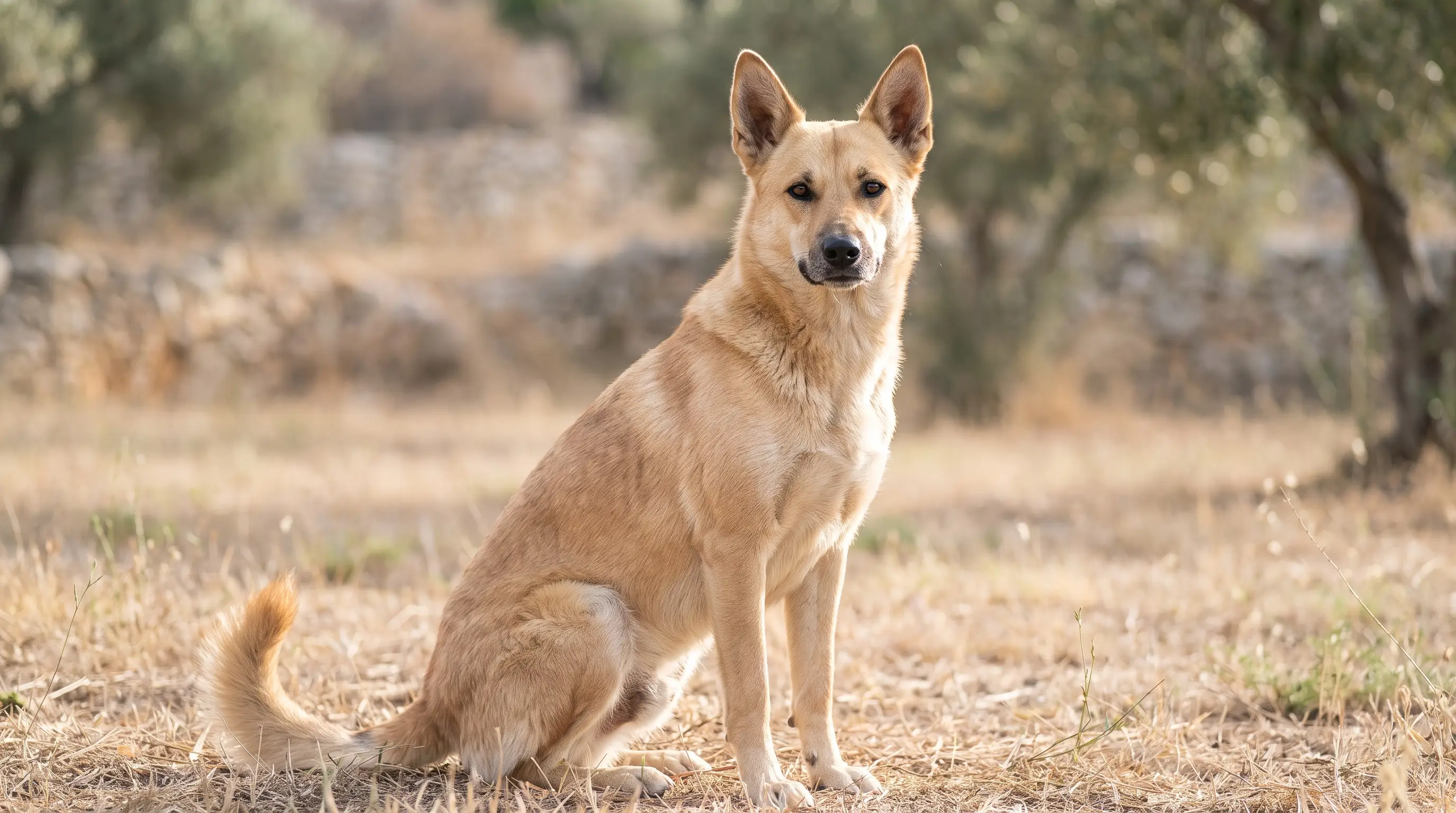
Canaan Dog
The desert survivor — an ancient pariah dog, dignified, alert and nobody's fool.
Vital stats
| Size | Medium · 50–60 cm |
| Weight | 18–25 kg |
| Life expectancy | 12–15 years |
| Energy | Moderate — 60 min/day |
| Shedding | Heavy, seasonal |
| Coat | Harsh, straight double coat · sand to red-brown, white with patches, black |
| Group | Herding · FCI №273 / AKC |
| Origin | Israel / Levant |
| FCI group | 5 — Spitz and primitive types · FCI 273 |
Breed traits
Friendliness
Care
Mind
The Canaan Dog by the numbers
The Canaan Dog facts owners search for most — price, lifespan, weight, shedding and colours, in one place.
Less common, so expect a waitlist and some travel to a reputable breeder — which pushes the price up. Plan for steady ongoing costs — mid-range food, routine vet care and insurance.
We don't quote a single figure: the real price swings with breeder, region, bloodline and health testing — and a rescue costs a fraction of a breeder's litter. Adopting is almost always the cheapest route.
Temperament
Millennia of surviving on its own wits in the desert left the Canaan Dog with judgement most breeds never needed: it watches first, decides for itself, and wastes trust on no one. With its family it's devoted and playful; with strangers, politely unconvinced. Training works when it's a conversation — never a drill.
Habits & quirks
Perimeter patrol
The garden boundary is walked, checked and formally maintained.
The high ground
It claims the best vantage point and keeps unhurried watch.
Reading the room
New people are studied from a distance before any verdict is issued.
The early warning
Anything new — a van, a hat, a rearranged chair — gets announced.
Health
The Canaan Dog is one of the healthiest breeds you can own, and that is not marketing — it spent thousands of years as a free-living desert dog, where natural selection did the culling no breeder could match. Inherited disease is uncommon and it tends to stay sound and active well into old age. The catch is the small gene pool: this is a rare breed, so a responsible breeder matters more than usual for keeping that diversity healthy. Ask about the parents' hips, meet a dog with a stable, confident temperament, and keep your own dog lean and well-exercised — a fit Canaan is a genuinely low-maintenance dog on the health front.
Nutrition
| Socialisation | Expose puppies widely and positively to people, dogs and places, and keep it up for life — wariness hardens without practice. |
| Training | Smart and quick, but repetition bores it; keep sessions short, varied and rewarding. |
| Exercise | An hour of walking plus scent games or agility — it needs purpose more than mileage. |
| Grooming | Easy most of the year, then a spectacular seasonal moult — brush daily when the undercoat lets go. |
A dog shaped by scavenging a hard landscape is an easy keeper, and the Canaan Dog is no exception — it does well on a modest, measured amount and puts on weight faster than you'd expect if you free-feed. Weigh the meals for an 18–25 kg adult, count treats into the day's total, and keep the ribs easy to feel under that dense double coat. Feed to the work it actually does: a Canaan that gets its hour of walking and a scent game needs less on a quiet day than a busy one, so adjust the bowl to the week rather than leaving it full.
Puppy guide
With a Canaan Dog, socialisation is the whole job, and the window is short. This is a naturally watchful, self-reliant breed, and a puppy that doesn't meet the world before sixteen weeks grows into an adult that treats everything new as a threat. So flood those early months, gently and positively, with people, other dogs, traffic, surfaces and places — and then keep it up for life, because the wariness hardens without practice. Let the independence be; don't drill it. Teach a solid recall early, reward every good choice, and build the calm confidence that a born sentinel needs to switch off.
Training
Train a Canaan Dog like a conversation, never a drill. It is clever and learns fast, but it also thinks for itself and finds pure repetition insulting — ask for the same thing ten times and it will start improvising. Keep sessions short, varied and genuinely rewarding, and work with the independence rather than against it: this is a dog that decides to cooperate, and does so reliably once it trusts your judgement. Recall and a settled off switch are the priorities, because the alert, territorial instinct is strong and best paired with a dog that listens when it counts.
Life expectancy
Canaan Dogs live 12–15 years. The Canaan Dog is a hardy, long-lived breed, and much of the work of keeping it at the top of that range is already done by its own history — thousands of years of natural selection built a genuinely sound dog. Your part is the ordinary part: a lean weight, an hour of real exercise a day, lifelong socialisation to keep the mind steady, and a breeder who guards the small gene pool with health-tested parents.
Similar breeds
Breeds with a similar build and background — worth a look if this one isn't quite the fit.
Breeds that look like this
Common questions
Are Canaan Dogs good pets?
For the right owner, excellent — they're clean, quiet-natured at home, healthy and deeply loyal. They need early socialisation and a household that understands aloofness isn't a flaw.
Are Canaan Dogs rare?
Yes — worldwide numbers are small, and finding a breeder often means a waiting list. It remains Israel's national breed with a devoted following.
Are Canaan Dogs aggressive?
No — they're naturally cautious rather than aggressive, preferring to keep distance and give warning. Good breeding and thorough socialisation keep that wariness from tipping into fear.
Does the Canaan Dog shed a lot?
Yes — the Canaan Dog is a heavy shedder, dropping hair year-round or in big seasonal moults. Brush it several times a week and expect regular vacuuming; it isn't the coat for you if loose fur is a dealbreaker.
Is the Canaan Dog hypoallergenic?
Not really. No dog is truly hypoallergenic, and the Canaan Dog's shedding coat releases plenty of the dander that sets off allergies. If someone at home is allergic, this isn't the easiest breed to live with — spend time around one first.
Is the Canaan Dog good with children?
They can be. The Canaan Dog is reasonably sociable and can be good with children in the right home, especially when socialised early. Supervise around young kids and teach dog and child to respect each other.
Is the Canaan Dog easy to train?
Reasonably. The Canaan Dog is trainable with consistency and rewards, though it isn't the quickest study. Keep sessions short and positive, and be patient with the basics like recall.
Stories featuring this breed
All stories →
Which dog breeds are actually ancient?
Genetics keeps naming the same handful of breeds as “ancient” — but that word means isolated from the Victorian breed factory, not unchanged since antiquity.

The village dog: the real default, and why your breed is the odd one out
Most dogs on Earth are free-ranging scavengers, not purebred pets. The breed is the recent human invention sitting on top of a much older, stabler kind of dog.

8 rare dog breeds most people never meet
Eight of the world's rarest dog breeds — where they come from, what makes them unusual, and why you almost never see one.