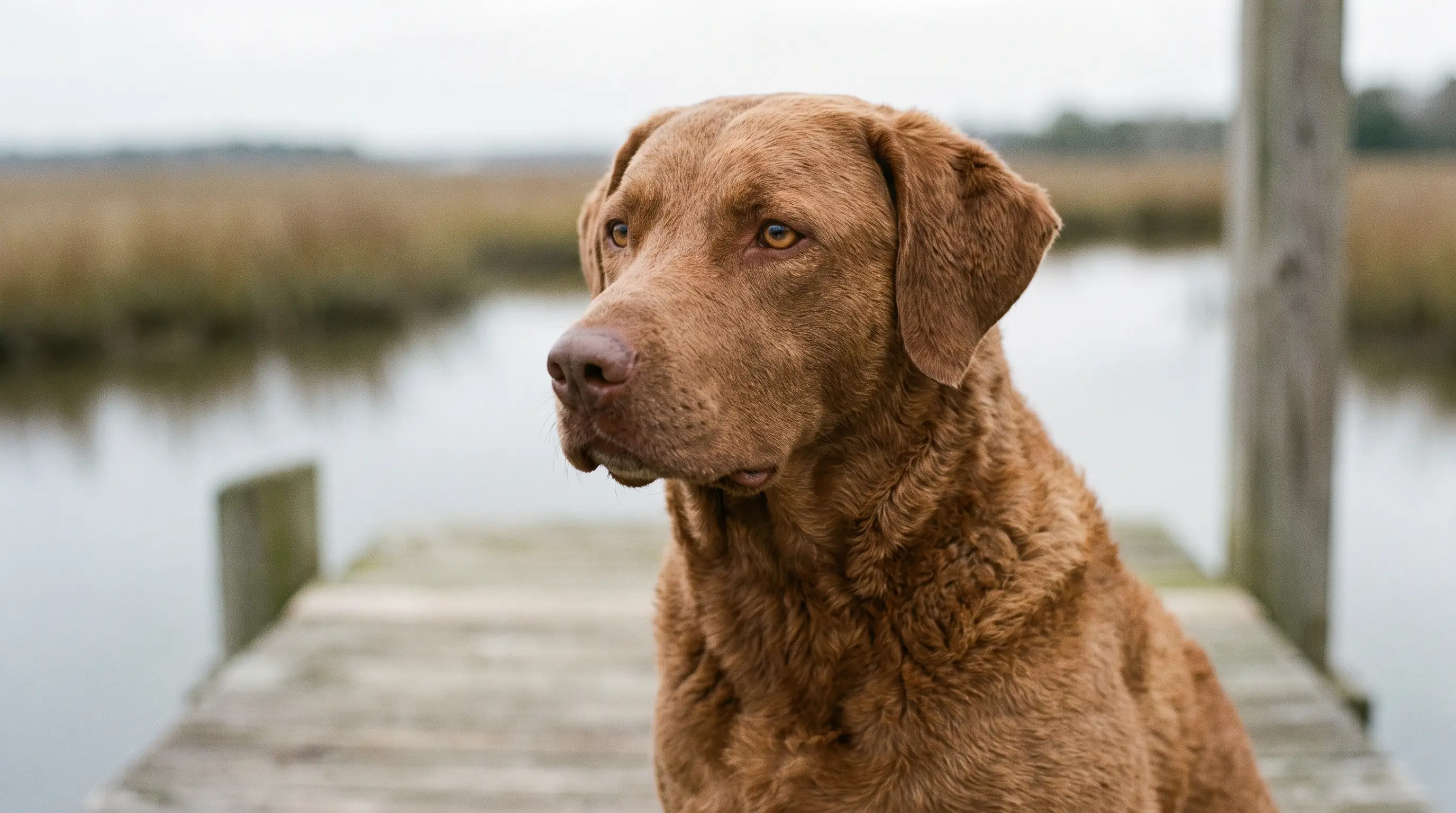
Chesapeake Bay Retriever
The duck dog that breaks ice for a living.
On these lists: Dogs for hunting
Vital stats
| Size | Large · 53–66 cm |
| Weight | 25–36 kg |
| Life expectancy | 10–13 years |
| Energy | High — 60–90 min/day |
| Shedding | Moderate, seasonal |
| Coat | Wavy, oily double coat · brown, sedge, deadgrass |
| Group | Sporting · FCI №263 / AKC |
| Origin | Maryland, United States |
| FCI group | 8 — Retrievers, Flushing Dogs and Water Dogs · FCI 263 |
Breed traits
Friendliness
Care
Mind
The Chesapeake Bay Retriever by the numbers
The Chesapeake Bay Retriever facts owners search for most — price, lifespan, weight, shedding and colours, in one place.
Widely bred, so you can usually find a litter from a registered breeder without a long wait. Ongoing costs run high — more food, bigger doses at the vet, and pricier insurance.
We don't quote a single figure: the real price swings with breeder, region, bloodline and health testing — and a rescue costs a fraction of a breeder's litter. Adopting is almost always the cheapest route.
Temperament
Bred by market hunters to retrieve hundreds of ducks a day from near-freezing water, the Chessie is tireless, tough-minded and more independent than its Labrador cousins. At home that reads as calm devotion to its family, polite reserve with everyone else, and a working brain that respects fair, consistent leadership.
Habits & quirks
Ice-breaker
Cold water that sends other dogs to the fireside is exactly where a Chessie wants to be.
One-family heart
Warm and silly with its own people, politely unimpressed by everyone else.
The Chessie smile
Many bare their front teeth in a toothy grin when happy — it looks alarming and means the opposite.
Self-appointed watchman
It keeps quiet tabs on the garden, the boat and the children without being asked.
Health
The Chesapeake is a hardy, generally sound retriever, and the health you can steer comes down to joints and weight. Buy from a breeder who screens hips and elbows, then keep him lean for life, because a heavy retriever pays for every extra kilo in joint wear, and this is a big, hard-working dog. The famous oily coat looks after itself: brush weekly and bathe rarely, since over-bathing strips the oils that waterproof it, and a faint musky smell is just the breed. Screen the joints, hold the weight, and the Chessie is a robust dog.
Nutrition
| Exercise | An hour or more daily, with swimming whenever possible — a bored Chessie invents projects you won't like. |
| Grooming | Weekly brushing only; never over-bathe, or you strip the protective oils that make the coat waterproof. |
| Training | Firm, fair and early — this breed tests soft handlers and remembers unfairness. |
| Health | Watch hips and elbows; keep it lean, as heavy retrievers pay for extra kilos in joint wear. |
A Chessie is a powerful water-dog, so feed to its real workload: a dog swimming and working hard and a quieter one don't eat the same. Weigh the meals, count treats into the day's total, and aim for ribs you can feel under that dense coat. Lean matters more here than looks, because this breed carries real muscle and real weight, and every extra kilo lands on the hips and elbows of a dog you want working into old age.
Puppy guide
A Chessie puppy is confident, water-mad and quick to form its own opinions, so the first year is where the partnership is set. This breed is naturally reserved with strangers, so socialize him early and widely to build good judgement rather than suspicion, and start firm, fair, reward-based training from the start. Keep the growing joints in mind by going easy on repetitive hard exercise, get him used to water and to being handled and brushed, and teach the rules kindly but clearly.
Training
The Chessie is as clever as a Labrador but far less eager to please, with an independent streak and a long memory for unfairness. Train it firmly, fairly and early, keep everything reward-based and consistent, and it becomes a superb working partner; nag it, bully it or bend the rules and it simply tunes you out. Give this powerful dog real daily work, ideally swimming, because a bored Chessie invents projects, and they are rarely the ones you'd have chosen.
Life expectancy
Chesapeake Bay Retrievers live 10–13 years. The Chessie is a fairly long-lived retriever for its size, and you keep it at the top of that range with a few honest basics: a breeder who screens hips and elbows, lean weight held for life so the joints last, a weekly brush and few baths to keep the coat doing its job, and enough hard daily work and swimming to keep body and mind sound. Do those and the Chessie ages well.
Similar breeds
Breeds with a similar build and background — worth a look if this one isn't quite the fit.
Breeds that look like this
Common questions
Are Chesapeake Bay Retrievers good family dogs?
Yes, for active families — they're devoted and patient with their own children. They are more protective and aloof with strangers than Labs or Goldens, so socialisation matters.
Why does my Chessie's coat feel oily?
That oil is the point — it sheds icy water and insulates the skin. Bathe rarely and brush weekly; a slightly musky smell is normal for the breed.
Is a Chesapeake harder to train than a Labrador?
Generally yes — it's just as clever but less eager to please, with an independent streak. Consistent, reward-based training from puppyhood works; nagging and harshness backfire.
Does the Chesapeake Bay Retriever shed a lot?
Moderately. The Chesapeake Bay Retriever sheds a fair amount, steadily through the year with heavier seasonal patches. A weekly brush keeps most of the loose hair off your floors and clothes.
Is the Chesapeake Bay Retriever hypoallergenic?
Not really. No dog is truly hypoallergenic, and the Chesapeake Bay Retriever's shedding coat releases plenty of the dander that sets off allergies. If someone at home is allergic, this isn't the easiest breed to live with — spend time around one first.