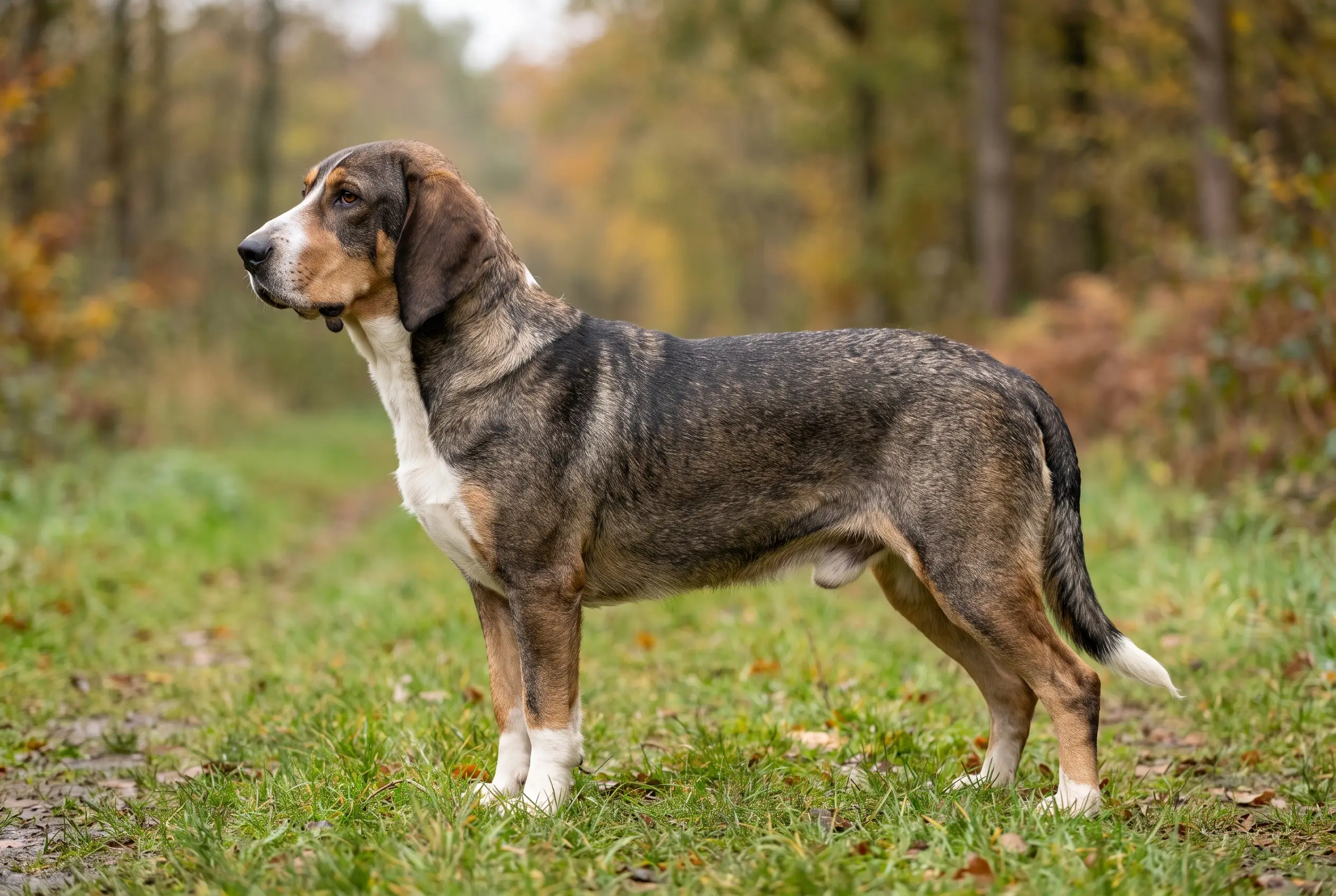
Chien d'Artois
A hare-and-badger-coloured pack hound believed extinct after World War II, then rebuilt from a handful of survivors in the 1970s — how faithfully is still argued.
Vital stats
| Size | Medium · 53–58 cm (dogs and bitches), 1 cm tolerance |
| Weight | 28–30 kg — the standard's own average |
| Life expectancy | 12–14 years — breed literature, not survey data |
| Energy | High — built to work country, wood and thicket in one day |
| Shedding | Low — short, flat coat, brushed weekly |
| Coat | Short, thick, quite flat · dark fawn tricolour like a hare or a badger, in mantle or large patches |
| Group | Hound · Medium-sized Scenthound (FCI №28, Group 6) |
| Origin | Artois, northern France |
| FCI group | 6 — Scent hounds and related breeds · FCI 28 |
Breed traits
Friendliness
Care
Mind
The Chien d'Artois by the numbers
The Chien d'Artois facts owners search for most — price, lifespan, weight, shedding and colours, in one place.
Less common, so expect a waitlist and some travel to a reputable breeder — which pushes the price up. Ongoing costs run high — more food, bigger doses at the vet, and pricier insurance.
We don't quote a single figure: the real price swings with breeder, region, bloodline and health testing — and a rescue costs a fraction of a breeder's litter. Adopting is almost always the cheapest route.
Temperament
The standard's own behaviour clause is a single sentence: "Vigorous and hardy dog, with a very fine nose, assembling well in the pack, balanced and affectionate." Every word there is doing a job. Vigorous and hardy describe a dog built for full days across three kinds of ground; a very fine nose is why it can pull in a hare that passed an hour ago in dry weather; assembling well in the pack says this is a hound meant to work alongside five or six others, not alone. The last two words matter just as much — balanced and affectionate rule out the touchy, standoffish temperament some pack hounds carry home from a day's hunting. The fault list backs that reading up: a merely "timid subject" is an ordinary fault, and "aggressive or overly shy dogs" are disqualified outright, so neither extreme is what generations of breeders, old or new, have actually bred for.
Habits & quirks
Three jobs, one dog
The standard lays out the Chien d'Artois' work field by field: in the country its acute sense of smell out-manoeuvres a hare's tricks; in scattered high woodland it hunts deer beautifully in the desired direction; in thicket its intrepidity and bravery let it stir up and push a stubborn boar. A working pack, per the standard, runs six to eight matched tricolour dogs, enough to be "susceptible of giving pleasure to a most demanding huntmaster."
A coat read against a hare, or a badger
The standard doesn't just name a colour, it names a comparison: "dark fawn tricolour, similar to the coat of the hare or the badger," laid down in a mantle or large patches, with a fawn head sometimes overlaid in black. Distinctly mottled colouring, or any colour other than the standard's own, both disqualify outright — the simile is doing real descriptive work, not decoration.
Written off twice, rebuilt once
The standard's own history names an earlier attempt that didn't fully land: around 1900, M. Levoir in Picardy tried to re-establish "the old Artois type without really succeeding," and the breeder who dominated the kennel afterward, M. Mallard, won show-ring awards with dogs the same text admits "were not always in the type conformed with the description given by the old authors." After the Second World War the breed was believed lost for good, until M. Audrechy of the Somme, working with Mme Pilat, set out in the early 1970s to rebuild it from what survived.
A square muzzle, by the numbers
The standard fixes the head with actual ratios, not just adjectives: skull width to head length between 5:9, muzzle length to skull length between 8:10. The upper lip is built to largely cover the lower lip and "give a square shape to the extremity of the muzzle" seen in profile — a specific, checkable geometry behind a word most breed pages would leave vague.
Health
Breed literature and the FCI standard between them don't name a single widely recognised inherited disorder in the Chien d'Artois, which is genuinely reassuring, but it isn't the whole picture. This breed was rebuilt in the 1970s from a small number of survivors, and the population has stayed small ever since, so the honest question to put to a breeder isn't which diseases they test for but how deep and how varied the pedigree is behind a litter. A pack hound kept fit and lean, worked regularly and bred from a thoughtfully managed gene pool is a hardy, uncomplicated dog.
Nutrition
| Exercise | This is a working pack hound the standard built for three different kinds of ground in a single day, at a speed it calls average but maintained rather than fast. Give it real daily distance with scent work folded in; hunting, tracking or long off-lead outings suit it far better than a walk around the block. |
| Grooming | The coat is short, thick and quite flat, and a weekly brush is enough to keep it in order. The long, flat, low-hung ears reach almost to the nose and are worth checking regularly, since anything that hangs that low picks up moisture and debris in cover. |
| Training | The standard calls it balanced and affectionate and quick to settle into a pack, which is a genuinely biddable temperament for a scenthound. It disqualifies both aggressive and overly shy dogs outright, so consistent, confidence-building handling matters as much as obedience drills. |
| Health | Neither the standard nor breed literature documents a widely recognised breed-specific disorder. The more relevant question for a would-be owner is the gene pool itself: the breed was rebuilt from a small number of surviving dogs in the 1970s, and today's population is still small enough that asking a breeder about pedigree depth is sensible, not paranoid. |
Feed the Chien d'Artois to the work it actually does. This is a scenthound built to cover open country, woodland and thicket in a single day at a steady working pace, and a dog putting in that kind of distance needs more fuel than one having a quiet week, so match the bowl to the season and the workload rather than filling it to a fixed line. Weigh the food, count the trail treats into the day's total, and keep him lean enough that you can feel the ribs under that flat coat; a nose this good will happily talk you into more than he needs.
Puppy guide
A Chien d'Artois puppy is a pack hound in the making, so spend the first year building the two things the standard prizes: a confident, even temperament and a dog that comes back. Introduce him widely and gently to people, other dogs and new places while he's young, because the standard treats both aggression and real shyness as serious faults, and steady early handling is how you steer clear of the timid end. Get a reliable recall and some fun scent games in before the nose fully takes over, keep his growing joints off hard repetitive work, and let him meet the wider world as the sociable dog he's bred to be.
Training
For a scenthound this is a genuinely biddable dog, the standard calls it balanced, affectionate and quick to settle into a pack, but it was bred to work alongside others and follow a line, not to heel in a park. Keep training positive and confidence-building rather than heavy-handed, since a Chien d'Artois that's pushed too hard just shuts down, and put your effort into a reliable recall and calm manners around other dogs. Give it real scent work to do; a hound with a job to occupy that fine nose is far easier to live with than one left to invent its own.
Life expectancy
Chiens d'Artois live 12–14 years — breed literature, not survey data. That's a good long run for a working hound, and you protect it the same way you'd keep any pack dog sound: a lean weight, plenty of real exercise, ears kept clean and dry after a day in cover, and a puppy from a breeder who can talk you through the depth of the pedigree behind a breed rebuilt from so few dogs.
Similar breeds
Breeds with a similar build and background — worth a look if this one isn't quite the fit.
Breeds that look like this
Common questions
Is the modern Chien d'Artois really the same breed that hunted under Henri IV?
That continuity is genuinely disputed, and the FCI's own standard is candid about why. It records the breed as already "crossbred and difficult to find pure" by 1890, names an attempt around 1900 by M. Levoir to re-establish "the old Artois type" that the standard itself says didn't really succeed, and then records the breed as believed "lost for ever" after the Second World War until M. Audrechy and Mme Pilat rebuilt it from a small number of survivors in the early 1970s. What exists today comes from that 1970s rebuild, bred to match old written descriptions of the Picard-turned-Artois hound rather than from an unbroken working line — which is why some French cynologists treat the modern Chien d'Artois as a careful recreation rather than a straight-line continuation of the pre-war breed.
Is the Chien d'Artois the same breed as the Basset Artésien Normand?
No — they share a province's name and not much else. The Basset Artésien Normand (FCI No. 34) is a short-legged basset built from 1870s crosses of French bassets, and its own standard records that the line with straight front legs was once called "Artois," after Count Le Couteulx de Canteleu, before the breed was pulled toward a heavier-boned Norman type instead. By 1930, the standard notes, the Société de Vénerie ruled that the Basset Artésien Normand should become "one stage of transition towards a Norman type, without any trace of Artois." The Chien d'Artois (FCI No. 28) is a taller, standing hound, unrelated to that basset line in anything but name history.
How rare is the Chien d'Artois today?
Rare enough that no French kennel body publishes a yearly registration count worth quoting, and that gap is itself telling. The breed was believed extinct after the Second World War, survives today through a rebuild that started with a handful of dogs in the 1970s, and is kept going almost entirely by a single dedicated club and the small number of French hunting packs that still run it. Finding one outside that circle, in France or anywhere else, is a genuine search, not a wait list.
Does the Chien d'Artois shed a lot?
Not much. The Chien d'Artois is a low-shedding breed, so loose hair around the home stays minimal. It still needs regular grooming, but you won't be fighting drifts of fur.
Is the Chien d'Artois hypoallergenic?
No dog is truly hypoallergenic, but the Chien d'Artois comes closer than most: its low-shedding coat releases less of the dander that triggers allergies. Many allergy sufferers manage well with this breed, but spend time around one before committing.
Is the Chien d'Artois good with children?
They can be. The Chien d'Artois is reasonably sociable and can be good with children in the right home, especially when socialised early. Supervise around young kids and teach dog and child to respect each other.
Is the Chien d'Artois easy to train?
Reasonably. The Chien d'Artois is trainable with consistency and rewards, though it isn't the quickest study. Keep sessions short and positive, and be patient with the basics like recall.