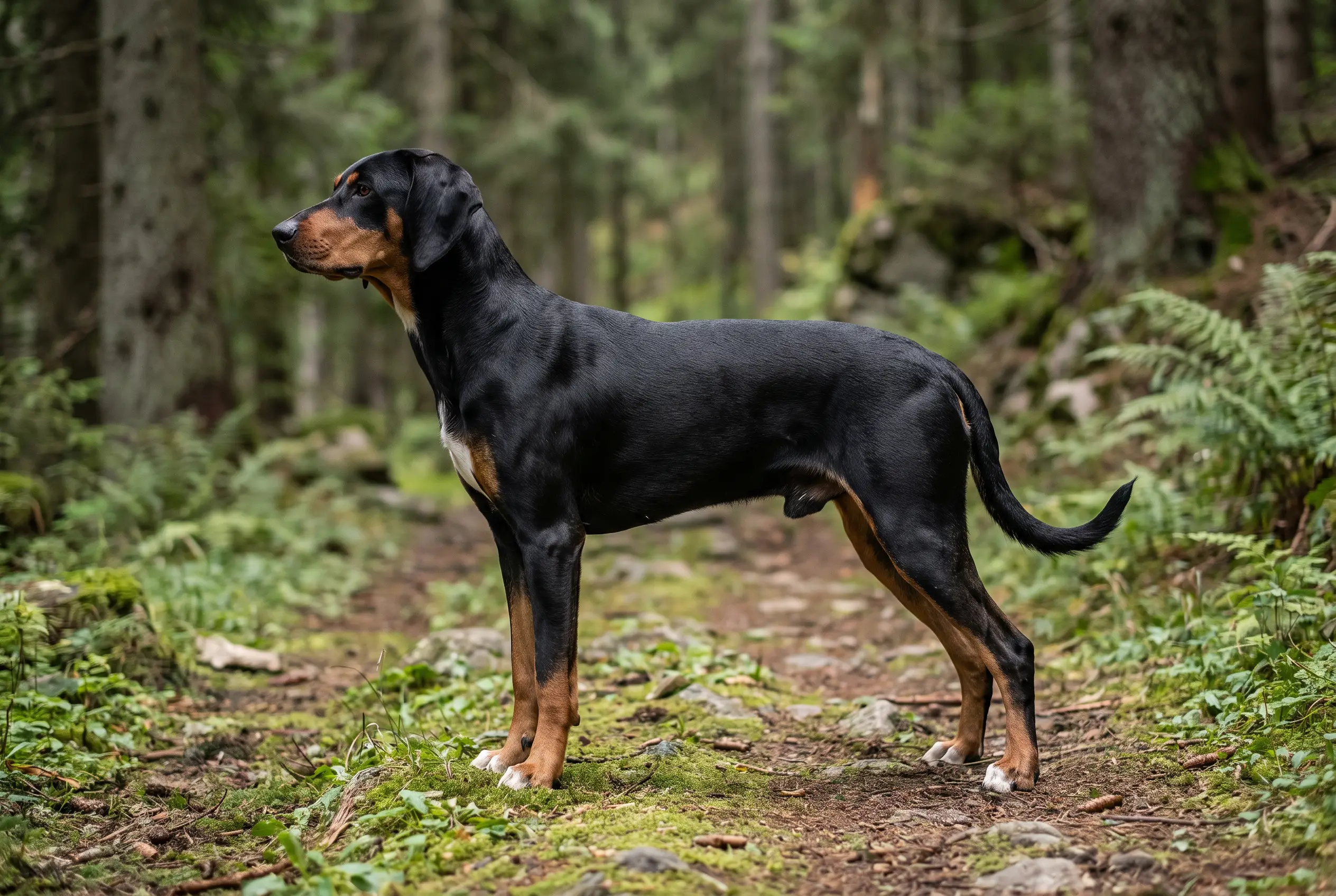
Erdélyi Kopó
It has two different barks — one for finding a scent, another for running it — and the standard writes down the difference.
Vital stats
| Size | Medium-large · 55–65 cm at the withers (ideal; the standard sets no separate range for dogs and bitches) |
| Weight | Minimum 25 kg — the standard's own floor, no upper limit stated; breed literature puts today's long-legged type at 30–35 kg |
| Life expectancy | 12–14 years — breed literature, not survey data |
| Energy | High — bred to gallop all day and hunt far from the handler |
| Shedding | Moderate — short coat over an undercoat, sheds seasonally |
| Coat | Short, dense, flat and coarse to the touch, longer on the neck, withers, thighs and tail underside · black with tan eyebrow points and tan on muzzle and legs, limited white permitted |
| Group | Hound · Medium-sized Scenthound (FCI №241, Group 6) |
| Origin | Hungary |
| FCI group | 6 — Scent hounds and related breeds · FCI 241 |
Breed traits
Friendliness
Care
Mind
The Erdélyi Kopó by the numbers
The Erdélyi Kopó facts owners search for most — price, lifespan, weight, shedding and colours, in one place.
Less common, so expect a waitlist and some travel to a reputable breeder — which pushes the price up. Ongoing costs run high — more food, bigger doses at the vet, and pricier insurance.
We don't quote a single figure: the real price swings with breeder, region, bloodline and health testing — and a rescue costs a fraction of a breeder's litter. Adopting is almost always the cheapest route.
Temperament
The standard's own behaviour clause is short and plain: "Good-natured, courageous, enduring. The basic character of the Hungarian Hound is quiet, even, but also determined and lively. He even stands extreme weather conditions." The utilization section fills in the working half of that character: this is a hound built to hunt independently, far enough from its handler that the handler ends up reading the dog by ear rather than by eye. On a fresh scent it yaps with a whining sound; once it commits to a trail and gives tongue in earnest, the standard calls the voice resounding, high-pitched and ringing — two distinct sounds for two distinct moments in the hunt. It drives and points game well and works just as happily alone as paired with another hound in a brace. The standard disqualifies any dog that is aggressive or overly shy, which is its own quiet statement about what stability is supposed to look like in this breed; breed literature adds that despite the working brief, it settles into family life as a good-natured, even-tempered dog rather than a hard or suspicious one.
Habits & quirks
Two voices for two moments
A whining yap means it has just found a scent; a resounding, high-pitched, ringing bark means it is committed to the trail and running it in earnest. The standard names both sounds specifically, because a hunter following this dog through Carpathian forest is hunting by ear, not by eye.
Built long, not tall
The standard fixes two ratios rather than leaving the shape to guesswork: skull to muzzle length is about 1:1, and height at the withers to body length is 10:11 — a build the standard describes as a prone rectangle, slightly longer than it is tall, made to hold a ground-covering gallop for a full day's hunt.
One variety of two survives
The standard itself records two historical types — a long-legged hound for the region's bigger game and a short-legged hound worked on fox, hare and chamois in tighter cover — kept as a single breed. Only the long-legged type is left; the standard's own line is that the short-legged variety disappeared, with no separate deletion event on record, just a population that thinned out and never came back.
A near-miss the standard barely mentions
The FCI's own history section gives the breed's low point one sentence: nearly extinct at the beginning of the 20th century. Popular dog-breed references tell a longer, harder story involving the Second World War and a deliberate postwar purge in Transylvania — a claim repeated widely enough to be worth knowing, but traced here only to general reference books, not to the standard or to any primary record. What is solid: definitive FCI recognition in 1963, and a determined breeding effort starting in 1968, per the standard's own account, that built the population that exists today.
Health
There's no widely recognised breed-specific disorder on record for the Erdélyi Kopó — neither the FCI standard nor the accessible breed literature names one, and its profile rates the general health well. The honest work sits in two ordinary places. First the ears: this is a drop-eared scenthound that works nose-down through rough Carpathian cover, so check them after every outing and keep them clean and dry. Second, and bigger, the gene pool. The breed was rebuilt from a near-extinction in the last century and lives almost entirely in Hungary and Romania, so ask any breeder directly about pedigree depth and genetic diversity — that conversation matters more here than any single test.
Nutrition
| Exercise | This is a hound bred to hunt independently at real distance from a handler and gallop all day on rough ground, so a lead-walk around the block falls well short. Give it long daily distance with a trail to work — hunting, tracking or serious scent games stand in reasonably well where hunting access doesn't exist. |
| Grooming | The short, dense, flat coat sits over an undercoat and needs a weekly brush to stay tidy, with more attention during seasonal sheds. There's no elaborate coat care beyond that; the standard itself calls the hair coarse to the touch and naturally shiny. |
| Training | The standard disqualifies dogs that are aggressive or overly shy, which points to a breed meant to be stable rather than reactive, but it is still an independent hunting dog built to work far from a handler's side. Recall has to be built early and reinforced constantly; this is not a breed that checks in by instinct. |
| Health | Neither the standard nor the accessible breed literature documents a widely recognised breed-specific disorder. The bigger practical concern is the population itself: a breed rebuilt after a near-extinction event within the last century or so, confined almost entirely to Hungary and Romania, is one where pedigree depth and genetic diversity are worth asking a breeder about directly. |
Feed this hound to the work it actually does. It was bred to gallop all day and hunt far from the handler, and a dog getting that kind of exercise eats very differently from one that mostly walks — match the bowl to the week. Weigh the meals, count any training treats into the day's total, and keep him lean enough to feel the ribs under that short, dense coat; extra weight steals the very stamina the breed is built on.
Puppy guide
An Erdélyi Kopó puppy grows into an independent hunting dog, and the first year shapes how much of that independence you can live with. Build recall from day one and reinforce it constantly, because this is not a breed that checks back in by instinct. Socialise him widely so the working drive settles into a stable, even temperament rather than nervousness — the standard itself disqualifies dogs that are aggressive or overly shy. Keep hard running light while the joints are still forming, and give the nose real work early: short scent games do more for this dog than a lap of the block.
Training
The standard describes a stable, even-tempered dog rather than a reactive one, which is the good news. The catch is that everything else about it is built to work far from your side, following a scent wherever it leads. Recall is the whole game: build it early, reward it richly, and reinforce it for life, because a hound running a trail is not listening for its name. Keep sessions varied and motivating, put that fine nose to work with tracking and scent games, and accept that off-lead freedom in open country is earned slowly, if at all.
Life expectancy
Erdélyi Kopós live 12–14 years — breed literature, not survey data. The Erdélyi Kopó is a hardy working hound with no widely documented breed-specific illness, and you keep one at the top of its range the plain way: lean weight, ears kept clean and dry, and enough real daily work to satisfy a dog bred to hunt all day. The one thing worth extra attention is the gene pool — a breed rebuilt from near-extinction and still concentrated in Hungary and Romania is one where a breeder's care over pedigree depth quietly matters for the long run.
Similar breeds
Breeds with a similar build and background — worth a look if this one isn't quite the fit.
Breeds that look like this
Common questions
Is the Erdélyi Kopó the same dog as the Transylvanian Hound?
Yes. Erdélyi Kopó is the Hungarian name and the one the FCI standard leads with; Hungarian Hound and Transylvanian Hound are the English names printed on that same standard, and Transylvanian Hound is the one most commonly used outside Hungary. All three describe FCI standard No. 241, one breed.
How is it different from the Brandlbracke, another black-and-tan hound?
Coat colour is nearly the only thing they share. The Brandlbracke is FCI standard No. 63, an Austrian mountain scenthound whose standard requires a tan spot above each eye by name — Vieräugl — as a pass/fail trait, disqualifying any dog missing one. The Erdélyi Kopó is FCI standard No. 241, Hungarian, runs larger at the top of its size range, and its standard notes a tan eyebrow point as something that is "always" present without ever listing it among the disqualifying faults. Different countries, different standards, a broadly similar-looking coat.
Can I get an Erdélyi Kopó outside Hungary or Romania?
It would be difficult. Every source that documents current numbers places the breeding population in Hungary and Romania, and nothing in the accessible literature points to an established presence anywhere else — no registration figures, no breed clubs abroad, no meaningful record outside those two countries. Add a genuine near-extinction event within the last century and a breed still built primarily for hunting, and this is one of the harder FCI hounds to find as a pet outside its home region.
Does the Erdélyi Kopó shed a lot?
Moderately. The Erdélyi Kopó sheds a fair amount, steadily through the year with heavier seasonal patches. A weekly brush keeps most of the loose hair off your floors and clothes.
Is the Erdélyi Kopó hypoallergenic?
Not really. No dog is truly hypoallergenic, and the Erdélyi Kopó's shedding coat releases plenty of the dander that sets off allergies. If someone at home is allergic, this isn't the easiest breed to live with — spend time around one first.
Is the Erdélyi Kopó good with children?
They can be. The Erdélyi Kopó is reasonably sociable and can be good with children in the right home, especially when socialised early. Supervise around young kids and teach dog and child to respect each other.
Is the Erdélyi Kopó easy to train?
Reasonably. The Erdélyi Kopó is trainable with consistency and rewards, though it isn't the quickest study. Keep sessions short and positive, and be patient with the basics like recall.