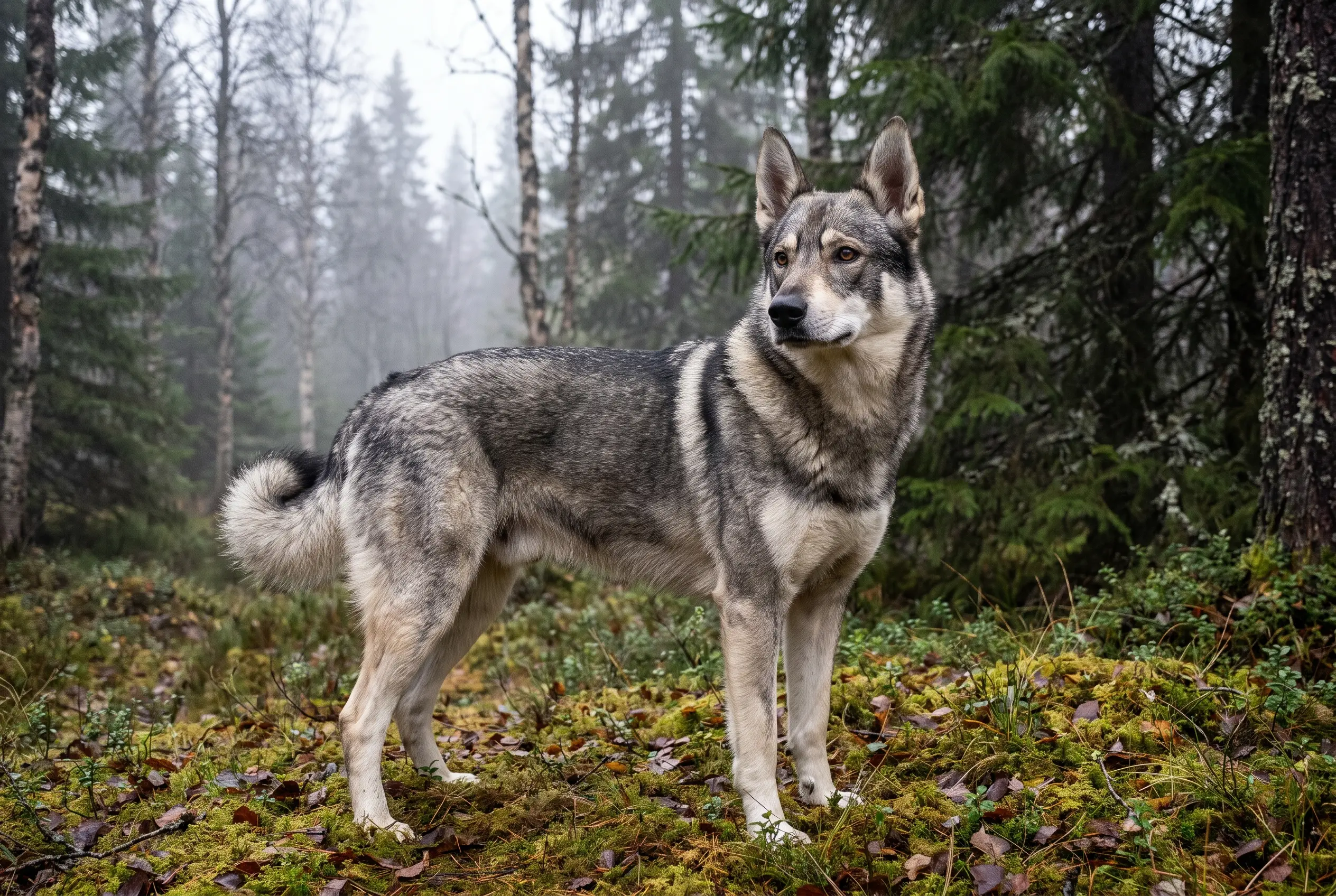
Jämthund
Sweden's big elk dog — and for decades it was filed under another breed's name.
Vital stats
| Size | Large · 57–65 cm (dogs), 52–60 cm (bitches) |
| Weight | 30–35 kg (dogs), 25–30 kg (bitches) — breed literature; the standard sets none |
| Life expectancy | 12–13 years — breed literature, not survey data |
| Energy | High — bred to range, find and bay big game for hours |
| Shedding | Very heavy, with two seasonal blows a year |
| Coat | Dense grey double coat · cream markings on muzzle, cheeks, throat, chest, belly and legs |
| Group | Hound · Nordic Hunting Dogs (FCI №42, Group 5) |
| Origin | Jämtland, Sweden |
| FCI group | 5 — Spitz and primitive types · FCI 42 |
Breed traits
Friendliness
Care
Mind
The Jämthund by the numbers
The Jämthund facts owners search for most — price, lifespan, weight, shedding and colours, in one place.
Less common, so expect a waitlist and some travel to a reputable breeder — which pushes the price up. Ongoing costs run high — more food, bigger doses at the vet, and pricier insurance.
We don't quote a single figure: the real price swings with breeder, region, bloodline and health testing — and a rescue costs a fraction of a breeder's litter. Adopting is almost always the cheapest route.
Temperament
The standard spends one line on character, courageous and energetic but also stoically calm, and that line does more work than it looks. A dog that holds a bull elk in place for an hour has to be brave enough to stay inside kicking range and level-headed enough not to close. Off the hill you meet the calm half: an undramatic dog that lies down in the middle of the room and stays there. On the hill you meet the other one, which leaves, works out of sight, and makes its own decisions for as long as the job takes. Both are the same animal, and the second is why recall is the entire training project. At home it is affectionate and, with strangers, reserved rather than suspicious. It is not a dog that spends its day looking to you for the next instruction.
Habits & quirks
Bays rather than bites
The work is to find the elk and then stand off it, barking, for however long the hunter needs to get there. The standard's own phrase is "under considerable time intensely". That means an enormous voice and the patience to use it for an hour.
The cream mask is compulsory
Light grey or cream on the sides of the muzzle and the cheeks is not a preference. A Jämthund without it is disqualified, alongside hanging ears and any height outside the standard's range.
Works out of sight
Elk hunting sends the dog ahead and away, then trusts it to hold position and report by voice. A Jämthund loose in unfenced country is doing its job, and it will keep doing it long after you would like it to stop.
Two speeds, no middle
It is either laid out flat and stoic or it is gone. Owners who expect an in-between setting are usually the ones who end up describing the breed as lazy indoors.
Care
| Exercise | Two hours a day of real work, most of it off the road. This is a dog built to range for hours over rough ground, and it does not spend itself on a lead walk round the block. Scent games, tracking and long hill walks fit it; a fixed suburban routine does not. In the Nordics almost all of them still hunt, which is worth holding in mind when you read how easy they are to live with. |
| Grooming | A harsh, close-lying topcoat over a short soft undercoat that the standard would prefer to be cream. Ordinary weeks need a brush. Twice a year the undercoat comes out in sheets and wants a rake every day for a fortnight. It is not a trimmed breed and never needs a clipper. |
| Training | Fair, quick and entirely capable of deciding your idea is worse than its own. Reward-based work goes well, drilling does not. The thing to build early and never stop building is recall, because the breed's default answer to an interesting smell is to follow it for a kilometre. A long line through the first year is not a failure of training. It is the training. |
| Health | No breed-wide health survey exists. Swedish breeders screen hips, and the population at home is large enough that a litter from screened parents is a realistic ask. Take hip scores and eye checks seriously, and treat the 12–13 years quoted in breed literature as folklore rather than data. |
Life expectancy
This breed has a typical life expectancy of 12–13 years — breed literature, not survey data.
Similar breeds
Breeds with a similar build and background — worth a look if this one isn't quite the fit.
Breeds that look like this
Common questions
What is the difference between a Jämthund and a Norwegian Elkhound?
Size and outline mostly, and the two were registered as one breed until 1946. The Jämthund is the bigger dog, 57–65 cm against 49–52, and rectangular, slightly longer than tall, where the Norwegian Elkhound is square. It also carries clear cream markings on the muzzle and cheeks, which is a disqualification to be without, and its tail lies in a loose curl over the thigh rather than tight on the back. The FCI keeps them as standards 42 and 242.
Can it live in a normal house?
Yes, if the day outside the house is long enough. Indoors it is calm to the point of looking sleepy. The problem is never the house, it is the two hours it wants first, and a Jämthund left with nothing to do will hunt the fence line and tell the neighbourhood about it.
Is it good with other dogs and cats?
Usually fine with dogs it knows; it is not an aggressive breed. Small fast animals are another question. This is a big-game hunter with a live prey drive, and a cat that runs is a cat being chased. Raised together from puppyhood most of them manage. Introduced to an adult Jämthund, do not assume it.
Does the Jämthund shed a lot?
Yes — the Jämthund is a heavy shedder, dropping hair year-round or in big seasonal moults. Brush it several times a week and expect regular vacuuming; it isn't the coat for you if loose fur is a dealbreaker.
Is the Jämthund hypoallergenic?
Not really. No dog is truly hypoallergenic, and the Jämthund's shedding coat releases plenty of the dander that sets off allergies. If someone at home is allergic, this isn't the easiest breed to live with — spend time around one first.
Is the Jämthund good with children?
They can be. The Jämthund is reasonably sociable and can be good with children in the right home, especially when socialised early. Supervise around young kids and teach dog and child to respect each other.
Is the Jämthund easy to train?
Reasonably. The Jämthund is trainable with consistency and rewards, though it isn't the quickest study. Keep sessions short and positive, and be patient with the basics like recall.