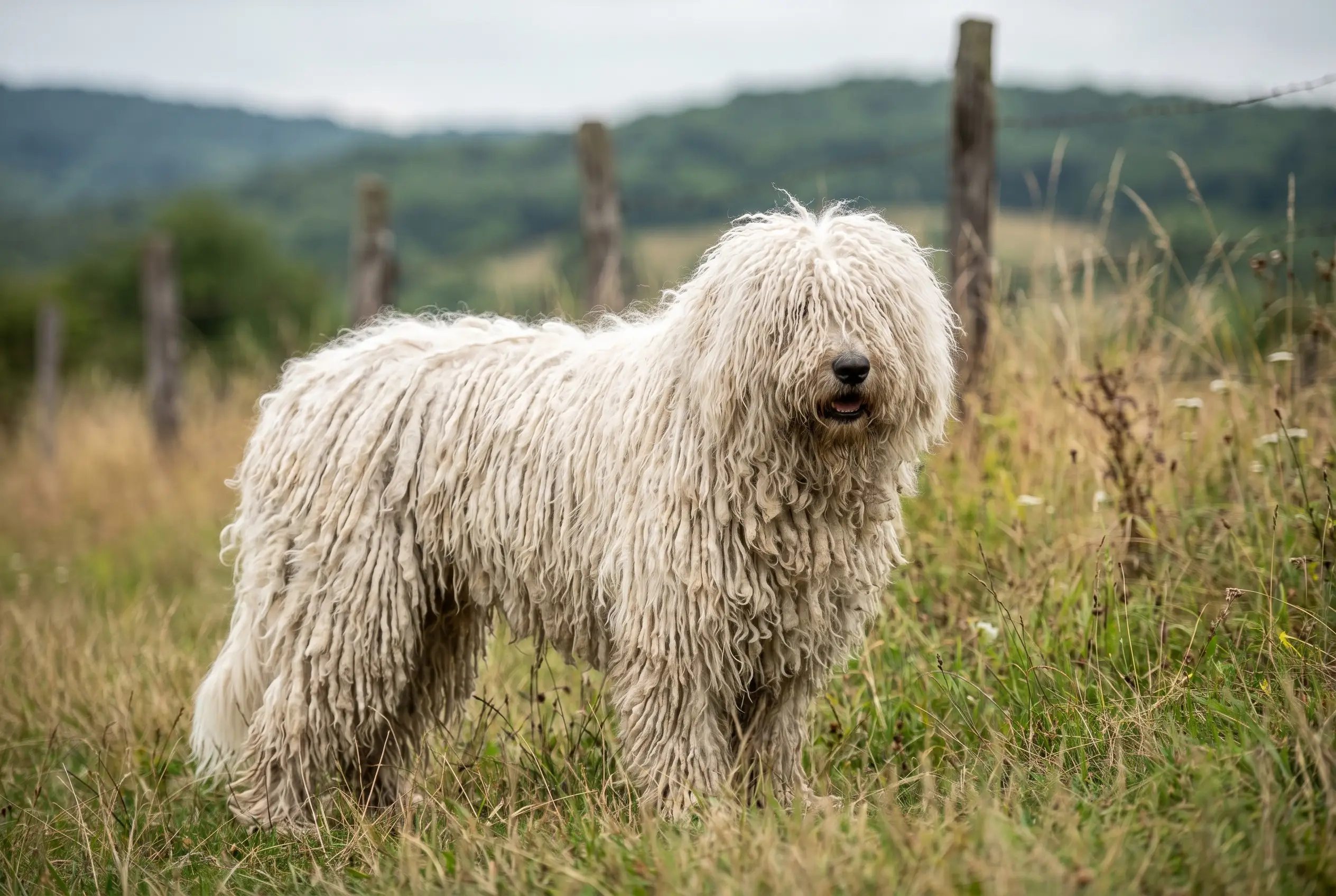
Komondor
A guardian disguised as a haystack — the flock's white shadow.
Vital stats
| Size | Giant · 65–80 cm |
| Weight | 40–60 kg |
| Life expectancy | 10–12 years |
| Energy | Moderate — patrols rather than plays |
| Shedding | Minimal — hair forms into cords |
| Coat | Long, corded · always white |
| Group | Working (AKC) · Sheepdog (FCI №53) |
| Origin | Hungary |
| FCI group | 1 — Sheepdogs and Cattledogs · FCI 53 |
Breed traits
Friendliness
Care
Mind
The Komondor by the numbers
The Komondor facts owners search for most — price, lifespan, weight, shedding and colours, in one place.
Less common, so expect a waitlist and some travel to a reputable breeder — which pushes the price up. Ongoing costs run high — more food, bigger doses at the vet, and pricier insurance. Its coat also needs a professional groom every few weeks — a real line in the budget.
We don't quote a single figure: the real price swings with breeder, region, bloodline and health testing — and a rescue costs a fraction of a breeder's litter. Adopting is almost always the cheapest route.
Temperament
Bred to live unsupervised among Hungarian flocks and make its own decisions about threats, the Komondor is calm, watchful and profoundly self-directed — obedience is a suggestion it will consider. With its own family it is steady and quietly devoted; with strangers and strange dogs it is a professional sceptic, and night-time is its shift.
Habits & quirks
Night shift
Centuries of guarding mean it dozes by day and patrols after dark, reporting anything irregular.
The doorway audit
It likes to lie where it can watch every entrance — usually across the one you need.
Slow-motion greeting
Family members get a dignified lean and tail sway; fireworks are for puppies.
Flock accounting
Children, cats and chickens get counted and shepherded — everyone is livestock now.
Care
| Coat | Never brush: cords are separated by hand regularly to keep them from matting into plates, and kept clean and dry to the skin. |
| Socialisation | Wide, early exposure to people and dogs is essential — the guarding instinct needs an educated 'off' switch. |
| Containment | A serious fence is non-negotiable; the Komondor extends its territory to whatever it can patrol. |
| Training | Expect thoughtful compliance, not eager obedience — short, respectful, consistent sessions from puppyhood. |
Life expectancy
This breed has a typical life expectancy of 10–12 years.
Similar breeds
Breeds with a similar build and background — worth a look if this one isn't quite the fit.
Breeds that look like this
Common questions
Do you brush a Komondor's coat?
No — brushing would destroy the cords. Instead, the cords are regularly separated by hand down to the skin, and kept clean and fully dry to prevent odour and matting.
Are Komondors good family pets?
For experienced owners with space and time, they're loyal and calm with their own household. But they're working guardians at heart — wary of visitors and unsuited to busy suburban social life.
Why does the Komondor have a corded coat?
The cords protected it from wolf bites and harsh weather, and let it blend in among the sheep it guarded. The coat begins to form naturally as the soft puppy fluff twists into the adult cords.
Does the Komondor shed a lot?
Not much. The Komondor is a low-shedding breed, so loose hair around the home stays minimal. It still needs regular grooming, but you won't be fighting drifts of fur.
Is the Komondor hypoallergenic?
No dog is truly hypoallergenic, but the Komondor comes closer than most: its low-shedding coat releases less of the dander that triggers allergies. Many allergy sufferers manage well with this breed, but spend time around one before committing.
Is the Komondor easy to train?
They can be a challenge. The Komondor is intelligent but independent, and would rather make its own decisions than take orders. Reward-based training and patience work best; expect recall in particular to take time.