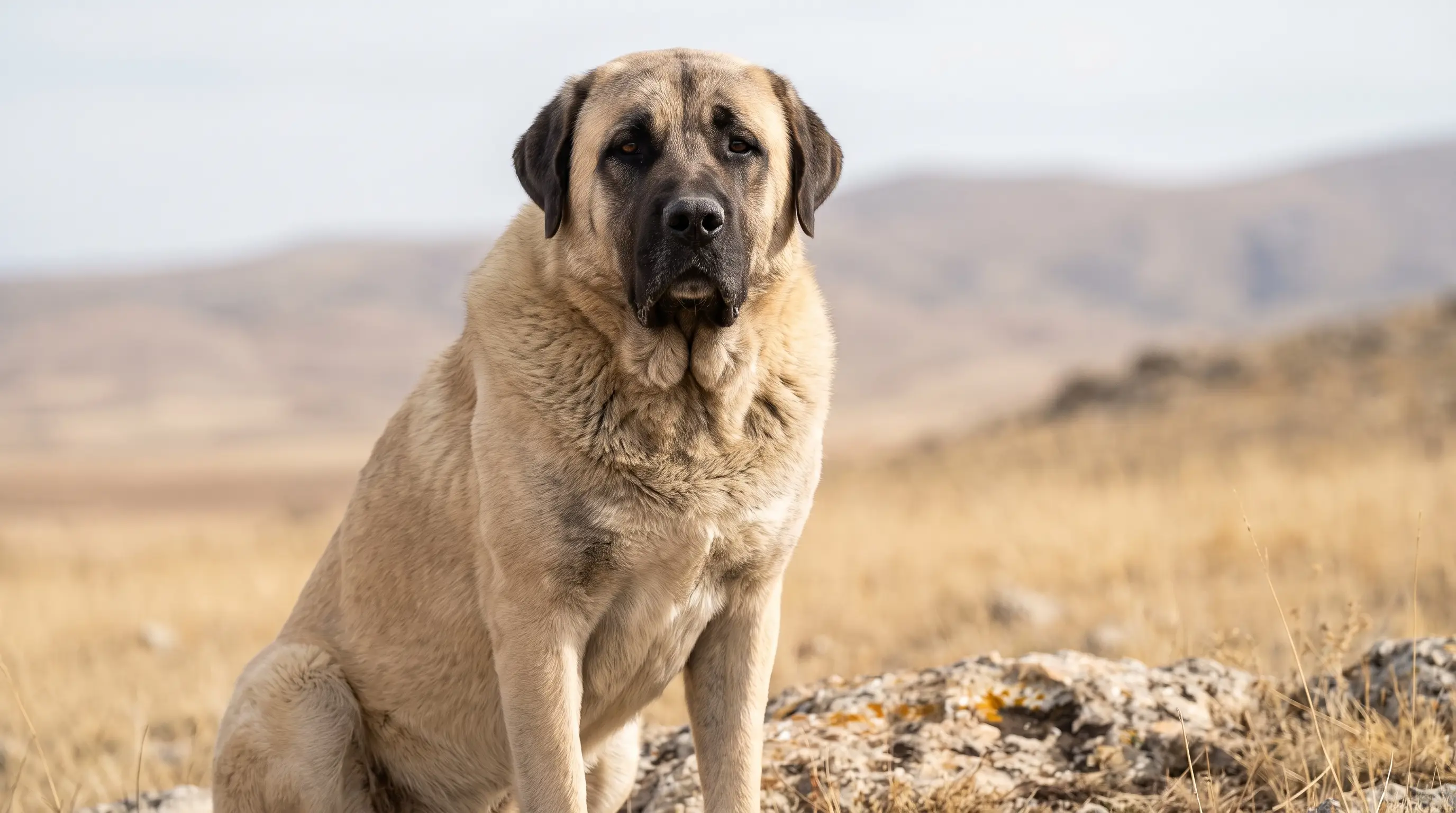
Anatolian Shepherd Dog
An ancient Turkish guardian that answers to the flock, not to you.
Vital stats
| Size | Giant · 71–81 cm |
| Weight | 40–65 kg |
| Life expectancy | 11–13 years |
| Energy | Moderate — patrols rather than plays |
| Shedding | Heavy, big seasonal blows |
| Coat | Short-to-rough double coat · fawn with black mask, various |
| Group | Working · AKC |
| Origin | Anatolian plateau, Türkiye |
| FCI group | 2 — Pinscher and Schnauzer, Molossoid and Swiss Mountain Dogs · FCI 331 |
Breed traits
Friendliness
Care
Mind
The Anatolian Shepherd Dog by the numbers
The Anatolian Shepherd Dog facts owners search for most — price, lifespan, weight, shedding and colours, in one place.
Widely bred, so you can usually find a litter from a registered breeder without a long wait. Ongoing costs run high — more food, bigger doses at the vet, and pricier insurance.
We don't quote a single figure: the real price swings with breeder, region, bloodline and health testing — and a rescue costs a fraction of a breeder's litter. Adopting is almost always the cheapest route.
Temperament
For millennia this breed worked alone on the Turkish steppe, deciding for itself when a wolf was worth confronting. That self-reliance is fully intact: aloof with strangers, gentle with its own flock — human or woolly — and unmoved by commands it deems unnecessary. Guarding isn't a behaviour to train out; it is the whole dog.
Habits & quirks
Night shift
Patrolling and barking after dark is the job description, not a fault.
Perimeter checks
Fence lines are inspected daily — by the dog, and they should be by you too.
Slow to warm
Guests are logged, watched and eventually, perhaps, accepted.
The flock is family
Whatever it was raised alongside — sheep, goats, children — falls under lifetime protection.
Health
There's no breed-specific screening scheme to quote for the Anatolian, so treat it as what it is: a slow-maturing giant guardian. Buy from a breeder who health-tests the parents and stands behind the litter, keep a growing puppy lean and off hard, repetitive exercise while the joints are still forming, and hold the adult at a lean working weight — extra bulk is hard on any big-boned dog and steals the easy stamina the job needs. Keep vaccinations and parasite cover current, and lean on a vet who knows large working breeds to set the checkpoints for a dog this size.
Nutrition
| Containment | Solid 1.8 m fencing is the minimum; a guardian without boundaries appoints its own territory |
| Training | Socialise broadly from puppyhood and expect cooperation, never obedience-trial precision |
| Grooming | A weekly brush most of the year, daily during the spectacular twice-yearly coat blow |
| Exercise | Long walks and room to patrol beat fetch — many won't chase a ball at all |
A working guardian this size eats to patrol, not to race, so feed a steady diet that holds it at a lean, athletic weight rather than a bulky one — you should feel ribs under the coat on a dog that patrols all day. Grow a giant-breed puppy slowly on food built for large breeds, because pushing early weight onto forming joints does a big dog no favours. Split the day's food into measured meals, count treats in the total, and let activity, not a full bowl, decide the amount.
Puppy guide
An Anatolian puppy is a guardian in the making, and the work is social, not obedience. Introduce it calmly and widely — people, other animals, the stock or the children it will grow up protecting — so its natural wariness settles into judgment rather than suspicion. Go easy on the growing joints, skip the forced runs and repetitive games, and accept early that you're raising a dog that will make its own decisions; the aim is a guardian that trusts your read of a situation, not one drilled into obedience it was never built for.
Training
Socialise broadly from puppyhood and expect cooperation, never obedience-trial precision. This breed spent millennia deciding for itself when a threat was worth confronting, and that independence is the whole dog, not a fault to drill out — guarding isn't a behaviour you train in or out, it's the temperament itself. Keep training calm, fair and consistent, build a solid recall, and work with the dog's judgment rather than against it. Containment matters more than commands: solid fencing keeps a guardian's sense of territory from expanding on its own.
Life expectancy
Anatolian Shepherds live 11–13 years. For a giant breed the Anatolian is reasonably long-lived, and lean weight is the biggest lever you hold: a dog kept trim, well-exercised and bought from health-tested parents ages better than a heavy one. Keep the vet checks regular, mind the joints of a big dog through its life, and give it the space and the job it was built for — a guardian with room to work stays sound.
Similar breeds
Breeds with a similar build and background — worth a look if this one isn't quite the fit.
Breeds that look like this
Common questions
Are Anatolian Shepherds good family pets?
In experienced rural homes, yes — calm, devoted guardians of their own people. In busy suburban settings, the barking, size and wariness of visitors become hard work.
Do Anatolian Shepherds bark a lot?
At night especially — warning off distant threats is exactly how the breed works. Rural neighbours understand; urban ones rarely do.
Is the Anatolian Shepherd the same as the Kangal?
They are closely related Turkish guardians, and some registries now treat them as one breed. The FCI recognises the Kangal Shepherd Dog, while the AKC registers the Anatolian Shepherd Dog separately.
Does the Anatolian Shepherd Dog shed a lot?
Yes — the Anatolian Shepherd Dog is a heavy shedder, dropping hair year-round or in big seasonal moults. Brush it several times a week and expect regular vacuuming; it isn't the coat for you if loose fur is a dealbreaker.
Is the Anatolian Shepherd Dog hypoallergenic?
Not really. No dog is truly hypoallergenic, and the Anatolian Shepherd Dog's shedding coat releases plenty of the dander that sets off allergies. If someone at home is allergic, this isn't the easiest breed to live with — spend time around one first.
Is the Anatolian Shepherd Dog easy to train?
They can be a challenge. The Anatolian Shepherd Dog is intelligent but independent, and would rather make its own decisions than take orders. Reward-based training and patience work best; expect recall in particular to take time.