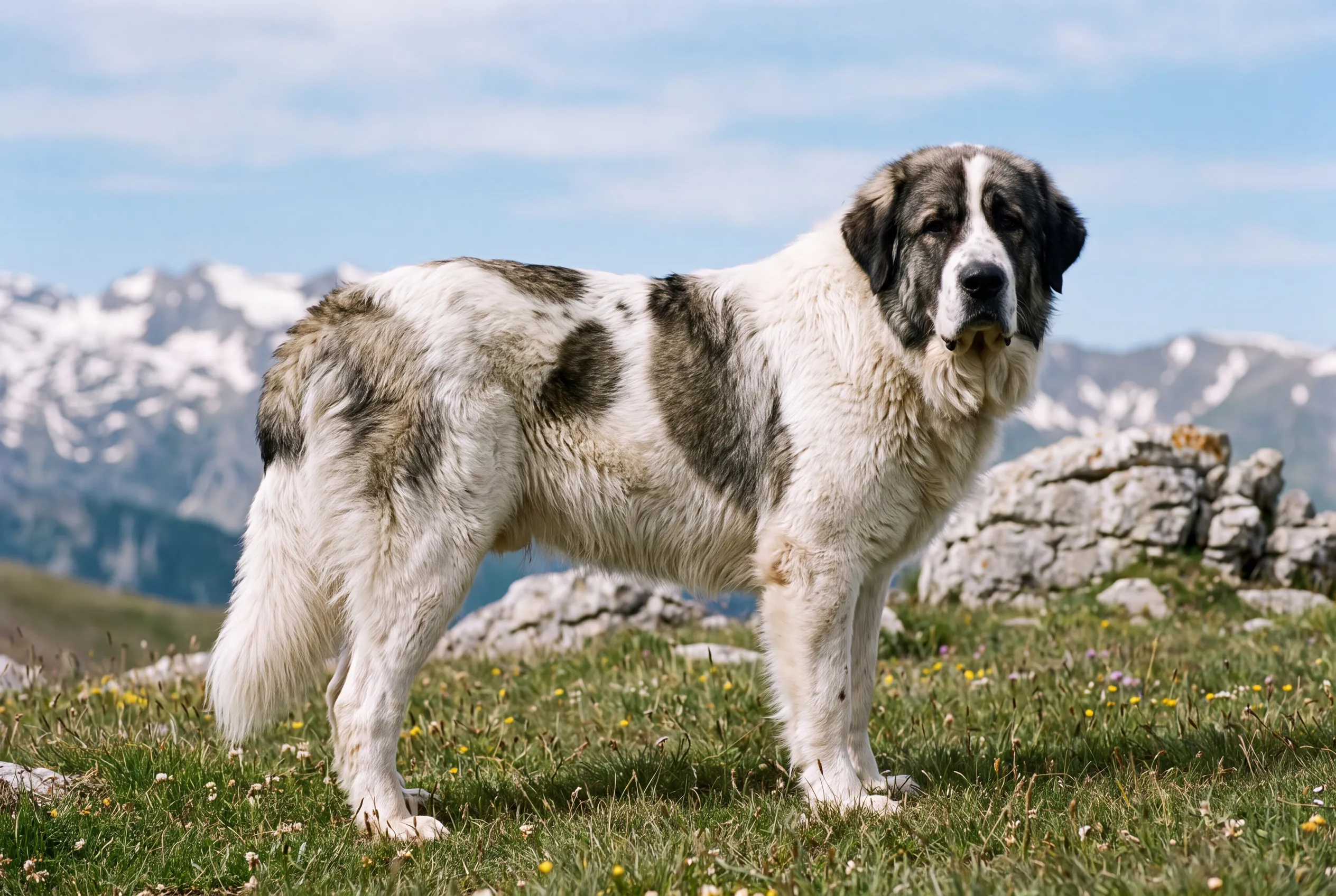
Mastín del Pirineo
Aragón's wolf dog: white, masked, and with no upper size limit.
Vital stats
| Size | Giant · from 77 cm (males) / 72 cm (females), no upper limit |
| Weight | 60–100 kg · males 70–100, females 55–80 — the standard sets none |
| Life expectancy | 10–12 years |
| Energy | Low to moderate — patrol pace, not exercise |
| Shedding | Heavy — thick coat, big seasonal moults |
| Coat | Bristly, 6–9 cm on the back · white with a dark mask and matching patches |
| Group | Working · Mountain Dog (FCI №92, Group 2) |
| Origin | Aragonese Pyrenees, Spain |
| FCI group | 2 — Pinscher and Schnauzer, Molossoid and Swiss Mountain Dogs · FCI 92 |
Breed traits
Friendliness
Care
Mind
The Mastín del Pirineo by the numbers
The Mastín del Pirineo facts owners search for most — price, lifespan, weight, shedding and colours, in one place.
Less common, so expect a waitlist and some travel to a reputable breeder — which pushes the price up. Ongoing costs run high — more food, bigger doses at the vet, and pricier insurance. Its coat also needs a professional groom every few weeks — a real line in the budget.
We don't quote a single figure: the real price swings with breeder, region, bloodline and health testing — and a rescue costs a fraction of a breeder's litter. Adopting is almost always the cheapest route.
Temperament
The FCI standard is unusually warm about this dog: friendly towards humans, calm, noble and very intelligent, at the same time courageous and proud towards strangers, from whom it never backs away. The line owners quote most is the one about other dogs — good natured, and aware of his superior strength — and it holds up. Most Pyrenean Mastiffs let a small dog make its point and decline to answer. When one does fight, the standard says it fights with great skill and calls that an atavism from centuries of wolves. Day to day this is a dog that lies down for hours and watches, gets up when something changes, and says so with a bark that comes from deep in the chest. It takes training better than most livestock guardians and the standard says as much, calling it easily trained. What stays its own is the guarding decision: it works out who has arrived and what that means, then tells you.
Habits & quirks
The mask is not optional
White base coat, a dark mask that must be clearly defined, and patches in that same colour scattered without pattern. The ears always carry spots, the tail tip and the lower legs stay white, and a clean-cut outline to the patches counts in the dog's favour. Solid white with no mask, or patches so faint they blur into the white, are both disqualifications.
A coat you can measure
The standard puts a ruler on the middle of the topline: 6 to 9 cm is the ideal, under 6 or over 11 is a fault, and 4 cm or under, or over 13 cm, disqualifies. The texture should be bristly rather than woolly, longer on the neck, shoulders, belly and the back of the legs, and long and soft on the tail, which finishes in a plume with a hook at the tip.
Aware of its own weight
Strange dogs get looked at rather than answered. The breed was worked in company with other dogs and around other people's flocks, and most adults carry that forward as a kind of slow tolerance. It is not timidity; the standard is explicit that the dog knows what it could do and generally sees no reason to.
Announces early, from a distance
Guarding here runs on voice and position long before anything else. The dog puts itself between the house and the approach, watches, and opens up with a deep bark while whatever it heard is still a long way off. Neighbours notice this before you do.
Care
| Growth before exercise | For the first two to three years this is a construction project, not an athlete. Keep young dogs off forced walks, repeated stairs and jumping, feed a large-breed diet on a vet's schedule rather than free-feeding, and let the frame close on its own. An adult wants an hour of steady walking a day, ideally with some slope in it, and very little more. |
| Grooming | Brush the bristly coat weekly, more often through the two heavy moults, and check the plume on the tail, the feathering behind the forearms and the folds of the dewlap for mats and damp. Never clip it; the coat works against heat as well as cold. A dog this size also needs its nails and feet watched, because it will not tell you when something hurts. |
| Containment and visitors | It picks a boundary and holds it, so fencing has to be real and off-lead trust in public is not on the table. Socialise wide and early and keep going past the first year, and meet visitors with the dog outside the gate rather than letting them walk in. Reward-based training works well here; force does not, and an eighty-kilo dog that has learned to argue is not an argument you win by hand. |
| Health and cost | Ask for hip and elbow scores on both parents before anything else, plus an eye check — the standard describes a slightly slack lower lid in repose, and entropion and ectropion both run in the breed. Gastric torsion is the deep-chest risk, so split meals and learn the signs. Budget honestly too: food, anaesthetics, insurance and boarding all scale with body weight, and ten to twelve years is a short run for the money and the attachment. |
Life expectancy
This breed has a typical life expectancy of 10–12 years.
Similar breeds
Breeds with a similar build and background — worth a look if this one isn't quite the fit.
Breeds that look like this
Common questions
How is this different from a Great Pyrenees?
Same mountain range, opposite sides of it, and two separate breeds. The Great Pyrenees, or Pyrenean Mountain Dog, is the French breed, FCI 137: lighter, predominantly white, and required by its standard to carry double dewclaws on each hind leg. The Mastín del Pirineo is the Spanish and specifically Aragonese one, FCI 92, and it is the heavier, more mastiff-like animal — bigger head, broad neck, a distinct double dewlap, and a height floor of 77 cm for males against the French dog's smaller frame. Colour is the fastest tell in the flesh. A Great Pyrenees may be all white; a Mastín del Pirineo may not, because the dark mask is compulsory and its absence disqualifies. Dewclaws are the reverse: here they may be single, double, missing or removed, and only count as a tiebreaker between equals.
Does one belong in a home with no livestock?
It can work, and it depends far more on the household than on the acreage. The guarding drive does not wait for sheep; with no flock, the dog appoints your family and your boundary instead. What it actually needs is a securely fenced area it can treat as its own, an hour of walking, an owner who will manage introductions for the whole life of the dog, and neighbours far enough off to live with a deep bark at night. A house with a garden and a committed owner is fine. A flat with a shared stairwell and a stream of unfamiliar people is close to the worst setting available, and a first-time owner who wanted an easygoing large family dog should look elsewhere.
How long does one take to grow up?
Two to three years to finish physically, and often longer to settle mentally, which is normal for a giant molossoid and catches people out anyway. A six-month-old is already large enough to move an adult human without meaning to and still has puppy judgement, so the training has to be done well before the size arrives. The guarding instinct switches on somewhere in the second year, usually as a change in how the dog treats arrivals rather than as one dramatic incident. Owners who front-load the socialising and the manners get an easy adult. Owners who wait for the dog to mature get an eighty-kilo teenager with opinions.
Does the Mastín del Pirineo shed a lot?
Yes — the Mastín del Pirineo is a heavy shedder, dropping hair year-round or in big seasonal moults. Brush it several times a week and expect regular vacuuming; it isn't the coat for you if loose fur is a dealbreaker.
Is the Mastín del Pirineo hypoallergenic?
Not really. No dog is truly hypoallergenic, and the Mastín del Pirineo's shedding coat releases plenty of the dander that sets off allergies. If someone at home is allergic, this isn't the easiest breed to live with — spend time around one first.
Is the Mastín del Pirineo good with children?
They can be. The Mastín del Pirineo is reasonably sociable and can be good with children in the right home, especially when socialised early. Supervise around young kids and teach dog and child to respect each other.
Is the Mastín del Pirineo easy to train?
Reasonably. The Mastín del Pirineo is trainable with consistency and rewards, though it isn't the quickest study. Keep sessions short and positive, and be patient with the basics like recall.