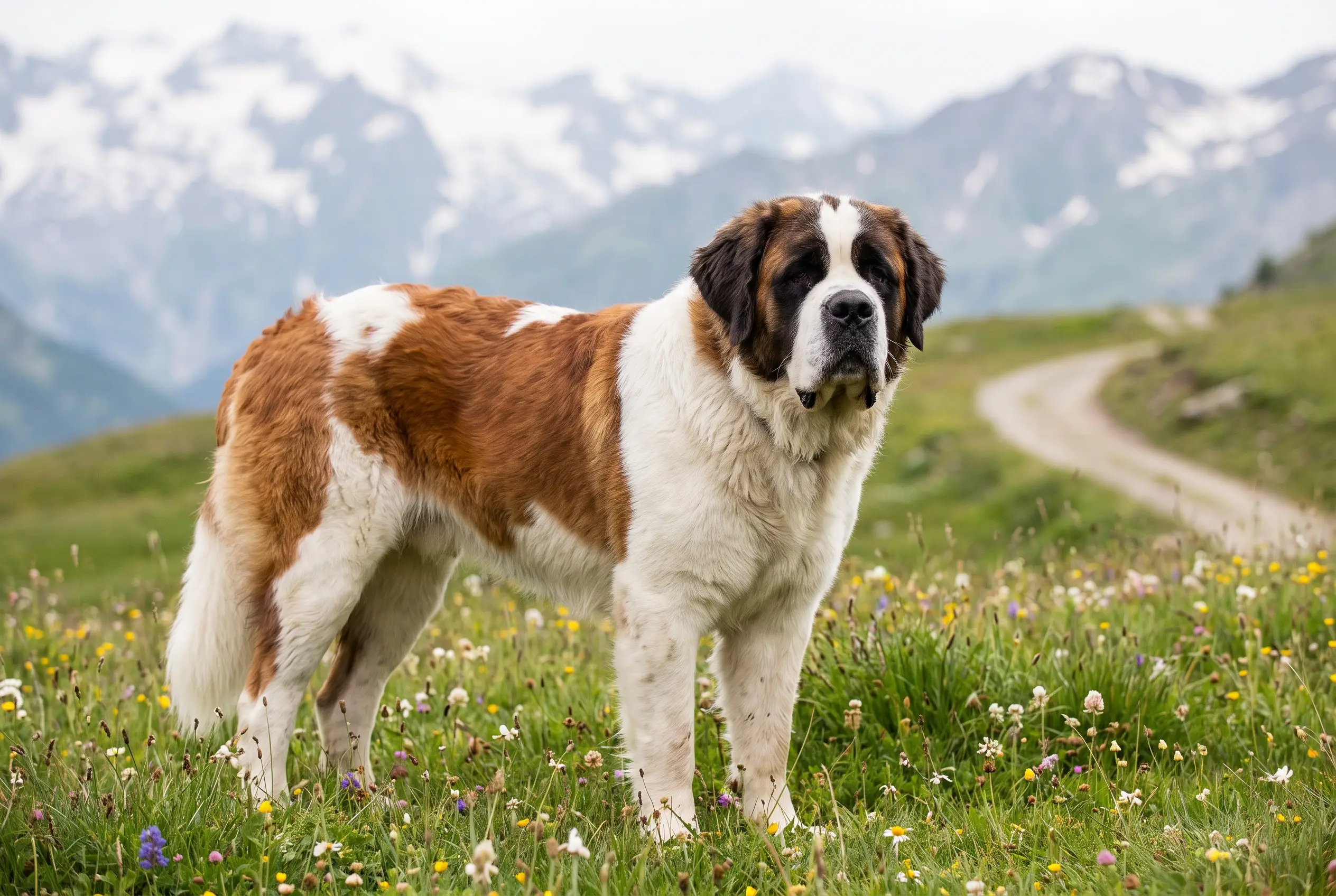
Saint Bernard
The gentle giant of the Alps — a mountain of patience with a rescuer's heart.
Vital stats
| Size | Giant · 65–90 cm |
| Weight | 54–82 kg |
| Life expectancy | 8–10 years |
| Energy | Moderate — 30–60 min/day |
| Shedding | Heavy, seasonal |
| Coat | Dense double coat, short or long · red and white |
| Group | Working · FCI №61 / AKC |
| Origin | Swiss Alps, Switzerland |
| FCI group | 2 — Pinscher and Schnauzer, Molossoid and Swiss Mountain Dogs · FCI 61 |
Breed traits
Friendliness
Care
Mind
The Saint Bernard by the numbers
The Saint Bernard facts owners search for most — price, lifespan, weight, shedding and colours, in one place.
Less common, so expect a waitlist and some travel to a reputable breeder — which pushes the price up. Ongoing costs run high — more food, bigger doses at the vet, and pricier insurance.
We don't quote a single figure: the real price swings with breeder, region, bloodline and health testing — and a rescue costs a fraction of a breeder's litter. Adopting is almost always the cheapest route.
Temperament
Bred by hospice monks to find travellers lost in Alpine snow, the Saint Bernard kept the steadiness the job demanded: unflappable, gentle and quietly attached to its people. At home that reads as a huge, patient shadow — slow to rile, tolerant of children, and convinced it is the right size for your sofa.
Habits & quirks
The lean
Sixty-plus kilos of affection applied gently but firmly to your legs.
Drool forecast
After water, food or a head-shake, expect precipitation — keep a towel by the door.
Snow mode
The first cold snap flips a switch: sudden puppy energy in a giant body.
Doorway sentry
Prefers to rest where it can watch every member of the household at once.
Health
Two things shape a Saint Bernard's health: its size and how long it grows. Bloat, where the stomach fills with gas and can twist, is a real emergency in a deep-chested giant, so split the meals, keep mealtimes calm, and learn the warning signs before you ever need them. The hips and elbows can develop dysplasia, and the two full years this breed spends growing make that worse — buy from a breeder who screens hips and elbows, and feed a giant puppy to come up slowly. Built for snow, it also feels the heat, so keep it cool in summer.
Nutrition
| Feeding | Split meals and rest after eating — bloat is a genuine emergency in giant breeds. |
| Health | Grows for two full years: keep puppies lean and exercise gentle to protect hips and elbows. |
| Heat | Built for snow, not summer — walk early, provide shade and never push in warm weather. |
| Grooming | Weekly brushing, daily during the two heavy seasonal blows; check ears and jowls. |
Feed a Saint Bernard several smaller meals rather than one big one, and keep mealtimes calm — a huge, deep-chested dog is the classic shape for bloat. A giant puppy needs to grow slowly on a large-breed diet, never pushed to bulk up fast, because rushed growth stores up joint trouble in a dog this heavy. Measure the food, count the treats, and keep the dog lean for its whole life.
Puppy guide
A Saint Bernard grows for two full years, and it stays fragile while it does. Go easy on the joints through that whole stretch: limit running, jumping and stairs, and keep walks gentle rather than hard. Grow it slowly on a large-breed diet, teach manners early while the puppy is still liftable, and get it used to grooming and to the heat rules from the start — this is a cold-weather dog in a warming climate.
Training
Saint Bernards are calm, patient and gentle, and they respond to steady, kind, reward-based training far better than to any heavy hand. Start early, while the dog is still a manageable size, and teach the everyday manners a giant has to have — greeting people without leaning or jumping, walking nicely on the lead. A well-mannered Saint is a joy; an untrained one is simply too big to argue with.
Known health issues
No breed is problem-free. These are the conditions most worth knowing about for this breed — with what a good breeder screens for and what an owner watches. General guidance, not a substitute for your vet.
Hip dysplasia
A poorly fitting hip joint that wears early and can cause pain and arthritis, most common in larger breeds. Good breeders screen: Hip-scored parents (BVA/OFA/FCI). Watch for: Stiffness, a bunny-hop run, or reluctance on stairs.
Elbow dysplasia
A developmental fault in the elbow that leads to lameness and arthritis, seen in fast-growing large breeds. Good breeders screen: Elbow-scored parents. Watch for: Front-leg limping that worsens after exercise.
Bloat (GDV)
A sudden, life-threatening twisting of the stomach, mostly in deep-chested breeds — a true emergency. Good breeders screen: Ask about family history; discuss preventive gastropexy for high-risk lines. Watch for: A swollen belly, unproductive retching, restlessness — go to a vet at once.
Inward-rolling eyelid
An eyelid that rolls inward so the lashes rub the eye, common in breeds with loose facial skin or heavy folds. Good breeders screen: A vet eye check on puppies and parents before breeding. Watch for: Squinting, redness, tearing, or pawing at one eye.
Life expectancy
Saint Bernards live 8–10 years. Like most giant breeds, the Saint Bernard is short-lived, but good breeding and steady care push toward the better end. Buy from lines that screen hips and elbows, feed for slow growth and a lean adult weight, and know the signs of bloat cold — the emergency you catch in time is the one your dog survives. Keeping it cool and lean does the rest.
Popular Saint mixes
Saint Berdoodle
A very large, gentle, often lower-shedding family cross that wants calm company and steady training. Its growth and joints need the same care as any giant dog, so health-test the lines.
Saint Bernese
An enormous, gentle, devoted family giant with a heavy coat. Giant-breed care throughout, and it feels the heat, so keep it cool.
Similar breeds
Breeds with a similar build and background — worth a look if this one isn't quite the fit.
Breeds that look like this
Common questions
Do Saint Bernards drool a lot?
Yes — loose jowls make drool part of the package, especially after eating or drinking. Owners learn to keep towels stationed around the house.
Are Saint Bernards good with children?
Famously so — patient, gentle and tolerant, they were practically designed for family life. Supervise toddlers simply because of the breed's sheer size.
How much exercise does a Saint Bernard need?
Moderate: a couple of unhurried walks a day keeps most adults content. Avoid strenuous exercise in puppyhood and in warm weather.
Does the Saint Bernard shed a lot?
Yes — the Saint Bernard is a heavy shedder, dropping hair year-round or in big seasonal moults. Brush it several times a week and expect regular vacuuming; it isn't the coat for you if loose fur is a dealbreaker.
Is the Saint Bernard hypoallergenic?
Not really. No dog is truly hypoallergenic, and the Saint Bernard's shedding coat releases plenty of the dander that sets off allergies. If someone at home is allergic, this isn't the easiest breed to live with — spend time around one first.
Is the Saint Bernard easy to train?
Reasonably. The Saint Bernard is trainable with consistency and rewards, though it isn't the quickest study. Keep sessions short and positive, and be patient with the basics like recall.