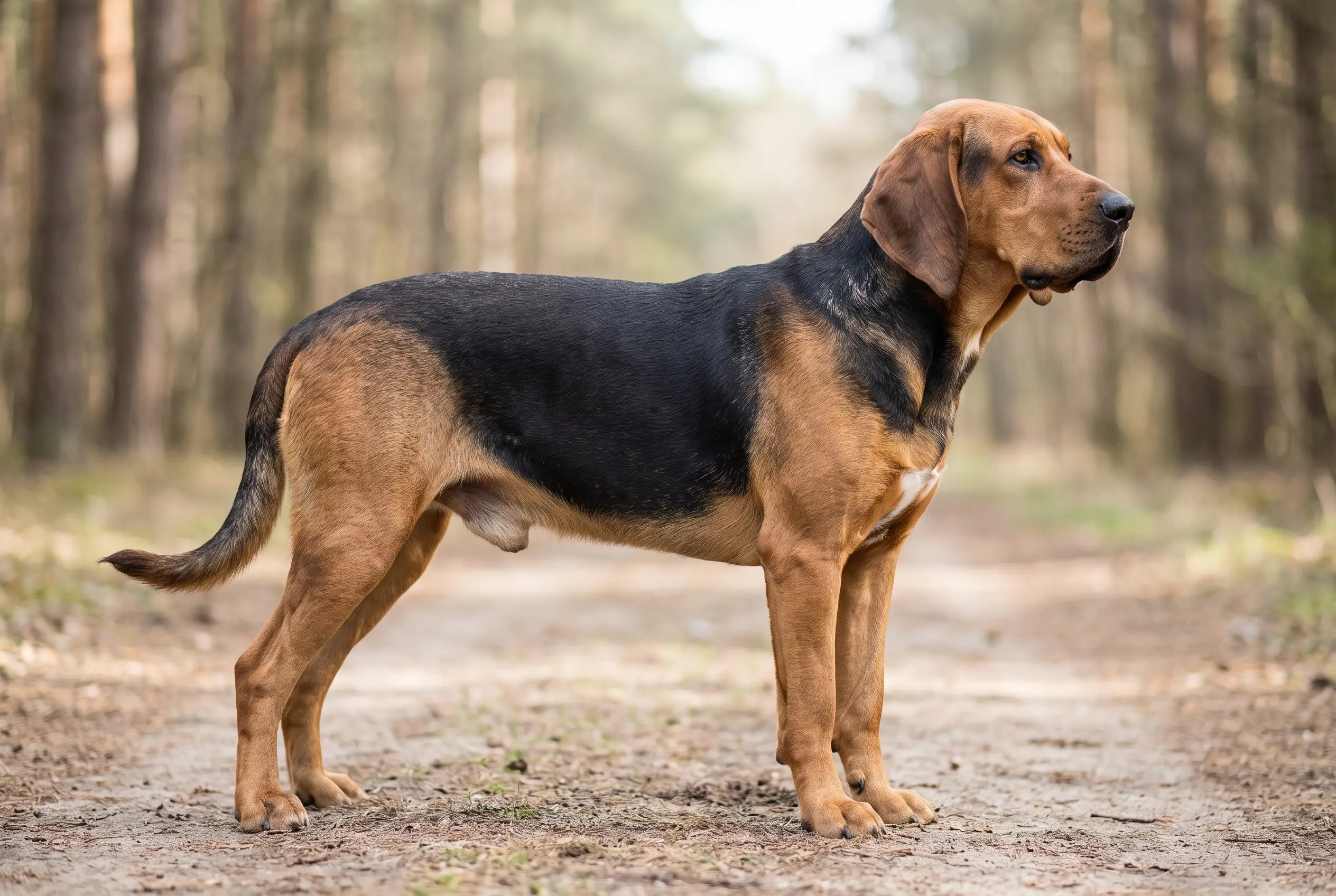
Ogar Polski
The heavier of Poland's two native hounds, rebuilt after the war from four imported dogs and prized for a voice hunters can follow blind.
Vital stats
| Size | Large · 56–65 cm (dogs), 55–60 cm (bitches) |
| Weight | 25–32 kg dogs, 20–26 kg bitches — breed literature; the standard ties weight to height and build, not a number |
| Life expectancy | 13–14 years — breed literature, not survey data |
| Energy | Moderate-high — built for a full day's trailing, not a sprint |
| Shedding | Moderate — dense double coat, sheds year-round |
| Coat | Medium length, thick and hard outer coat over a soft, dense undercoat · dark saddle over tan |
| Group | Hound · Large-sized Scenthound (FCI №52, Group 6) |
| Origin | Poland |
| FCI group | 6 — Scent hounds and related breeds · FCI 52 |
Breed traits
Friendliness
Care
Mind
The Ogar Polski by the numbers
The Ogar Polski facts owners search for most — price, lifespan, weight, shedding and colours, in one place.
Less common, so expect a waitlist and some travel to a reputable breeder — which pushes the price up. Ongoing costs run high — more food, bigger doses at the vet, and pricier insurance.
We don't quote a single figure: the real price swings with breeder, region, bloodline and health testing — and a rescue costs a fraction of a breeder's litter. Adopting is almost always the cheapest route.
Temperament
The standard's own behaviour section reads: "The Polish Hound, like all scent hounds, chase the game on the hot trail, with loud barking. The voice is lower pitched in the male and higher in the female. The barking is called 'giving tongue' by hunters, and the loud game pursuit by the dogs is described as 'the chase'. This outstanding hunting dog is also an excellent family dog, easy to maintain, devoted to the household and wary of strangers." Read plainly, this is a dog built to announce its own hunt — Polish hunters follow the voice through cover where they can't see the dog itself, and a quiet trail is treated as a fault of instinct, not a virtue. At home, the same clause promises the opposite temper: easy to keep, attached to its household, and reserved rather than hostile with people it doesn't know.
Habits & quirks
A saddle, not a coat of spots
The standard calls for a dark saddle — black or dark grey hair covering the whole nape, the back and the top of the tail — laid over a body that runs dark yellow to mahogany everywhere else, with the ears always the darkest shade of tan on the dog. It's the same structural pattern as a few other Central European hounds, just carried on a heavier frame.
Rebuilt from four dogs
Every Ogar Polski alive traces back to a handful of animals Colonel Piotr Kartawik brought out of the old eastern borderlands in 1959, after the war had wiped out the breed's main breeding population inside Poland's new borders. He named the kennel 'z Kresów' — 'from the borderlands' — and it is the only postwar foundation the breed has.
Nobody agrees on its own name
Polish sources offer three separate theories for where 'ogar' comes from: 'ogorzały,' meaning tawny, describing the coat; 'grać,' to give tongue, describing the bark; or the Czech 'ohař,' meaning pointing dog. The standard's own history section records all three without picking one.
Built to outlast the trail, not outrun it
The standard specifies a slow trot at rest and, even in full chase, 'not a very fast gallop' — a hound bred to hold a scent for hours on a muscular, rather heavy frame, not to sprint it down. Endurance is the entire design brief.
Care
| Exercise | This is a stamina hound, not a sprinter — the standard's own gait description tops out at 'not a very fast gallop' even in full chase. Long daily distance with real scent work suits it far better than a short, fast outing; hunting, tracking or long off-lead walks all fit. |
| Grooming | The medium-length outer coat is thick and hard over a soft, dense undercoat, and it sheds year-round rather than in a single blowout. A weekly brush covers the coat; the loose, folded skin at the throat and the thick, drooping lips are worth a wipe-down too. |
| Training | The standard calls it 'easy to maintain' and devoted to its household, but it is still a scent hound bred to hunt largely on its own instinct. Recall around a fresh trail needs real, early work, because nothing in the standard promises the dog checks in once it's chasing. |
| Health | Neither the standard nor the breed literature available for this profile documents a widely recognised breed-specific disorder. The population outside Poland is thin — a handful of dogs registered across a scatter of European countries and the US — so pedigree depth is worth asking about wherever a litter turns up. |
Life expectancy
This breed has a typical life expectancy of 13–14 years — breed literature, not survey data.
Similar breeds
Breeds with a similar build and background — worth a look if this one isn't quite the fit.
Breeds that look like this
Common questions
Is the Ogar Polski the same breed as the Gończy Polski?
No, though the two were tangled together for decades. Both trace to the same postwar rebuilding effort — Colonel Piotr Kartawik's heavier dogs and Colonel Józef Pawłusiewicz's lighter ones were both provisionally registered as 'Ogar Polski' through the 1960s and 70s before the lines were split apart. Kartawik's type kept the name and became FCI standard No. 52; Pawłusiewicz's line eventually became its own breed, the Gończy Polski, FCI standard No. 354, not recognised until 2017. Side by side, the Ogar is the heavier, taller dog — 56–65 cm at the withers in dogs against the Gończy's 55–59 cm — with a broader, heavier head and thick, drooping lips against the Gończy's leaner, 'noble' head; the Ogar today works boar and fox on flat and rolling ground at a measured trot, while the Gończy was purpose-built for the mountainous south and moves at a far more energetic pace.
Is the Ogar Polski a good family dog, or strictly a hunting breed?
The standard calls it 'an excellent family dog, easy to maintain, devoted to the household' in the same paragraph that describes it chasing game with loud, sustained barking, so it's built to do both rather than just one. The catch is the one that comes with most working scent hounds: it needs real daily distance and a scent to follow, and a bored one will find its own entertainment, loudly. Polish breed clubs place most litters with hunters, which makes a non-hunting home possible but not the usual path.
Can I find an Ogar Polski outside Poland?
Not easily. Polish club records describe the breed growing from 15 registered dogs in 1967 to 101 by 1976 — breed literature, not FCI census data — and it has stayed close to a Polish-only breed ever since, with only scattered individual dogs registered across a handful of European countries and the US, and a small enthusiast base in Germany. Expect a long wait and a breeder who wants to know exactly why you want one.
Does the Ogar Polski shed a lot?
Moderately. The Ogar Polski sheds a fair amount, steadily through the year with heavier seasonal patches. A weekly brush keeps most of the loose hair off your floors and clothes.
Is the Ogar Polski hypoallergenic?
Not really. No dog is truly hypoallergenic, and the Ogar Polski's shedding coat releases plenty of the dander that sets off allergies. If someone at home is allergic, this isn't the easiest breed to live with — spend time around one first.
Is the Ogar Polski easy to train?
Reasonably. The Ogar Polski is trainable with consistency and rewards, though it isn't the quickest study. Keep sessions short and positive, and be patient with the basics like recall.