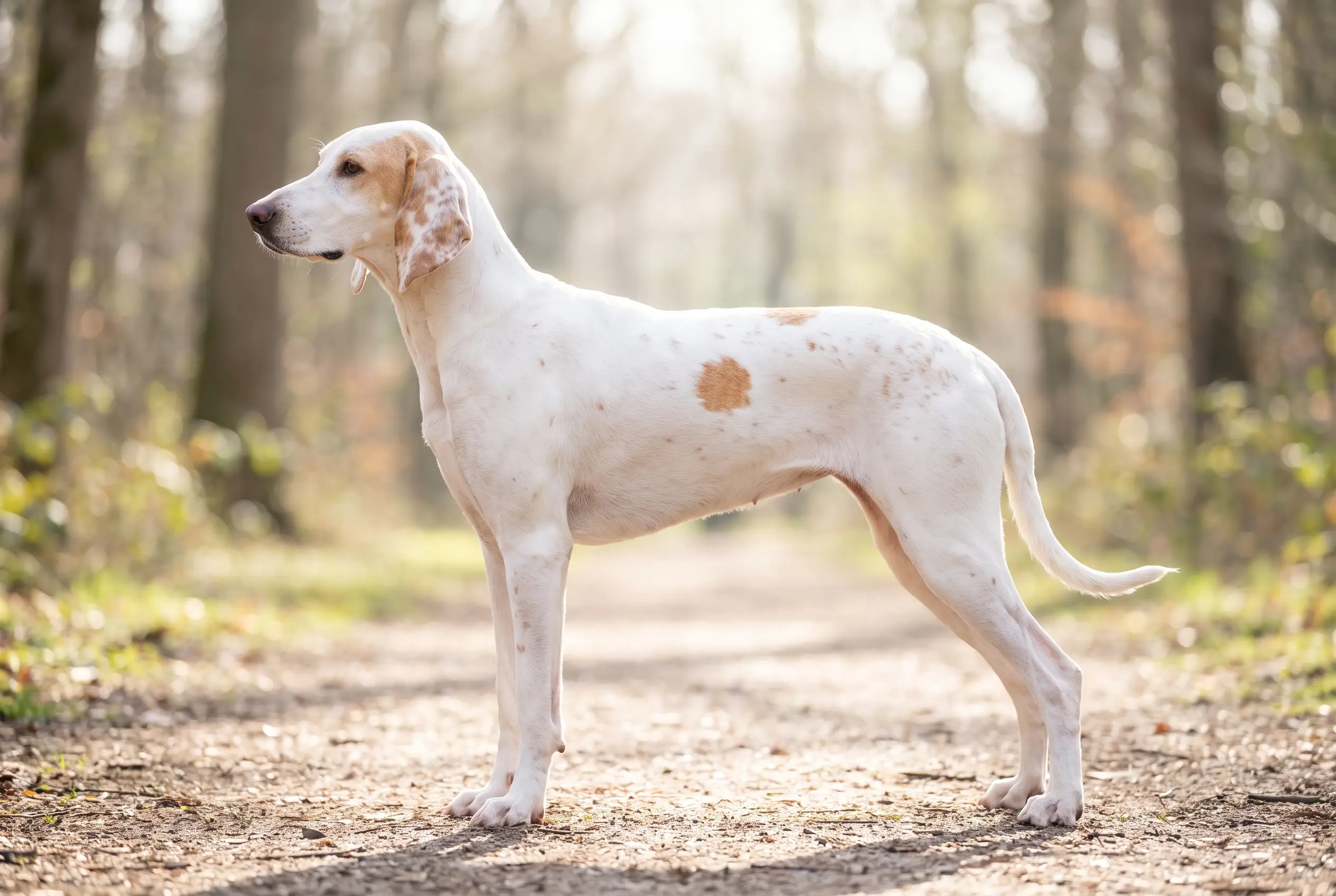
Porcelaine
Named for a coat so fine and thin the light seems to pass through it, like glaze on porcelain.
Vital stats
| Size | Medium · 55–58 cm (dogs), 53–56 cm (bitches) |
| Weight | 25–28 kg — breed literature; the standard sets none |
| Life expectancy | 12–13 years — breed literature, not survey data |
| Energy | High — built to gallop with a pack all day |
| Shedding | Low — short, close-lying coat |
| Coat | Very short, thin and shining · white with round orange spots, never a mantle; skin beneath marbled black |
| Group | Hound · Medium-sized Scenthound (FCI №30, Group 6) |
| Origin | Franche-Comté, eastern France |
| FCI group | 6 — Scent hounds and related breeds · FCI 30 |
Breed traits
Friendliness
Care
Mind
The Porcelaine by the numbers
The Porcelaine facts owners search for most — price, lifespan, weight, shedding and colours, in one place.
Less common, so expect a waitlist and some travel to a reputable breeder — which pushes the price up. Ongoing costs run high — more food, bigger doses at the vet, and pricier insurance.
We don't quote a single figure: the real price swings with breeder, region, bloodline and health testing — and a rescue costs a fraction of a breeder's litter. Adopting is almost always the cheapest route.
Temperament
Unlike many FCI standards revised in the last few decades, the Porcelaine's carries no dedicated behaviour section — it was brought up to date in 1997 but keeps the shape of the original 1964 text, which never had one. What it does say leans practical rather than psychological: the eyes should read with an "expression intelligent and sweet," the gait should be "lively and gay; gallop light and tireless," and the disqualifying faults rule out any dog that is "aggressive or overly shy." Put together, that's a hound built to work hard and stay approachable, not a temperament sketch. Breed literature fills in the rest: energetic and single-minded on a hunt, gentle and social at home, which tracks with a dog raised in packs around handlers and other hounds all day — but that description comes from clubs and hobbyists, not the FCI text.
Habits & quirks
The coat that gives it the name
The standard's own words: coat "very white, with roundish orange spots, never extended to a mantle," with "orange ticking on the ears" called "highly characteristic of the breed." Underneath, the skin is "fine and supple, marbled with numerous black spots" — the layering that reportedly caught the eye of the Marquis Théodore de Foudras, who is credited with naming the breed after fine porcelain in the mid-1800s.
Ears built to reach the muzzle
The standard sets a precise test: the ear leather is thin, "well curled inwards, ending rather in a point," and must reach "the end of the muzzle." It is set on narrow and must never rise above the line of the eye — a lower, tighter attachment than several other French hounds carry.
One extra centimetre, for a good stud dog only
Height tops out at 58 cm for dogs and 56 cm for bitches, and going over or under counts as a fault like any other — except the standard carves out one exception: a male "excelling in [his] quality and therefore capable of being used at stud" may reach 60 cm and still pass.
Rebuilt once already
The packs that kept the breed going were scattered during the French Revolution, and 19th-century breeders rebuilt it from what French stock remained, crossed with the small hounds of Switzerland's own Laufhund line — the same family behind this wave's Schweizer Laufhund. Breed literature calls it the oldest French scenthound and points to written references as far back as the 15th century in Franche-Comté and Berry; no two sources agree on a single earliest date, and the FCI standard has no history section to check it against.
Care
| Exercise | Bred to gallop with a pack from morning to evening, so a lead walk around the block barely registers. Give it a real daily outlet — hunting, long off-lead runs, or scent work — and expect it to want that every single day, not just on weekends. |
| Grooming | The coat is about as low-maintenance as hound coats get: short, smooth and close-lying, needing only an occasional wipe-down. The skin underneath is described as fine, not thick, so a Porcelaine feels the cold more than a rough-coated hound and can sunburn on lightly pigmented patches — worth a coat in a cold kennel and some shade in summer, even though neither is in the standard. |
| Training | The standard doesn't give a training clause any more than it gives a temperament one, so go by what the breed is built for: a nose-first pack hound that commits fully to a scent once it's on one. Recall around game needs to start early and stay consistent, since instinct wins that argument otherwise. |
| Health | Neither the FCI standard nor mainstream breed literature documents a widely recognised breed-specific disorder. The long, curled, low-set ears are worth a regular check, and because the breeding population is small and concentrated in French hunting circles, asking about pedigree depth is sensible wherever a litter turns up. |
Life expectancy
This breed has a typical life expectancy of 12–13 years — breed literature, not survey data.
Similar breeds
Breeds with a similar build and background — worth a look if this one isn't quite the fit.
Breeds that look like this
Common questions
Why is it called Porcelaine?
For the coat, not for any decorative china connection. The standard describes it as very white with round orange spots that never spread into a mantle, over skin that is "fine and supple, marbled with numerous black spots" — a combination that gives the coat a glassy, layered look in good light, similar to the glaze on fine porcelain. The name is usually credited to the Marquis Théodore de Foudras, writing about the breed in the mid-19th century, around the time it was being rebuilt after nearly disappearing.
Did the Porcelaine really almost go extinct?
Close to it, by most accounts. The hunting packs that kept the breed going were broken up during the French Revolution, and 19th-century breeders had to rebuild it from surviving French dogs crossed with Switzerland's own Laufhund stock — the same hound family behind the Schweizer Laufhund. Breed literature markets it as the oldest French scenthound, with references going back to the 15th century in Franche-Comté and Berry, but no source agrees on a single earliest document, and the FCI standard doesn't cover history at all, so treat the deep antiquity as tradition rather than a verified date.
Is it a good family pet, or strictly a hunting dog?
Mostly the latter, in practice. It is still bred and kept almost entirely by hunting packs in France, in genuinely small numbers, and everything about its build points to a dog that wants a full day's work with a pack, not a house routine. Breed sources describe it as gentle and social at home, which is plausible for a pack-raised hound, but finding a Porcelaine outside French (and a little Italian) hunting circles is the real obstacle, well before whether it would suit a family.
Does the Porcelaine shed a lot?
Not much. The Porcelaine is a low-shedding breed, so loose hair around the home stays minimal. It still needs regular grooming, but you won't be fighting drifts of fur.
Is the Porcelaine hypoallergenic?
No dog is truly hypoallergenic, but the Porcelaine comes closer than most: its low-shedding coat releases less of the dander that triggers allergies. Many allergy sufferers manage well with this breed, but spend time around one before committing.
Is the Porcelaine easy to train?
Reasonably. The Porcelaine is trainable with consistency and rewards, though it isn't the quickest study. Keep sessions short and positive, and be patient with the basics like recall.