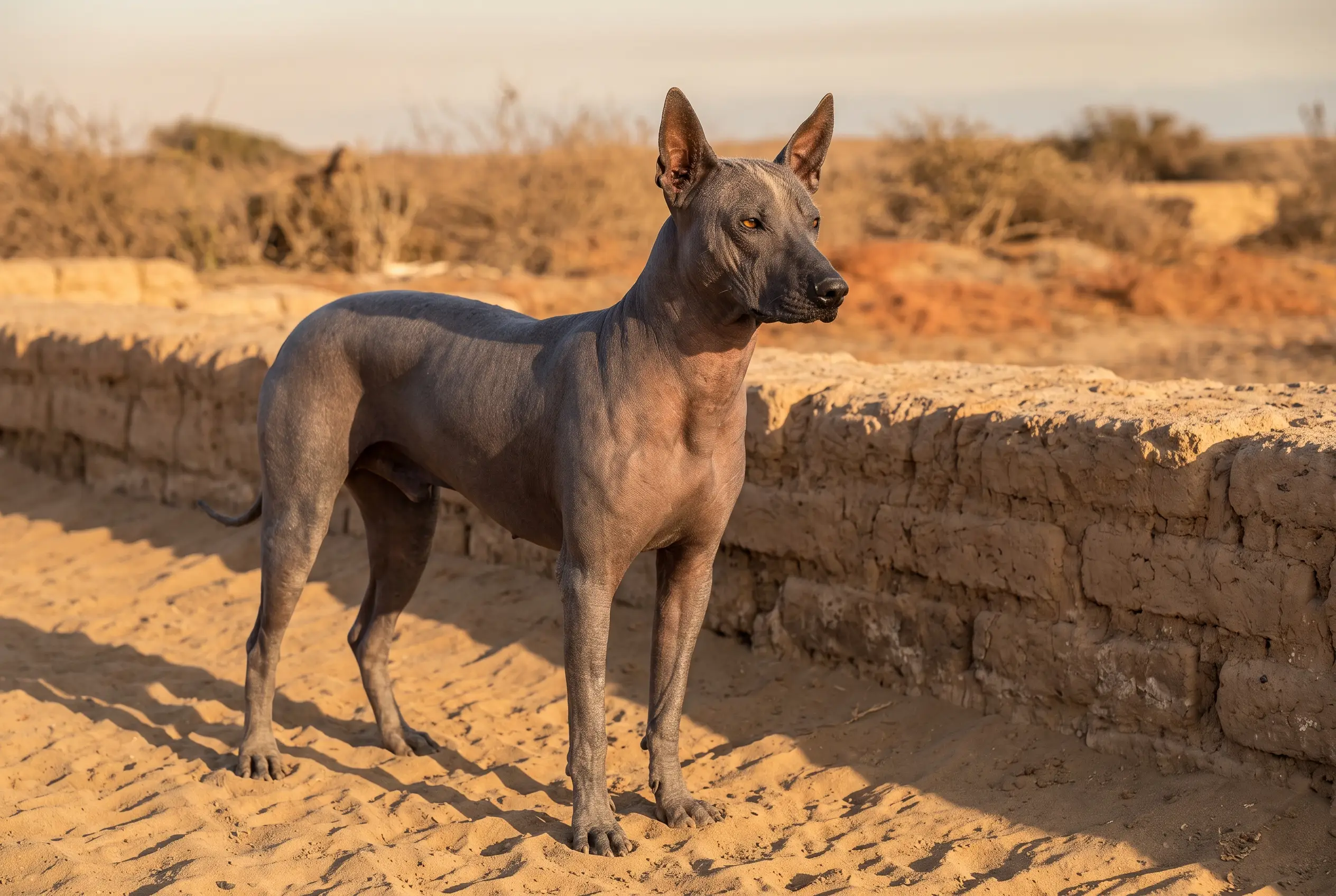
Peruvian Hairless Dog
Peru's viringo: bare warm skin, an incomplete smile, and coated puppies in the same litter.
On these lists: Dogs for allergies
Vital stats
| Size | Three sizes · 25–40, 41–50, 51–65 cm |
| Weight | 4–8, 8–12, 12–30 kg by size |
| Life expectancy | 12–14 years — AKC breed data; the standard sets none |
| Energy | Moderate to high — about an hour a day, plus somewhere safe to run |
| Shedding | None in the hairless variety · light in the coated |
| Coat | Bare skin, or a short tight coat · black and greys through bronze, copper, dark brown to light blond |
| Group | Non-sporting · Dogs of primitive type (FCI №310, Group 5) |
| Origin | Peru |
| FCI group | 5 — Spitz and primitive types · FCI 310 |
Breed traits
Friendliness
Care
Mind
The Peruvian Hairless Dog by the numbers
The Peruvian Hairless Dog facts owners search for most — price, lifespan, weight, shedding and colours, in one place.
Less common, so expect a waitlist and some travel to a reputable breeder — which pushes the price up. Plan for steady ongoing costs — mid-range food, routine vet care and insurance.
We don't quote a single figure: the real price swings with breeder, region, bloodline and health testing — and a rescue costs a fraction of a breeder's litter. Adopting is almost always the cheapest route.
Temperament
The standard asks for a dog "noble and affectionate at home with those close to him, at the same time lively and alert", adding that "he might be wary of strangers and is a good watch dog". That wariness is breed character rather than a training failure, and early, patient socialisation is what keeps it from hardening into fear. The body underneath belongs to a runner: the standard wants an outline expressing "speed, strength and harmony without ever appearing coarse", with hare feet, well-developed inter-digital membranes and pads it describes as heat-resistant. The AKC has run the breed in lure coursing since 2012 and will place it in the Hound Group. Expect a light, quick, physically affectionate dog that wants a real walk and a safe place to open up, then comes home and takes the warmest spot in the house.
Habits & quirks
Warm to lean on, and the standard says why
The FCI text takes the trouble to note that a hairless dog's internal and external temperature is the same as any other breed's. What differs is that "the absence of hair leads to an immediate and direct emanation of heat", where a coated dog's warmth filters out through the coat. Hence the old reputation as a bed warmer, and the jumper in winter.
Two varieties, one litter
Hairless and coated puppies arrive together, and the standard sets the traffic rules. A coated dog registered for the first time must come from two hairless parents already in a studbook or appendix, may then be mated only to hairless dogs, and coated-to-coated crosses are prohibited. The preamble is candid about the reason: the coated variety widens a gene pool that breeding for bare skin keeps narrow.
Gaps in the mouth, written into the standard
In the hairless variety "the absence of one or more teeth is accepted". In the coated variety the dentition must be complete, a missing PM1 is a fault and more than one missing tooth disqualifies. A 2017 study of pedigreed hairless skeletons found permanent canines and premolars absent, deciduous teeth retained and molar cusps reduced, while coated littermates carried full mouths (Kupczik et al., Scientific Reports).
Three sizes, and two sets of names
Small 25–40 cm, medium 41–50 cm, large 51–65 cm, with weight following height at 4–8, 8–12 and 12–30 kg. Over 65 cm or under 25 cm is a disqualifying fault. The FCI's own nomenclature page lists the three varieties as Large, Medium-sized and Miniature, all eligible for the CACIB, so the labels on the page and in the standard do not quite match.
Care
| Skin | This is where coat care would be. PetMD's vet-reviewed guidance for hairless breeds is a weekly bath in lukewarm water with a mild shampoo, a dog-safe moisturiser on dry patches, and a look for redness, flaking and blackheads while you wash. Strong sun wants dog-safe sunscreen or a shirt, and the blond, bronze and depigmented dogs burn soonest. |
| Warmth | No coat means no insulation. A jumper or coat outdoors in cold weather, blankets indoors and a warm bed are equipment, not costume, and a hairless dog will tell you where the radiator is. |
| Teeth | Assume an incomplete mouth in a hairless dog and plan around it: brushing from puppyhood, a vet's eye on retained puppy teeth, and dental checks on the yearly list. The coated variety should carry a full set, which the standard treats as a matter of record rather than preference. |
| Exercise and manners | A companion dog by FCI utilisation and a sighthound by AKC group. About an hour a day of walking suits most, with an enclosed space to sprint, and recall deserves early work because the breed has been lure coursing under AKC rules since 2012. Socialise widely and gently from the start so the standard's wariness of strangers stays polite. |
Life expectancy
This breed has a typical life expectancy of 12–14 years — AKC breed data; the standard sets none.
Similar breeds
Breeds with a similar build and background — worth a look if this one isn't quite the fit.
Breeds that look like this
Common questions
Is a Peruvian Hairless Dog the same as a Xoloitzcuintli?
No. Two breeds, two countries, two standards: Peru's is FCI No. 310, Mexico's Xoloitzcuintle is FCI No. 234, though the FCI files both under Dogs of primitive type and both carry the same FOXI3 mutation, so both throw coated puppies. The Peruvian is the lighter-built one, its standard asking for an elegant, slim dog that expresses speed. The AKC registers it as the Peruvian Inca Orchid, has run it in lure coursing since 2012 and will place it in the Hound Group, while the Xolo shows in Non-Sporting.
Why are some puppies born with hair?
Because the hairless gene cannot be doubled up. A puppy that inherits the FOXI3 variant from both parents does not survive to birth, so every hairless dog carries one hairless copy and one normal one. Mate hairless to hairless and the homozygous embryos are lost, leaving roughly a third of the surviving litter coated; mate hairless to coated and it splits about half and half. The FCI recognises the coated variety for show and for breeding, and the standard's preamble makes the genetic case for keeping it.
How much work is the skin?
About as much as a heavy coat, paid in a different currency. Weekly bathing, moisturiser where the skin dries, sunscreen or a shirt in strong sun, a jumper in the cold, and an eye on spots and blackheads. In return there is no shedding, very little dog smell, and a dog that is genuinely warm to lean on.
Does the Peruvian Hairless Dog shed a lot?
Not much. The Peruvian Hairless Dog is a low-shedding breed, so loose hair around the home stays minimal. It still needs regular grooming, but you won't be fighting drifts of fur.
Is the Peruvian Hairless Dog hypoallergenic?
No dog is truly hypoallergenic, but the Peruvian Hairless Dog comes closer than most: its low-shedding coat releases less of the dander that triggers allergies. Many allergy sufferers manage well with this breed, but spend time around one before committing.
Is the Peruvian Hairless Dog good with children?
They can be. The Peruvian Hairless Dog is reasonably sociable and can be good with children in the right home, especially when socialised early. Supervise around young kids and teach dog and child to respect each other.
Is the Peruvian Hairless Dog easy to train?
Reasonably. The Peruvian Hairless Dog is trainable with consistency and rewards, though it isn't the quickest study. Keep sessions short and positive, and be patient with the basics like recall.