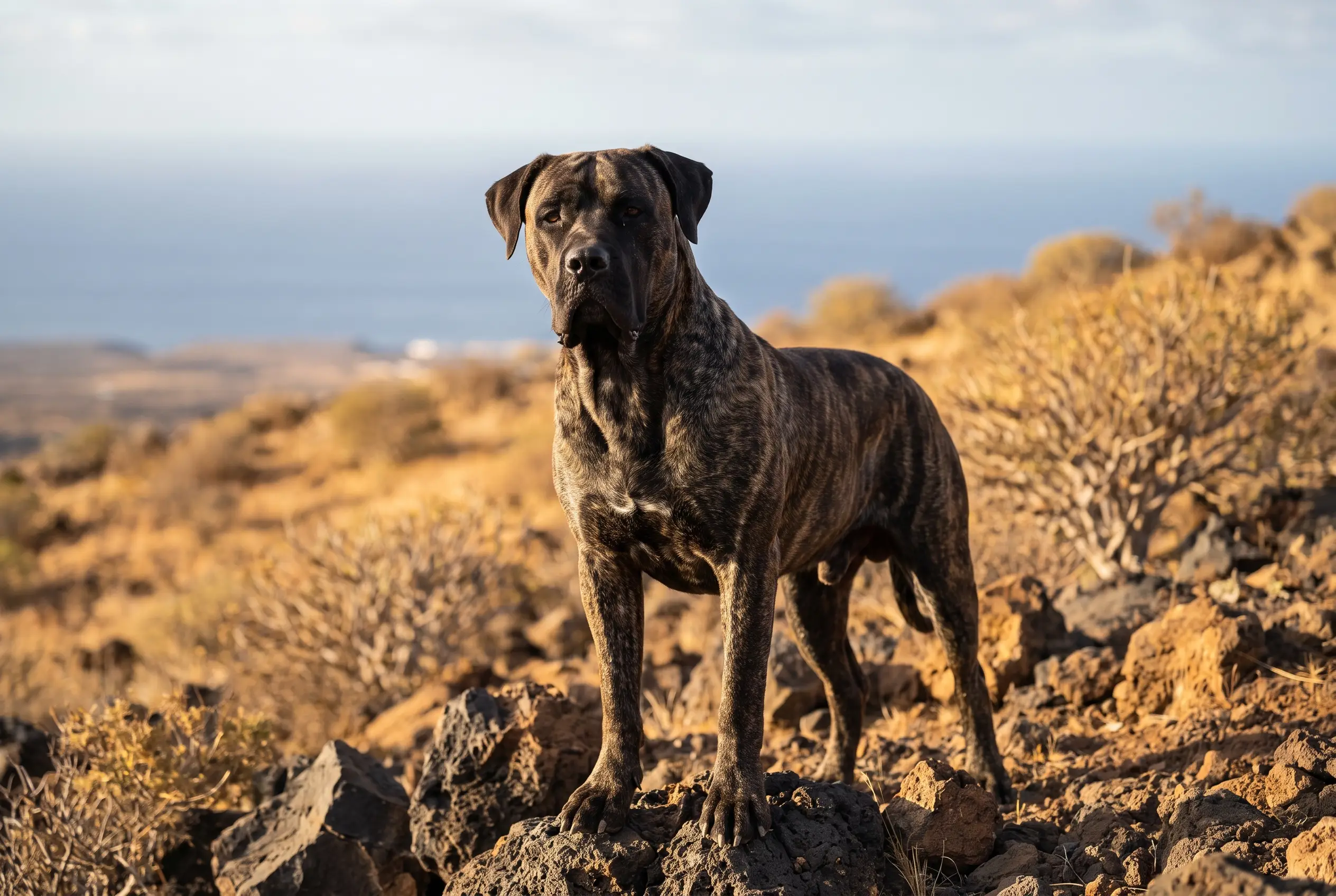
Presa Canario
The Canary Islands' cattle guardian, calm right up to its property line.
Vital stats
| Size | Large · 56–66 cm |
| Weight | 40–65 kg |
| Life expectancy | 9–11 years |
| Energy | Moderate — steady daily walks plus a territory to watch |
| Shedding | Low — short coat, a weekly brush covers it |
| Coat | Short and coarse · brindle or fawn, usually with a black mask |
| Group | Working · Molossoid (FCI №346, Group 2) |
| Origin | Canary Islands, Spain |
| FCI group | 2 — Pinscher and Schnauzer, Molossoid and Swiss Mountain Dogs · FCI 346 |
Breed traits
Friendliness
Care
Mind
The Presa Canario by the numbers
The Presa Canario facts owners search for most — price, lifespan, weight, shedding and colours, in one place.
Widely bred, so you can usually find a litter from a registered breeder without a long wait. Ongoing costs run high — more food, bigger doses at the vet, and pricier insurance.
We don't quote a single figure: the real price swings with breeder, region, bloodline and health testing — and a rescue costs a fraction of a breeder's litter. Adopting is almost always the cheapest route.
Temperament
The Presa Canario is calm to the point of stillness and sure of itself in a way few breeds are. With its family it is steady, affectionate and often surprisingly gentle; with strangers it is aloof, watchful and slow to accept. It was bred to hold cattle and guard ground, and both jobs are still in it: it makes its own decisions, tests a handler who hesitates, and takes the property seriously without being asked. Wide socialisation from puppyhood and consistent, calm training decide whether the adult dog is a reliable companion or a liability. This is a breed for experienced owners, and honest breeders say so first.
Habits & quirks
Owns a vantage point
It picks the spot with a view of the gate and the front door and holds it for hours. Guarding the ground is the job it was bred for, and it clocks in on its own.
Quiet on duty
It rarely barks for nothing. One deep warning usually means something on its territory has actually changed, and it is worth checking.
A slow hello
New people get a long, level look before anything else. Acceptance runs through you: welcome a guest in and the dog stands down and ignores them.
The full-body lean
For all its gravity, this is a physical, affectionate dog with its own people — 60 kg of it will settle against your legs while you cook.
Care
| Exercise | An hour of walking a day plus room to patrol keeps an adult content. Skip forced running before 18 months; the joints of a fast-growing molosser need time to close. |
| Training | Start obedience and socialisation in puppyhood and keep both going for life. It needs to meet many people, dogs and places while young, and an owner who stays calm, consistent and worth following. |
| Grooming | The short, coarse coat needs a weekly going-over with a rubber brush and little else. Check the ears, keep nails short, and accept that some drool comes with the head. |
| Health | Screen breeding stock for hip and elbow dysplasia; dilated cardiomyopathy runs in some lines. Like all deep-chested giants it can bloat, so split meals and enforce rest after eating. |
Life expectancy
This breed has a typical life expectancy of 9–11 years.
Similar breeds
Breeds with a similar build and background — worth a look if this one isn't quite the fit.
Breeds that look like this
Common questions
Is it legal to own a Presa Canario where I live?
Check before you fall for a puppy, because the answer changes by country and sometimes by city. In Spain it sits on the national list of potentially dangerous dogs (PPP), which means a licence, liability insurance, and muzzle and lead in public. Parts of Australia and New Zealand ban or restrict it outright, and some US home insurers refuse households that keep one. The law applies whatever your individual dog is like.
Is a Presa Canario a good first dog?
No. It is big, powerful and confident enough to make its own decisions, and it will test a handler who hesitates. It suits experienced owners with a securely fenced property, time for training and socialisation that never really ends, and no illusions about what a 60 kg guardian breed is. First-time owners have easier ways to be happy.
Dogo Canario and Presa Canario — same dog?
Same breed, two chapters of naming. When the FCI recognised it in 2001 it used the name Dogo Canario; in 2018 the standard was renamed Presa Canario, the name the islands had used all along. Perro de Presa Canario and Canary Mastiff refer to the same dog.
Does the Presa Canario shed a lot?
Not much. The Presa Canario is a low-shedding breed, so loose hair around the home stays minimal. It still needs regular grooming, but you won't be fighting drifts of fur.
Is the Presa Canario hypoallergenic?
No dog is truly hypoallergenic, but the Presa Canario comes closer than most: its low-shedding coat releases less of the dander that triggers allergies. Many allergy sufferers manage well with this breed, but spend time around one before committing.
Is the Presa Canario good with children?
They can be. The Presa Canario is reasonably sociable and can be good with children in the right home, especially when socialised early. Supervise around young kids and teach dog and child to respect each other.
Is the Presa Canario easy to train?
Reasonably. The Presa Canario is trainable with consistency and rewards, though it isn't the quickest study. Keep sessions short and positive, and be patient with the basics like recall.