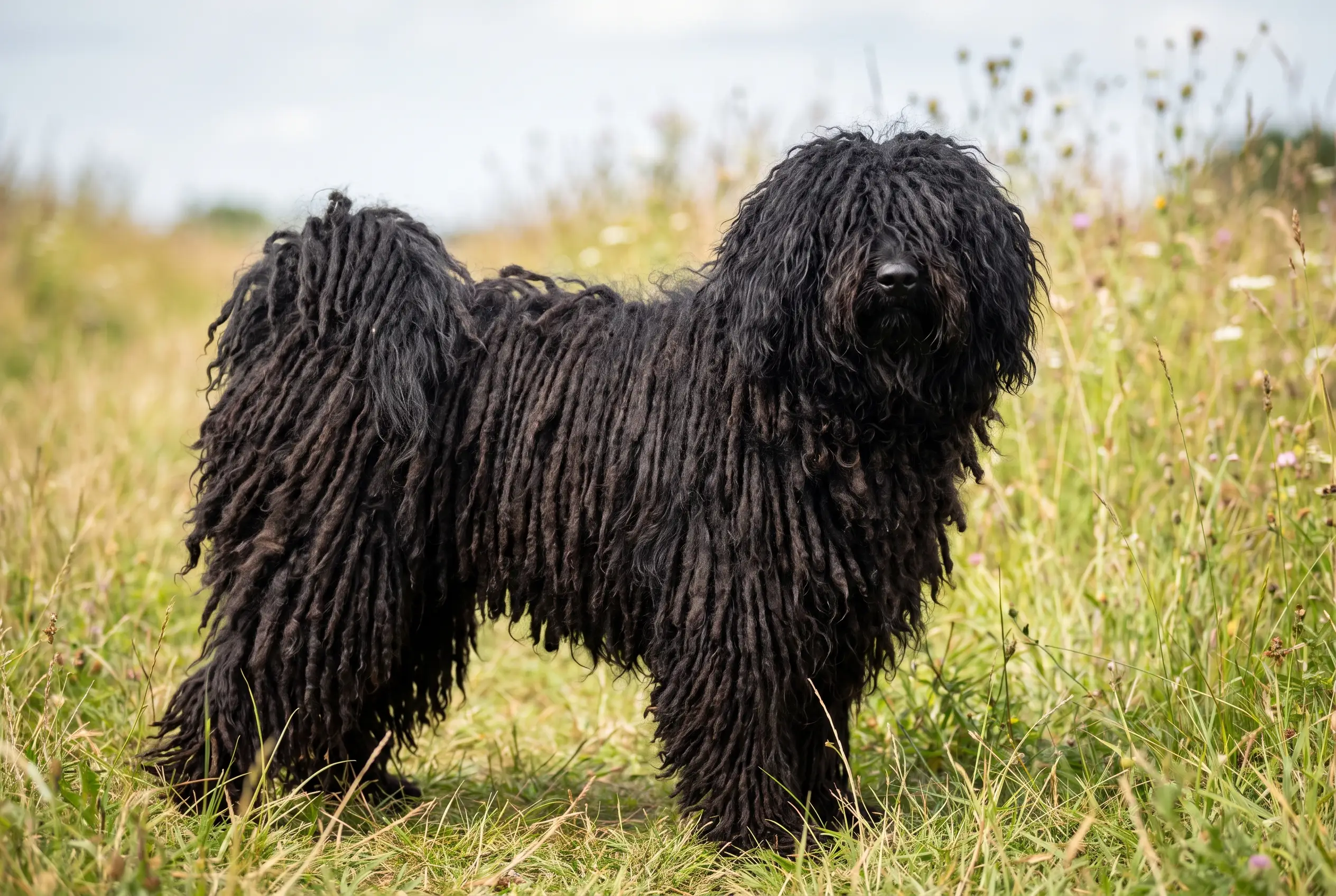
Puli
A spring-loaded sheepdog disguised as a mop — Hungary's bouncing shepherd in cords.
Vital stats
| Size | Small–medium · 37–44 cm |
| Weight | 10–15 kg |
| Life expectancy | 12–16 years |
| Energy | High — 60+ min/day |
| Shedding | Minimal — hair forms cords instead |
| Coat | Corded double coat · black, grey, white |
| Group | Herding · FCI №55 / AKC |
| Origin | Hungary |
| FCI group | 1 — Sheepdogs and Cattledogs · FCI 55 |
Breed traits
Friendliness
Care
Mind
The Puli by the numbers
The Puli facts owners search for most — price, lifespan, weight, shedding and colours, in one place.
Less common, so expect a waitlist and some travel to a reputable breeder — which pushes the price up. Plan for steady ongoing costs — mid-range food, routine vet care and insurance. Its coat also needs a professional groom every few weeks — a real line in the budget.
We don't quote a single figure: the real price swings with breeder, region, bloodline and health testing — and a rescue costs a fraction of a breeder's litter. Adopting is almost always the cheapest route.
Temperament
Bred to turn flocks on the Hungarian plains at a sprint, the Puli is fast, decisive and remarkably springy — famous for bouncing vertically to see over sheep. At home it is loyal and playful with its family, reserved with strangers, and permanently on duty: an under-employed Puli will find work you didn't assign.
Habits & quirks
The vertical bounce
Centuries of seeing over sheep left a dog that leaps straight up like it's on springs.
Perimeter patrol
Garden boundaries get inspected on a schedule only the Puli knows.
The watchful flop
It lies facing the door, cords over its eyes, seeing everything anyway.
Flock management
Family members drifting apart on a walk will be discreetly regathered.
Care
| Grooming | Cords must be separated by hand regularly and can take a full day to dry after bathing — this is the breed's defining commitment. |
| Exercise | An hour daily of real activity; herding, agility and obedience suit its quick mind best. |
| Training | Clever and independent — motivate rather than drill, and socialise early against over-guarding. |
| Health | A tough, weatherproof breed; ask breeders for hip scores and eye testing. |
Life expectancy
This breed has a typical life expectancy of 12–16 years.
Similar breeds
Breeds with a similar build and background — worth a look if this one isn't quite the fit.
Breeds that look like this
Common questions
Do Puli cords form naturally?
The coat mats naturally, but the cords need regular hand-separating to form neatly rather than felting into plates. Owners learn the routine or work with a groomer.
Do Pulik shed?
Barely — loose hair stays caught in the cords instead of falling. The trade-off is one of dogdom's most demanding coat-care routines.
Are Pulik good family dogs?
Yes for active families — they're playful, devoted and gentle with their own children. Expect wariness with strangers and some herding of small, fast humans.
Is the Puli hypoallergenic?
No dog is truly hypoallergenic, but the Puli comes closer than most: its low-shedding coat releases less of the dander that triggers allergies. Many allergy sufferers manage well with this breed, but spend time around one before committing.
Is the Puli easy to train?
Reasonably. The Puli is trainable with consistency and rewards, though it isn't the quickest study. Keep sessions short and positive, and be patient with the basics like recall.