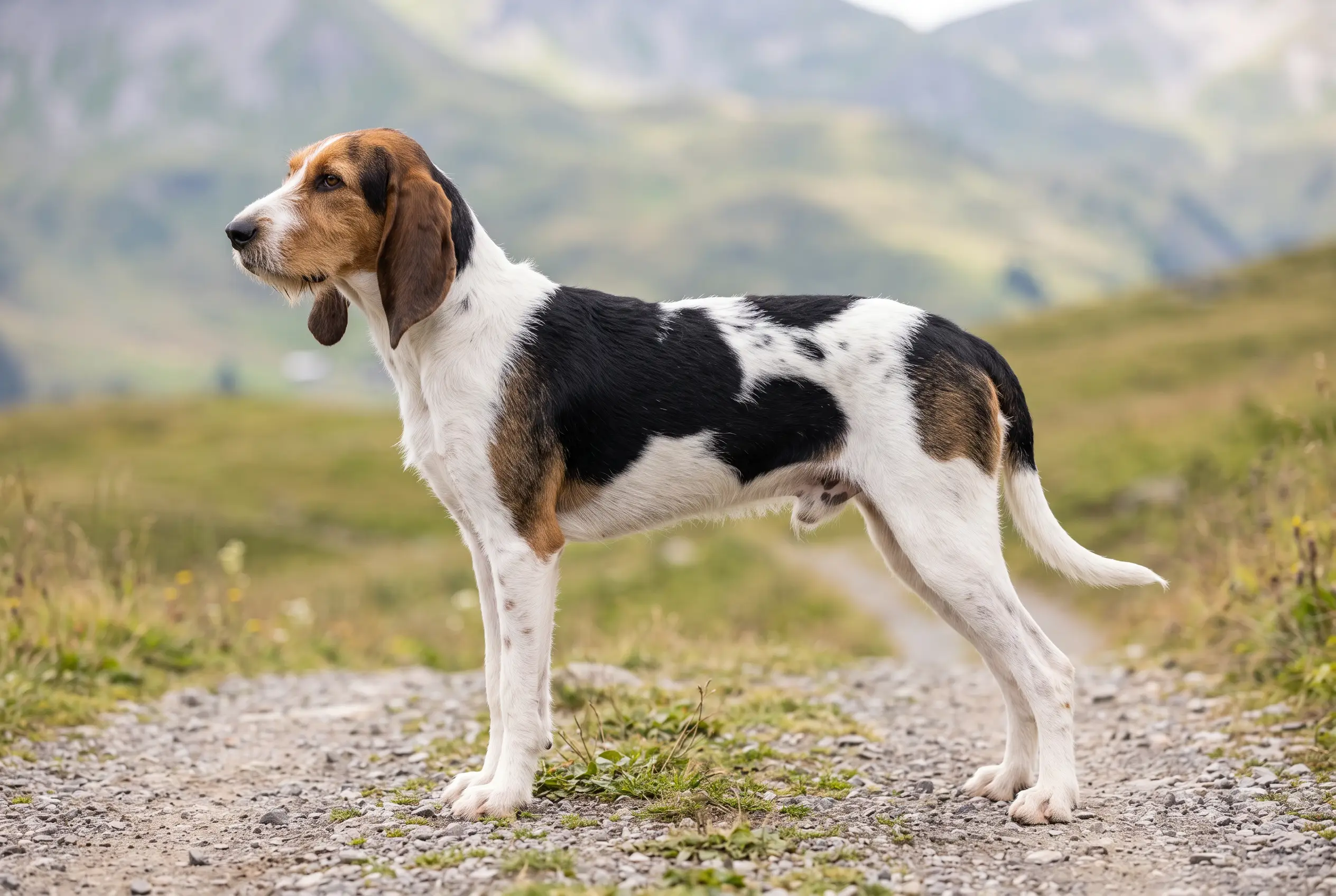
Schweizer Laufhund
Four Swiss varieties, one FCI standard — only the coat says which is which.
Vital stats
| Size | Medium · 47–59 cm (dogs 49–59, bitches 47–57) |
| Weight | 18–25 kg — no figure in the standard or in accessible breed literature; an editorial estimate from comparably built FCI hounds |
| Life expectancy | 12–14 years — no breed-specific figure found; typical range for a working hound this size |
| Energy | High — built for full days on mountain and flat terrain alike |
| Shedding | Low — short, dense, close-lying coat |
| Coat | Short, smooth, dense, fine on head and ears · colour fixed per variety, never mixed |
| Group | Hound · Medium-sized Scenthound (FCI №59, Group 6) |
| Origin | Switzerland |
| FCI group | 6 — Scent hounds and related breeds · FCI 59 |
Breed traits
Friendliness
Care
Mind
The Schweizer Laufhund by the numbers
The Schweizer Laufhund facts owners search for most — price, lifespan, weight, shedding and colours, in one place.
Less common, so expect a waitlist and some travel to a reputable breeder — which pushes the price up. Plan for steady ongoing costs — mid-range food, routine vet care and insurance.
We don't quote a single figure: the real price swings with breeder, region, bloodline and health testing — and a rescue costs a fraction of a breeder's litter. Adopting is almost always the cheapest route.
Temperament
The standard's own behaviour clause is one sentence: "Lively and passionately keen on hunting, sensitive, docile and very attached to his master." Every word there is doing real work. "Passionately keen" matches the utilization clause's own claim that the dog "searches and hunts with great determination" even on difficult ground; "sensitive" and "docile" rule out the hard-headed obstinacy some scenthounds carry, and "very attached to his master" is the standard's own account of a one-person dog rather than an all-comers greeter. It hunts independently, not in a pack, and gives tongue — bays loudly and continuously on a hot scent — so a hunter on foot can follow the voice through cover he can't see into. None of this describes a dog built for apartment living or a stranger's lap; breed clubs in Switzerland and neighbouring countries place puppies almost entirely with hunters, and an unworked Laufhund is a loud, frustrated one.
Habits & quirks
Four dogs under one number
In 1882 Switzerland wrote a separate standard for each of five regional hound varieties. By the 1909 revision the Thurgovie hound was extinct, and an older St Hubert-type strain within the Jura line was gone too, per the standard's own history section. On 22 January 1933 the FCI folded the surviving four — Bernese, Jura, Lucerne and Schwyz — into the single standard still in force as No. 59, and it still faults the wrong colour turning up in the wrong place: a Bernese Hound is faulted for tan on the outer ear, a Schwyz Hound for white there instead.
On a Roman mosaic before anyone wrote a standard
The history section doesn't hedge: it cites a mosaic discovered at Avenches, capital of Roman Helvetia, showing packhounds it says correspond to the Swiss hound varieties. Italian hunters sought it out in the 15th century and French hunters in the 18th, prized for hunting hare, and the standard credits French mercenaries with bringing home scenthounds that shaped the breed's own lines in turn. That same cross-border traffic later helped rebuild France's Porcelaine (FCI №30) after the Revolution scattered its packs — the two breeds share a documented Swiss-French exchange, not just a region.
Hunts alone and says so loudly
"Hunting dog used for hunting the hare, the roedeer, the fox and sometimes the boar. He hunts in an independent manner giving tongue. Even on difficult terrains, searches and hunts with great determination" — the standard's own utilization clause. Giving tongue means baying loudly and continuously once it strikes a scent, so a hunter on foot can follow the voice through ground he can't see into. Independent means what it says: this is a lone-working scenthound, not a pack hound running alongside others.
Its own short-legged cousin
Around 1900 several Swiss cantons introduced fenced hunting grounds where a dog built to gallop all day simply outran the enclosure. Breeders answered with a smaller, shorter-legged version in the same four colour lines, registered separately by the FCI as the Schweizer Niederlaufhund, standard No. 60; its own breed club, founded in 1905, was first named the Schweizerischer Dachsbracken Club. Stood side by side, the two read as the same family at different heights: 47–59 cm for the Laufhund, 33–45 cm for the Niederlaufhund.
Care
| Exercise | Built to hunt hare, roedeer and fox across ground the standard itself calls difficult terrain, "with great determination" — a lead walk barely registers. Give it long daily distance with real scent work: hunting, tracking, or extended off-lead time on varied ground suits it far better than a loop around the block. |
| Grooming | The short, dense, close-lying coat needs only occasional brushing to stay tidy, and shedding stays light year-round. The ears are the real maintenance item — long, low-set and folded close to the cheeks — and are worth a regular check for trapped moisture after a day working scent close to the ground. |
| Training | The standard calls it sensitive and docile rather than headstrong, but the hunting drive behind that is total: this is a dog that commits fully to a scent once it opens up on one. Recall work needs to start early and stay consistent, and heavy-handed correction works against a temperament the standard itself flags as sensitive. |
| Health | Neither the FCI standard nor the breed literature checked for this profile documents a widely recognised breed-specific disorder. Given how small and hunter-concentrated the population is outside Switzerland, asking about hip screening and pedigree depth is sensible practice for a low-population working hound, rather than a documented club requirement. |
Life expectancy
This breed has a typical life expectancy of 12–14 years — no breed-specific figure found; typical range for a working hound this size.
Similar breeds
Breeds with a similar build and background — worth a look if this one isn't quite the fit.
Breeds that look like this
Common questions
How do I tell the four Schweizer Laufhund varieties apart?
By colour alone — build and size are identical. The Bernese Hound is white with black patches or a black saddle, tan over the eyes, cheeks, ear insides and vent. The Jura Hound is tan with a black blanket, or black with tan points, sometimes with a small white or lightly speckled chest patch. The Lucerne Hound is "blue" — black and white hairs mixed into a dense overall speckle — with black patches or a black saddle and tan points. The Schwyz Hound is white with orange patches or an orange saddle. All four share one FCI standard, No. 59, and a judge cannot fault a dog for wearing its own variety's pattern.
Is the Schweizer Laufhund the same dog as the Schweizer Niederlaufhund?
Related, not the same — different FCI standards, different sizes. Both come in the same four colour varieties and both hunt by giving tongue, but the Niederlaufhund (FCI №60) was bred down deliberately around 1900, when several Swiss cantons introduced fenced hunting grounds too small for a fast, wide-ranging Laufhund. It stands 33–45 cm against the Laufhund's 47–59, and its breed club — founded in 1905 as the Schweizerischer Dachsbracken Club — organised specifically around that smaller, short-legged type.
Would a Schweizer Laufhund work as a family pet?
Rarely, in practice. It is bred and placed almost entirely through Swiss and neighbouring hunting circles, built around a nose and voice that expect daily scent work, and the standard's own description — "passionately keen on hunting" — is not a temperament that idles well. A home that supplies real daily hunting-level exercise could work; finding a breeder willing to place a puppy outside hunting circles is usually the first obstacle, well before the question of fit.
Does the Schweizer Laufhund shed a lot?
Not much. The Schweizer Laufhund is a low-shedding breed, so loose hair around the home stays minimal. It still needs regular grooming, but you won't be fighting drifts of fur.
Is the Schweizer Laufhund hypoallergenic?
No dog is truly hypoallergenic, but the Schweizer Laufhund comes closer than most: its low-shedding coat releases less of the dander that triggers allergies. Many allergy sufferers manage well with this breed, but spend time around one before committing.
Is the Schweizer Laufhund easy to train?
They can be a challenge. The Schweizer Laufhund is intelligent but independent, and would rather make its own decisions than take orders. Reward-based training and patience work best; expect recall in particular to take time.