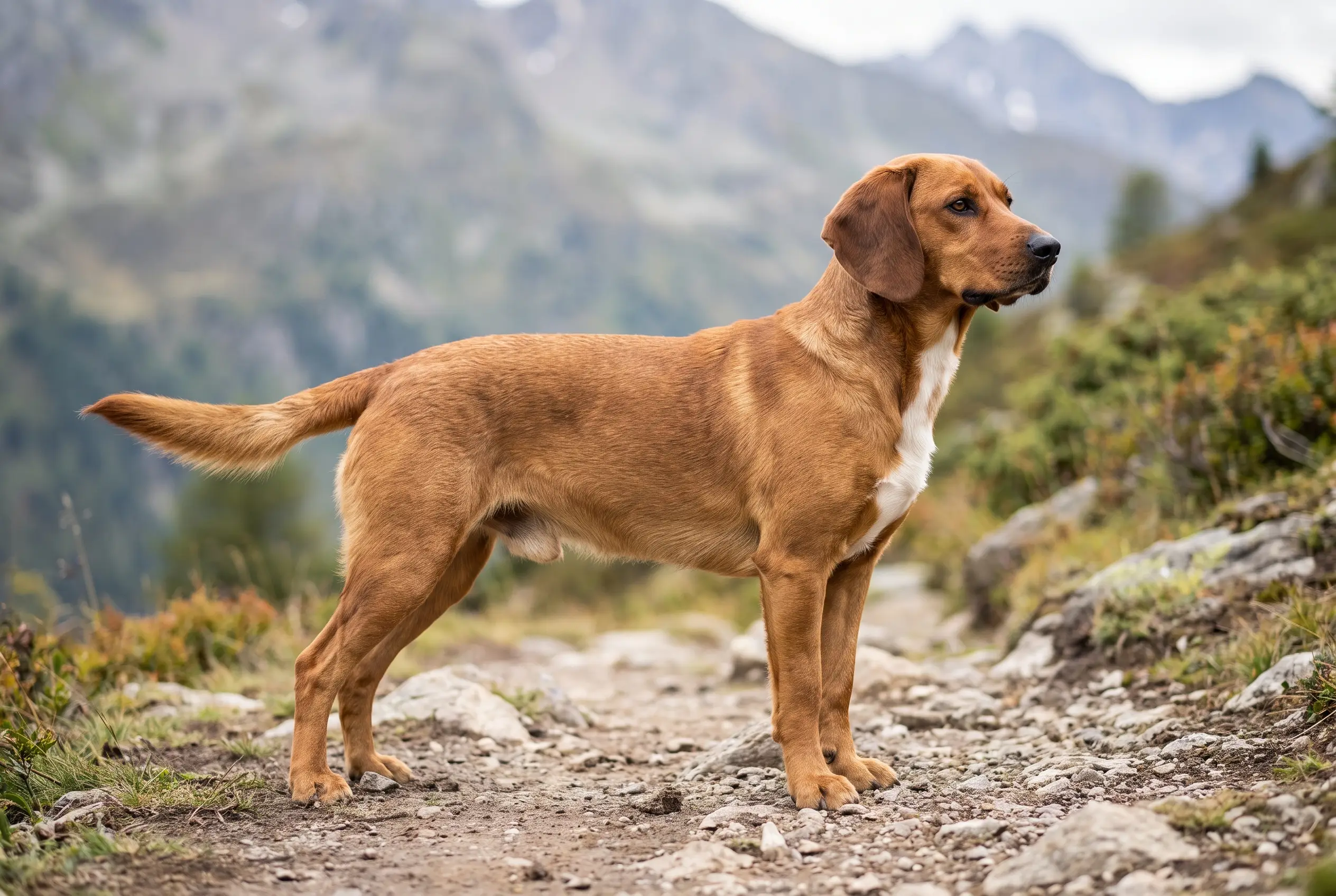
Tiroler Bracke
Hunts hare and fox alone or in pairs, never as part of a pack — and gives tongue the whole way so the hunter can follow by ear.
Vital stats
| Size | Medium · 42–50 cm (dogs 44–50, bitches 42–48) |
| Weight | 16–27 kg — breed literature; the standard sets none |
| Life expectancy | 12–14 years — breed literature, not survey data |
| Energy | High — ground-covering gait built for a full day's mountain hunt |
| Shedding | Low — thick double coat, sheds lightly year-round |
| Coat | Thick double coat, coarse undercoat · red, or black-and-tan (may run tricolour) |
| Group | Hound · Medium-sized Scenthound (FCI №68, Group 6) |
| Origin | Austria |
| FCI group | 6 — Scent hounds and related breeds · FCI 68 |
Breed traits
Friendliness
Care
Mind
The Tiroler Bracke by the numbers
The Tiroler Bracke facts owners search for most — price, lifespan, weight, shedding and colours, in one place.
Less common, so expect a waitlist and some travel to a reputable breeder — which pushes the price up. Plan for steady ongoing costs — mid-range food, routine vet care and insurance.
We don't quote a single figure: the real price swings with breeder, region, bloodline and health testing — and a rescue costs a fraction of a breeder's litter. Adopting is almost always the cheapest route.
Temperament
The standard's own behaviour clause is exact: "Steady, passionate hunting hound with fine scenting ability. Works independently and hunts with endurance, whereby giving tongue clearly and following scent firmly with a good sense of direction." Read plainly, that's a dog that doesn't need a pack, a partner or much supervision to do its job — it works out a trail on its own nerve and announces the find loudly enough for the hunter to follow on foot. Breed literature adds a household note the standard doesn't cover: affectionate and highly active at home, but wary of strangers, with little instinct toward guarding. The standard backs up the steady half of that description with two disqualifying faults of its own — "aggressive or overly shy" — so a dog that panics or one that attacks is written out of the breed entirely, not just marked down.
Habits & quirks
Two colours left, out of many
The standard says so directly: "From the many types of Bracke native to the Tyrol, only the red and the black and tan colour varieties remain." Everything else Tyrol once bred simply didn't make it onto the written page — today's dog comes in red, or black-and-tan that may also run tricolour, and nothing else passes.
A short-legged version of itself, gone since 1994
Until 1994, the FCI standard for the Tiroler Bracke covered a short-legged variety alongside the normal-legged dog — one breed, two builds. That year the standard deleted the short-legged type outright, leaving a single medium-sized hound. It's easy to confuse with the Alpenländische Dachsbracke, Austria's other short-legged mountain scenthound, but that's a separate FCI breed (No. 254) with its own standard, not a survivor of this one's deletion.
Never a pack dog
The standard's utilization clause calls it the ideal working dog for the hunter in wood and mountains, sent after hare and fox on its own while giving tongue, and used to track any wounded game. In practice that means one dog, or two working as a pair — not a pack running together, the way some Bracke types across the Alps still hunt.
An emperor's diary, not a folk tale
The standard claims descent from the Keltenbracke, the Celtic hound, without hedging the point — but the oldest fact anyone can actually date is Emperor Maximilian I hunting with this Tyrolean bloodline around 1500, recorded in his own hunting diaries as the source of his lead hounds. Controlled breeding didn't start for another 360 years, and the written standard is younger still: drawn up in 1896, officially recognised in 1908.
Care
| Exercise | This is a mountain hunting dog built for a full day on foot through wood and high ground, alone or paired with one other hound, not a dog for a lead-walk loop. The standard calls its gait ground-covering, very quick and enduring — give it long daily distance and real scent work, hunting or tracking practice if you can arrange it, hard hiking if you can't. |
| Grooming | The thick double coat, with a coarse rather than fine undercoat, sheds lightly by most accounts and needs only a weekly brush to stay in order. The broad, high-set ears reach nearly to the canine tooth when extended and hang close to the head — check them regularly, especially after a day working in cover. |
| Training | The standard's own behaviour clause credits it with working independently, which in a house means a dog that thinks for itself before it checks in with you. Start recall and socialisation early: the standard disqualifies both "aggressive" and "overly shy" outright, so the entire useful range sits in the calm, confident middle, and getting there takes consistent early work. |
| Health | The standard closes on a breeding clause — "only functionally and clinically healthy dogs, with breed typical conformation should be used for breeding" — and asks for a complete set of 42 teeth, tolerating the loss of up to two premolars. Breed literature reports no widely documented breed-specific disorder beyond the ordinary joint wear of a working hound and a higher risk of ear infection given the long, close-hanging ears; the population outside Austria is small enough that pedigree depth is worth asking about. |
Life expectancy
This breed has a typical life expectancy of 12–14 years — breed literature, not survey data.
Similar breeds
Breeds with a similar build and background — worth a look if this one isn't quite the fit.
Breeds that look like this
Common questions
How is the Tiroler Bracke different from the Brandlbracke?
Both are medium-sized Austrian scenthounds in the same FCI group and section — Group 6, Section 1.2 — which is exactly why they get confused. The numbers separate them cleanly: the Tiroler Bracke is FCI standard No. 68, runs 42–50 cm, and comes in red or black-and-tan (which may run tricolour), with the tan spots above the eyes, the Vieräugl marking, merely permitted. The Brandlbracke is FCI standard No. 63, runs larger at 48–56 cm, is black-and-tan only, and disqualifies any dog missing those same Vieräugl spots outright — on the Brandlbracke they're compulsory, not optional.
How is the Tiroler Bracke different from the Alpenländische Dachsbracke?
Different build, different job, different FCI paperwork. The Alpenländische Dachsbracke (FCI No. 254) is short-legged — 34–42 cm, built on a fixed 2:3 ratio of height to body length — and works Section 2, led on a leash to track one specific wounded animal at close range. The Tiroler Bracke (FCI No. 68) stands taller at 42–50 cm on ordinary legs, sits in Section 1.2, and runs hare and fox free as well as tracking wounded game. The overlap runs deeper than it looks: the Tiroler Bracke standard itself once covered a short-legged variety of its own, deleted in 1994 — a near-miss with the Dachsbracke's whole reason for existing, even though the two remain separate breeds with separate papers.
Is the Tiroler Bracke a good pet, or strictly a hunting dog?
It's possible, but it's a genuine working hound first. The standard builds it to hunt alone or in pairs across difficult mountain terrain all day and disqualifies shyness as firmly as aggression, which in practice means a confident, independent-minded dog that still needs real socialisation to land in the middle. Breed literature adds that it's affectionate and highly active at home but wary of strangers, with little guarding instinct — a non-hunting home can work, provided it supplies serious daily exercise and scent work rather than a walk around the block.
Does the Tiroler Bracke shed a lot?
Not much. The Tiroler Bracke is a low-shedding breed, so loose hair around the home stays minimal. It still needs regular grooming, but you won't be fighting drifts of fur.
Is the Tiroler Bracke hypoallergenic?
No dog is truly hypoallergenic, but the Tiroler Bracke comes closer than most: its low-shedding coat releases less of the dander that triggers allergies. Many allergy sufferers manage well with this breed, but spend time around one before committing.
Is the Tiroler Bracke good with children?
They can be. The Tiroler Bracke is reasonably sociable and can be good with children in the right home, especially when socialised early. Supervise around young kids and teach dog and child to respect each other.
Is the Tiroler Bracke easy to train?
Reasonably. The Tiroler Bracke is trainable with consistency and rewards, though it isn't the quickest study. Keep sessions short and positive, and be patient with the basics like recall.