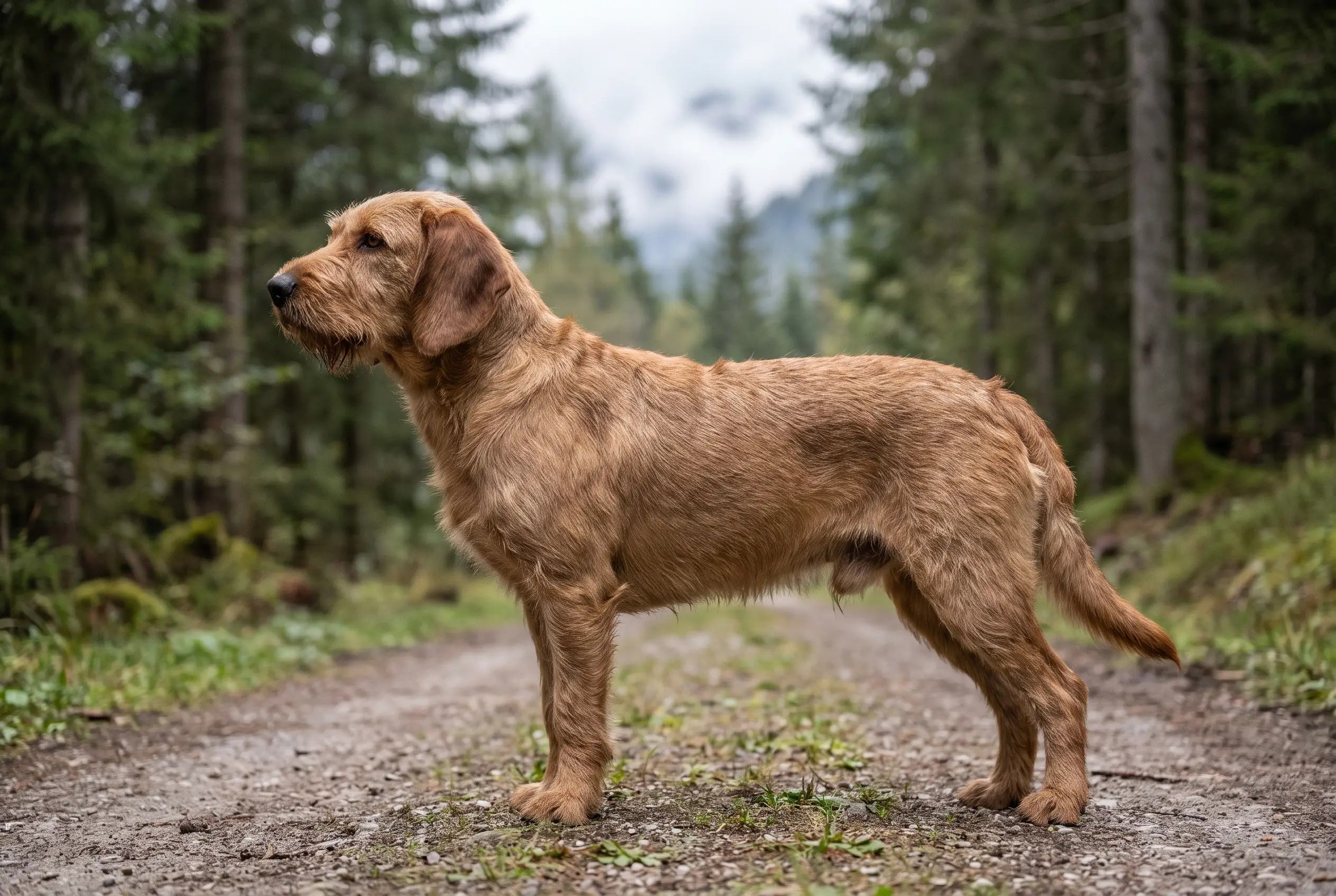
Steirische Rauhhaarbracke
The rough coat isn't decoration — Carl Peintinger bred it in 1870 so this hound could work Styrian mountains no smooth-coated bracke could survive.
Vital stats
| Size | Medium · 45–53 cm (dogs 47–53, bitches 45–51) |
| Weight | 15–18 kg — breed literature; the standard sets no weight |
| Life expectancy | Around 12 years — breed literature, not survey data |
| Energy | High — built for full mountain days after boar and wounded deer |
| Shedding | Low to moderate — rough coat, a weekly brush |
| Coat | Harsh, coarse, without gloss · shorter on the head, forming a moustache |
| Group | Hound · Medium-sized Scenthound (FCI №62, Group 6) |
| Origin | Styria, Austria |
| FCI group | 6 — Scent hounds and related breeds · FCI 62 |
Breed traits
Friendliness
Care
Mind
The Steirische Rauhhaarbracke by the numbers
The Steirische Rauhhaarbracke facts owners search for most — price, lifespan, weight, shedding and colours, in one place.
Less common, so expect a waitlist and some travel to a reputable breeder — which pushes the price up. Plan for steady ongoing costs — mid-range food, routine vet care and insurance.
We don't quote a single figure: the real price swings with breeder, region, bloodline and health testing — and a rescue costs a fraction of a breeder's litter. Adopting is almost always the cheapest route.
Temperament
The standard's behaviour clause is one sentence: "A passionate, tough hunting dog which unceasingly giving tongue; a firm and determined tracker." (The grammar is the official translation's own — this is a working description, not a polished one.) That's a dog built to hold a scent for hours on rough ground and announce every step of it, not to lie by a fire. General appearance calls for an expression that is serious but not vicious, and the disqualifying faults strike both edges of the temperament scale at once: an aggressive dog and an overly shy one are equally out. Breed literature is more direct about what this means at home: reserved with strangers, loyal to one handler, and by most accounts a poor match for households with small children — a description of the working line doing its job, not a character flaw. Anyone considering one as a pet rather than a hunting partner should plan on a real job for it, an experienced hand, and a lot of unstructured space to range in; it is not a breed for an apartment or a first dog.
Habits & quirks
One man, two bloodlines, 1870
Carl Peintinger, an industrialist in Vordernberg, Styria, crossed his Hanoverian Scent Hound bitch Hela I with a coarse-haired male Istrian Hound in 1870 and bred on from the best of that litter. The standard's own history section names both parent breeds outright — no tidied-up legend required.
The coat is the job
The standard doesn't call the coat rough for looks: it specifies harsh, coarse, without gloss, and credits it directly with making the dog resistant to bad weather. It runs shorter over the head, where it gathers into a moustache — the one place the standard singles out for length.
Forty-two teeth, two allowed to go missing
Like its Alpine cousins, the standard wants a complete set of 42 teeth in a scissor bite and tolerates the loss of up to two premolars, PM1 or PM2. Lose a third, or run under- or overshot, and it's a disqualifying fault, not a cosmetic note.
Boar country, not lowland
Its own utilization clause puts tracking wounded game in difficult mountain territory on equal footing with hunting by giving tongue. This is a dog shaped for steep Styrian ground, and breed literature has it still worked there and across the border in Slovenia today, chiefly on wild boar.
Care
| Exercise | This is a mountain tracking hound built for full days on steep ground, and breed literature puts the daily minimum around ninety minutes of real activity, not a lead-walk loop. Give it a scent to work — hunting, tracking training, or long off-lead hikes over rough country — and expect a dog still ready to go once the walk ends. |
| Grooming | The harsh, weatherproof coat needs only a weekly brush to stay clean and tidy — breed literature backs the standard up here, calling it low-maintenance by hound standards. Check the flat, medium-sized ears regularly for infection; hanging ears on a dog that spends its days in cover pick up moisture and debris. |
| Training | The standard describes a dog that tracks firmly and determinedly and never stops giving tongue once it's on a trail — the drive arrives pre-loaded, and channelling it takes an experienced, consistent hand rather than a first-time owner. Breed literature is blunt that this isn't a breed for beginners or for households built around small children. |
| Health | The standard's own closing note restricts breeding to functionally and clinically healthy dogs with breed-typical conformation, and neither the standard nor breed literature documents a widely recognised inherited disorder. Breed literature flags two practical risks instead: joint strain from exercise on unsuitable terrain, and infections in the hanging, medium-set ears — both manageable, neither a genetic gamble. |
Life expectancy
This breed has a typical life expectancy of Around 12 years — breed literature, not survey data.
Similar breeds
Breeds with a similar build and background — worth a look if this one isn't quite the fit.
Breeds that look like this
Common questions
Is the Steirische Rauhhaarbracke related to the Hanoverian Schweisshund?
Yes, directly — it's one of the breed's two documented founding lines. The standard's own history section names Carl Peintinger crossing his Hanoverian Scent Hound bitch, Hela I, with a coarse-haired male Istrian Hound in 1870, then breeding on from the best puppies of that litter. The Hanoverian side contributed tracking pedigree; the Istrian sire is credited with hunting quality and appearance, and, being coarse-haired himself, is the likely source of the rough coat, though the standard doesn't spell out which parent supplied it.
How is it different from the Brandlbracke, another Austrian hound in this catalog?
Coat and colour, mostly. Both are Group 6, Section 1.2 medium-sized Austrian hounds recognised within days of each other in 1954 (FCI standards No. 62 and No. 63) and share the region and the wounded-game tracking job. But the Brandlbracke has a smooth, short black-and-tan coat with two disqualifying tan spots above the eyes — Vieräugl, four-eyes — while the Steirische Rauhhaarbracke is red or fawn under a deliberately harsh, weatherproof rough coat with no tan markings required at all. The Brandlbracke's own standard traces it to the old Celtic hound type; this breed has one specific, dated founding cross instead.
Is this a good family or house dog?
Not really, and the standard's own temperament clause explains why: it calls for a passionate, tough hunting dog that never stops giving tongue and tracks firmly and determinedly — traits built for a mountainside, not a living room. Breed literature is more direct still: reserved with strangers, a poor match for households with small children, and not recommended for first-time owners. It's a working specialist bred by and for hunters in Austria and Slovenia, and anyone taking one on without hunting work to offer needs to replace that job with serious daily exercise and mental work, not just affection.
Does the Steirische Rauhhaarbracke shed a lot?
Moderately. The Steirische Rauhhaarbracke sheds a fair amount, steadily through the year with heavier seasonal patches. A weekly brush keeps most of the loose hair off your floors and clothes.
Is the Steirische Rauhhaarbracke hypoallergenic?
Not really. No dog is truly hypoallergenic, and the Steirische Rauhhaarbracke's shedding coat releases plenty of the dander that sets off allergies. If someone at home is allergic, this isn't the easiest breed to live with — spend time around one first.
Is the Steirische Rauhhaarbracke easy to train?
They can be a challenge. The Steirische Rauhhaarbracke is intelligent but independent, and would rather make its own decisions than take orders. Reward-based training and patience work best; expect recall in particular to take time.