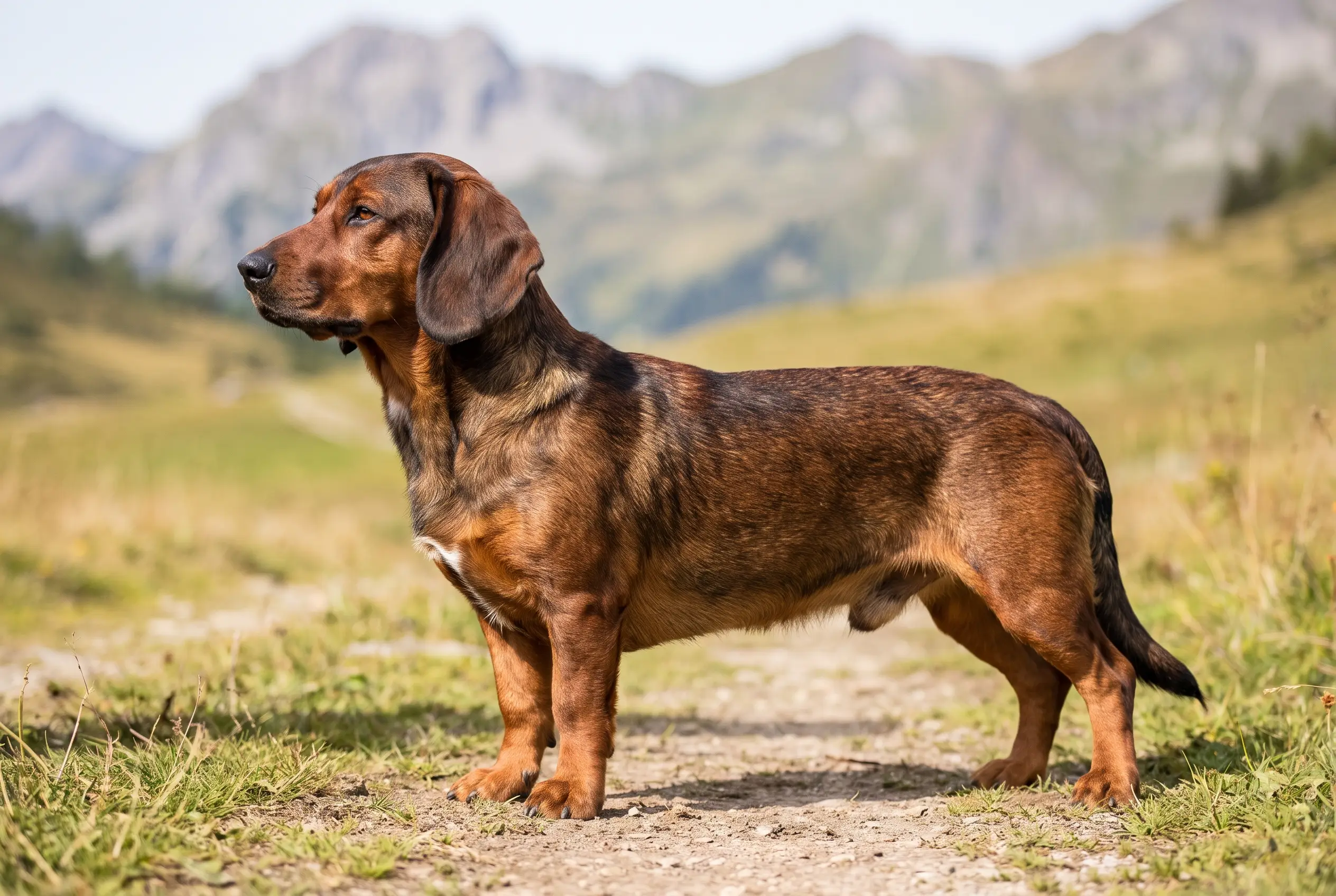
Alpenländische Dachsbracke
Short legs, a long back, and the nerve to walk a wounded deer down on a leash.
Vital stats
| Size | Small · 34–42 cm at the withers |
| Weight | 15–18 kg — breed literature; the standard sets none |
| Life expectancy | 12–14 years — breed literature, not survey data |
| Energy | High — built for a full day of mountain hunting work |
| Shedding | Moderate — dense double coat, heavier during two moults |
| Coat | Dense, close-fitting double coat · dark deer red, or black with red-brown markings |
| Group | Hound · Leash (scent) hound (FCI №254, Group 6) |
| Origin | Austria |
| FCI group | 6 — Scent hounds and related breeds · FCI 254 |
Breed traits
Friendliness
Care
Mind
The Alpenländische Dachsbracke by the numbers
The Alpenländische Dachsbracke facts owners search for most — price, lifespan, weight, shedding and colours, in one place.
Less common, so expect a waitlist and some travel to a reputable breeder — which pushes the price up. Plan for steady ongoing costs — mid-range food, routine vet care and insurance.
We don't quote a single figure: the real price swings with breeder, region, bloodline and health testing — and a rescue costs a fraction of a breeder's litter. Adopting is almost always the cheapest route.
Temperament
The standard's behaviour clause is two short sentences: "Expression intelligent and friendly. Fearless personality." Fearless is not decoration here — a dog worked on a lead up to a wounded deer, or sent after a boar, has to hold its nerve at close range with an animal that can turn and fight. At home the same dog reads as attentive and good-natured rather than tough: it works closely with one huntsman by scent and voice, which in a family carries over as a dog that pays close attention to its people and settles once it has had its work. The standard disqualifies both ends of the temperament scale outright — "aggressive or overly shy" and "weakness in temperament" — so a stable, biddable nerve is not a bonus trait in this breed, it is the standard.
Habits & quirks
Two parts height, three parts length
The standard fixes the build as a ratio, not an impression: relation of height at the withers to length of body is 2:3. That is the short-legged, long-bodied silhouette written into law, one notch less extreme than a Dachshund's.
The Vieräugl marking
Alongside the preferred dark deer red, the standard permits black dogs with clearly defined red-brown markings on the head, chest, legs, feet and underside of the tail. The head markings have their own Austrian hunting name, Vieräugl — "four eyes" — for the pair of tan spots above the eyes.
Forty-two teeth, and no more than two missing
The standard wants a complete set of 42 teeth with a scissor or pincer bite. It tolerates the loss of up to two premolars (PM1 or PM2, the third molar isn't counted) — lose a third and it's a disqualifying fault, not a cosmetic note.
Crown Prince Rudolf's hunting dogs
In 1881 and 1885, Crown Prince Rudolf of Habsburg had his gamekeepers bring Alpine Dachsbracken along on hunting trips to Turkey and Egypt — the breed's earliest documented outing beyond the Alps, per its own FCI history section.
Health
The Alpenländische Dachsbracke is a robust, weather-hardened working hound, and its own standard restricts breeding to functionally and clinically healthy dogs. There is no widely documented breed-specific illness on record, but the population outside Austria, Germany and Slovenia is small, so ask breeders about hip and joint screening — sensible for any short-legged, long-backed working dog even without a formal scheme behind it. Check the long hanging ears regularly too; they reach down to the canine teeth and can trap moisture after a day in wet cover.
Nutrition
| Exercise | This is a working scenthound bred to cover difficult mountain ground all day, not a dog for one short walk. The standard asks for movement that is "ground covering, not tripping," with the trot as the preferred gait — give it real distance, and let the nose lead on some of it. |
| Grooming | The double coat — a thick top coat over a dense undercoat — sheds moderately and needs a weekly brush, more during the two seasonal moults. Check the hanging ears regularly; they're long enough to reach the canine teeth and can trap moisture after a day in cover. |
| Training | It is bred to work at a distance from its handler by scent, so recall and voice control matter more than they do for a dog that stays underfoot. Start early: the standard disqualifies both aggression and overshyness, and a well-socialised puppy is how you land in the middle. |
| Health | The standard's own closing note restricts breeding to "functionally and clinically healthy dogs, with breed typical conformation." Breed literature reports no widely documented breed-specific conditions, but the population outside Austria, Germany and Slovenia is small — ask breeders about hip and joint screening, standard practice for a short-legged working hound even without a formal scheme behind it. |
Feed to the work: this is a scenthound built to cover mountain ground all day, and its needs rise and fall with how hard it is actually hunting. Keep it lean above all — a long back carried on short legs does not want the strain of extra weight — so weigh the meals, count the treats a food-motivated hound will happily earn, and keep the ribs easy to feel under the dense coat.
Puppy guide
The standard disqualifies both aggression and over-shyness, so a well-socialised puppy is how you land on the steady, friendly nerve the breed is meant to have — start early and widely. This is a dog bred to work at a distance by scent, so teach a reliable recall young, before the nose starts making its own plans. Go easy on the growing joints of a long-backed pup: steady exercise while the frame sets, not forced distance.
Training
Because it was bred to work away from its handler by scent and voice, recall and voice control matter more here than for a dog that stays underfoot — build them early and keep them solid. Start young to settle the stable, biddable nerve the standard asks for, keep it reward-based, and give the nose real tracking work to do. A hound with a job to follow is far easier to live with than one left to invent its own trail.
Life expectancy
Alpenländische Dachsbracken live 12–14 years — breed literature, not survey data. The Alpenländische Dachsbracke is a tough Alpine working breed with a working lifespan to match. You keep it near the top of that range the way its mountain job always did: a lean weight off those short-legged joints, real ground and scent work every day, clean dry ears, and parents you have asked about for hips and joints.
Similar breeds
Breeds with a similar build and background — worth a look if this one isn't quite the fit.
Breeds that look like this
Common questions
Is the Alpenländische Dachsbracke just a Dachshund with longer legs?
They share an ancestor's shortcut: breed history holds that the old Alpine hunting dog was bred down in leg length partly by crossing with Dachshunds. But they end up doing different jobs. The Dachsbracke is a scenthound that tracks wounded game across open mountain terrain and is built accordingly — the standard's own proportion is height to body length 2:3, a much less extreme stretch than the Dachshund's, and the legs, while short, are built to cover ground, not to go to earth after badgers.
How is it different from the Westphalian Dachsbracke?
Same idea, different country and different FCI paperwork. The Alpenländische Dachsbracke is Austrian, standard No. 254, and sits in Group 6, Section 2 as a leash (scent) hound — worked one-to-one on a lead to track wounded deer. The Westfälische Dachsbracke is German, from Westphalia, standard No. 100, and sits in Group 6, Section 1.3 among the small pack hounds, closer to Germany's beagle-and-basset tradition. The coats read differently too: the Austrian breed is dark deer red or black with red-brown Vieräugl markings, while the Westphalian dog runs red-to-yellow with a black saddle and white "Bracken" markings on the muzzle, chest, legs and tail tip.
What does "leash hound" mean in the breed's FCI section?
Bracke is the old Central European word for a scenthound, and Dachsbracke means a short-legged one — the Alpenländische Dachsbracke is one of several across the Alps and Germany built on that same short-legged template. FCI Group 6 splits its scenthounds by how they work: Section 1 covers hounds that hunt in packs and give tongue as they run, while Section 2, this breed's section, covers hounds worked on a leash by a single handler to track a specific wounded animal — deer or boar hit by a hunter — by cold scent, often over hours and difficult ground. It's a slower, closer-range job than pack hunting, and the standard's emphasis on nerve and a ground-covering, unhurried gait follows from it.
Does the Alpenländische Dachsbracke shed a lot?
Moderately. The Alpenländische Dachsbracke sheds a fair amount, steadily through the year with heavier seasonal patches. A weekly brush keeps most of the loose hair off your floors and clothes.
Is the Alpenländische Dachsbracke hypoallergenic?
Not really. No dog is truly hypoallergenic, and the Alpenländische Dachsbracke's shedding coat releases plenty of the dander that sets off allergies. If someone at home is allergic, this isn't the easiest breed to live with — spend time around one first.
Is the Alpenländische Dachsbracke good with children?
Generally yes. The Alpenländische Dachsbracke is a friendly, people-loving breed that usually does well with children when raised and socialised well. As with any dog, teach children to be gentle and supervise around toddlers.
Is the Alpenländische Dachsbracke easy to train?
Reasonably. The Alpenländische Dachsbracke is trainable with consistency and rewards, though it isn't the quickest study. Keep sessions short and positive, and be patient with the basics like recall.